In this article we break down CoinEx Wallet: non-custodial storage, TRX staking, the DApp browser, the Authorization Detector, and working with USDT TRC-20 in one mobile environment.
Content
CoinEx Wallet works as a non-custodial crypto wallet inside the CoinEx exchange ecosystem. It is designed for those who prefer a mobile format and want to manage assets across more than 60 networks. The user gets a full-fledged Web3 tool that allows them to store cryptocurrency, stake, work with DApps, and use advanced TRON support within a single app.
In this article we will cover:
what coinex wallet is, its key parameters, and its strengths in terms of security, convenience, and interaction with DeFi;
practical scenarios that show how to use coinex wallet, including staking and DApps;
coinex wallet features and capabilities, with a special focus on the Web3 browser and staking.
Today, users increasingly choose tools that help save on fees and provide simple access to Web3 services. Against this backdrop, coinex wallet support for tron and trc-20 looks like a significant advantage. This is why a logical question arises: whether CoinEx Wallet is suitable for those looking for a full-fledged coinex wallet alternative to trust wallet, especially when it comes to frequent work with the TRON network.
Key metrics of CoinEx Wallet: supported networks, fees, and functionality
Before going into detail, it’s useful to look at the key parameters of CoinEx Wallet. This summary assessment helps quickly understand the wallet’s strengths, possible limitations, and how well it fits your needs. For users choosing their first app or comparing several options, this table provides a holistic view of the capabilities and quality of the coinex crypto wallet.
Criterion
Score (1–10)
Comment
Supported networks and tokens
9
CoinEx Wallet works with more than 60 networks (BTC, ETH, SOL, TRON, BNB, CET, etc.) and supports over one million tokens. For those interested in coinex wallet supported networks, this set is sufficient to work with most popular ecosystems.
Security and key control
6
The wallet is non-custodial, so the keys are stored by the user. This approach strengthens control over coinex wallet cryptocurrency storage. The closed-source code reduces transparency, but the functionality is complemented by “Authorization Detector”, which helps track DApp permissions.
Interface convenience
9
The interface is fully translated into Russian. Simple navigation and two interface themes make the app convenient even for those who need a step-by-step guide.
Backups
8
A 12-word seed phrase, import via private key, QR code, and cloud backup. This simplifies coinex wallet seed recovery and transferring the wallet to a new device.
Fees and optimization
7
Standard network fees are used. There are no fiat tools, but the built-in DEX aggregator helps execute swaps where the coinex wallet fee is composed of network costs and routing conditions.
Integration with DeFi and Web3
9
The app has a full-fledged DApp browser and WalletConnect support, so staking and dapps become part of a unified Web3 environment.
Cross-platform availability
5
CoinEx Wallet is only available as a coinex wallet mobile app (iOS, Android, APK). Desktop and browser extension are absent, which may limit users who are used to working from a PC.
Support and documentation
8
The built-in help center, tutorials, and in-app support help users master the wallet faster without searching the internet.
Special features
9
Advanced TRON support (Energy/Bandwidth, TRX staking), a BTC transaction accelerator, “Authorization Detector”, an address converter, and “dust” hiding. All this extends the coinex wallet features and capabilities compared to basic wallets.
This table shows that CoinEx Wallet combines broad network support, advanced features, and a convenient interface, although it does have limitations related to the closed-source code and the lack of a desktop version. Overall, this set of indicators helps to quickly assess the app’s potential and understand whether it fits your Web3 needs.
Security of CoinEx Wallet: key storage, access model, and risks
Security in CoinEx Wallet is based on a non-custodial model, so private keys and the seed phrase are stored only by the device owner. This approach gives full control over coinex wallet cryptocurrency storage, but requires responsibility, since losing the seed phrase means losing access to assets.
Coinex wallet: non-custodial cryptocurrency storage and working with the seed phrase
Work with the wallet starts with creating a 12-word seed phrase, which the app suggests saving in a safe place. The built-in wizard helps create a backup and reminds you that restoring the seed in coinex wallet remains the only way to regain access if the device is lost.
To choose a convenient backup format, the user can use several options:
standard seed phrase;
private key;
QR code;
cloud backup.
These options make it easy to import a seed phrase into coinex wallet or transfer the wallet to another device. After configuring the backup, local wallet protection is enabled: a PIN code and, if needed, Face ID or Touch ID. This makes unauthorized access nearly impossible and reduces the risk of transfers being executed without your permission.
Coinex wallet: is it safe — closed code, hardware wallets, and Authorization Detector
The second part of security is related to the wallet architecture. CoinEx Wallet is not an open-source product, which reduces transparency and does not allow independent experts to verify encryption implementation and key storage. This raises questions among those who assess how safe it is in terms of code and internal logic. Another nuance is the lack of integration with hardware wallets like Ledger or Trezor. For those who are used to storing large amounts on cold devices, CoinEx Wallet remains more of a working tool than a long-term vault.
At the same time, the app includes a useful protection system:
Authorization Detector analyzes permissions granted to DApps;
shows smart contracts that have access to tokens;
allows you to quickly revoke suspicious permissions.
This feature, combined with the DApp browser, helps to notice dangerous contracts in time and reduces the risk of encountering fake services, making everyday Web3 use more secure.
Installing and setting up coinex wallet
The easiest way to install CoinEx Wallet is through official stores, so you should focus on trusted sources from the start. The app is available in the App Store for iOS, Google Play for Android, and as an APK that is safe to download only from official CoinEx resources. This approach reduces the risk of encountering fake apps, so in the context of coinex wallet guides for beginners it is important to emphasize that downloading from random links in chats or emails always creates a security threat.
After installation, the creation of a new wallet begins. The user opens the app, selects the option for creating a new vault, and sees a 12-word seed phrase. It must be written down in a safe place and then the correct word order has to be confirmed. The next step is setting up a PIN code and, if desired, enabling Face ID or Touch ID. Already at this stage, it becomes clearer how to use coinex wallet, since the interface offers to connect the necessary networks and enable display of the required tokens.
If the user already has another non-custodial wallet, it can easily be migrated into CoinEx Wallet. For this, the coinex wallet import seed phrase feature is available. If necessary, other recovery methods are also supported:
import via private key;
recovery via QR code;
using a cloud backup created earlier within CoinEx Wallet.
Thanks to these options, asset migration happens without complicated steps, so the wallet is convenient to use as a multichain solution even for those who already have prior experience and a formed set of crypto assets.
Functionality of CoinEx Wallet: staking, DApps, swaps, and Web3 capabilities
The features of CoinEx Wallet cover all the main tasks users solve in Web3 on mobile devices. The wallet helps manage assets, swap tokens, work with staking, connect to DApps, and use additional tools that make daily work more convenient.
Built-in swap
CoinEx Wallet has a built-in swap module that works as a DEX aggregator and selects the most profitable swap route for the user. The interface suggests choosing a network and a trading pair, after which the wallet automatically queries different decentralized exchanges and chooses the best option.
This feature is convenient because it allows you to make coinex wallet cryptocurrency transfers within a single network without having to go to a centralized exchange. At the same time, there are minimum amounts for swaps, which, depending on the network, range from 12 to 30 dollars. The limitations are related both to network fees and to the specifics of the routes selected by the DEX aggregator.
It is important for the user to understand that the coinex wallet fee for a swap consists of:
standard network fees;
a possible aggregator spread, which is included in the final rate.
The wallet itself does not add any extra fees, which makes swaps as transparent as possible.
Buying and selling with fiat
CoinEx Wallet has no fiat tools, so the wallet does not allow buying cryptocurrency with a bank card or selling it for fiat directly. This is an important point for beginners, as the app does not replace an exchange or exchanger when it comes to fiat on-ramps and off-ramps.
If you need to deposit your first assets, you will have to use an exchange, p2p, or an external exchanger, and then transfer cryptocurrency to the wallet. The same applies to the question of how to withdraw money from coinex wallet, because any cash-out into fiat always happens through a third-party service.
Staking and yield (“Earn”)
The wallet has an “Earn” section where simple and clear staking is implemented. This section is especially useful for those interested in staking and dapps, since it combines yield tools with access to Web3 applications.
The user can delegate coins to validators and receive rewards, and the wallet allows working with staking across several networks. The available options include:
ATOM;
KAVA;
IRIS;
TRX;
FET;
SEI.
NFT gallery and Web3 browser (DApps)
For collectors, the wallet has a separate NFT tab where collections and individual tokens from supported networks are displayed.
For those who actively interact with Web3, the built-in DApp browser called “Explorer” comes in handy. Through it, you can open popular apps, connect to them via WalletConnect, and control permissions granted to smart contracts, which is especially convenient in combination with Authorization Detector.
Thanks to this set of tools, coinex wallet staking and dapps become part of a full-fledged Web3 portal that combines storage, DeFi, NFT, GameFi, and other areas in a single mobile app.
Features of CoinEx Wallet: BTC Accelerator, Authorization Detector, and other perks
CoinEx Wallet offers several additional features that significantly simplify everyday use of cryptocurrencies. Among them:
a BTC transaction accelerator that helps push through stuck operations in the Bitcoin network;
an address converter, useful when working with different address formats;
“dust” hiding, which allows you to remove small token leftovers from the list and make the interface cleaner.
These tools are not mandatory, but they are exactly what create the coinex wallet features and capabilities that distinguish it from other multichain wallets and make working with it more convenient and flexible.
Asset management and working with TRON (USDT TRC-20)
Asset management in CoinEx Wallet is built so that it is convenient for the user to work with several networks at once and quickly switch between them. This approach makes the coinex crypto wallet a universal tool both for beginners and experienced users who hold assets in different ecosystems and want to manage them from a single app.
Multichain approach and supported networks
The wallet supports dozens of networks, which allows flexible configuration of the workspace. The user can enable or disable specific blockchains, add new ones, and hide those that are not used. This is convenient for those who are interested in coinex wallet supported networks and work not only with the usual BTC, Ethereum, BNB Chain, TRON, or Solana, but also with less common ecosystems.
The wallet correctly displays native coins and a huge number of contract tokens, including ERC-20 and TRC-20. This universal set helps to abandon the idea of keeping a separate wallet for each network, because CoinEx Wallet handles most common tasks within a single interface.
Support for TRON and USDT TRC-20
A separate strong point of CoinEx Wallet is its deep support for the TRON network and TRC-20 tokens. The interface shows the TRX balance and all TRC-20 assets, including USDT. The user can easily send, receive, and top up USDT TRC-20, and the app displays key TRON network parameters: available Energy, Bandwidth and the actual consumption of resources for each operation. This simplifies navigation and helps to understand exactly how the fee for a specific transfer is calculated.
TRON fees: Energy, Bandwidth, and how to save up to 65%
In the TRON network, transfers are paid either by burning TRX or by using Energy and Bandwidth. CoinEx Wallet correctly displays current resource limits, but does not reduce the cost of transactions by itself — it only shows the network’s actual parameters.
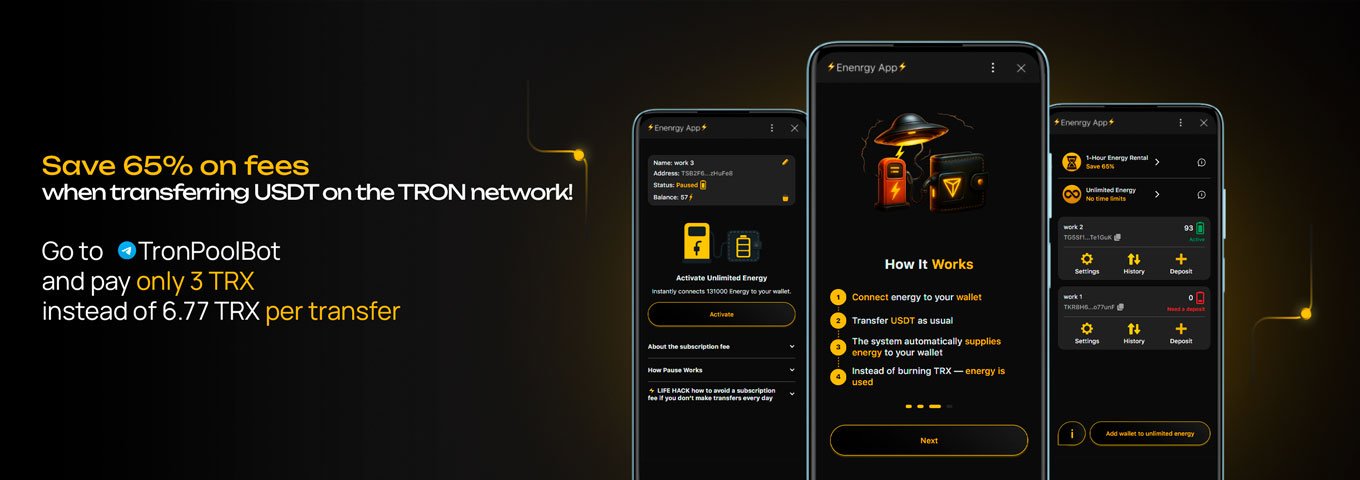
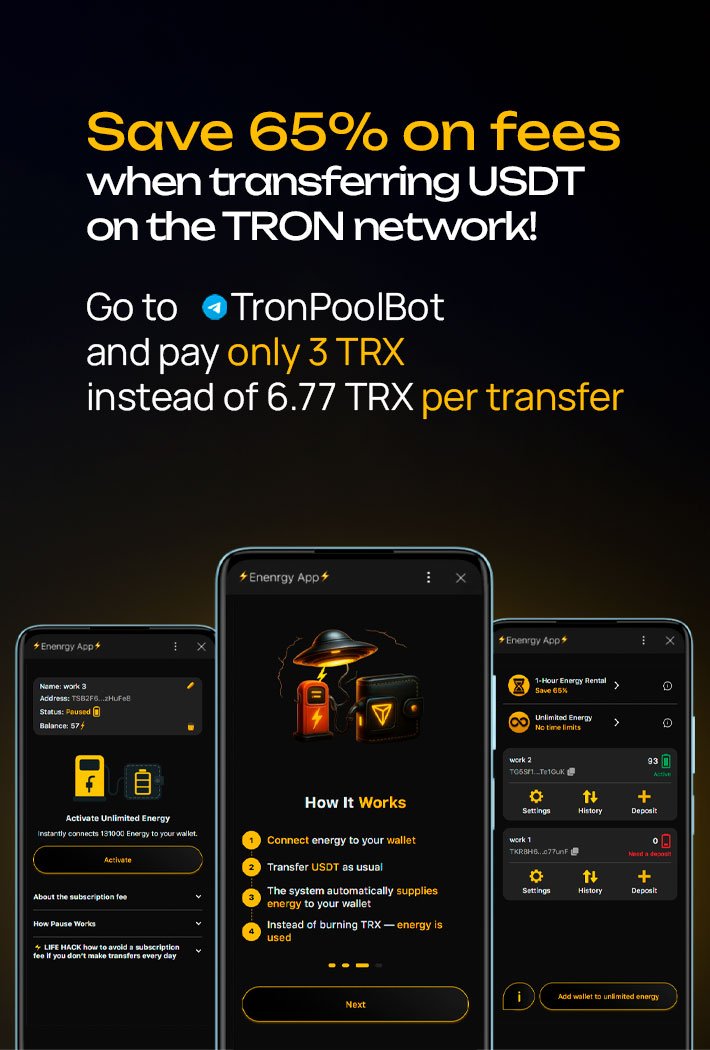
For those who regularly transfer USDT TRC-20, the most cost-effective solution is renting energy through Tron Pool Energy. This allows you to completely get rid of the need to keep TRX on balance and save money on fees. On average, a transfer costs 3–6 TRX instead of the standard ~13,37 TRX, which gives about 65% savings compared to paying fees with the native coin.
Save up to 65% on USDT TRC-20 transfers. Energy is activated instantly, requires no access to private keys, and supports managing multiple wallets.
Tron Pool Energy provides additional advantages:
energy is connected instantly and works without time limits;
the service is compatible with CoinEx Wallet and any other non-custodial wallets that support USDT TRC-20;
the connection is secure — only a public address is used, with no access to keys;
you can manage several wallets at once from a single account;
when using an unlimited package, energy covers both smart contract calls and Bandwidth, allowing you to completely zero out the TRX balance in the wallet.
Thanks to this, CoinEx Wallet and Tron Pool Energy become a convenient combination for those who actively work with USDT TRC-20 and want to minimize network costs without complex settings.
Pros and cons of CoinEx Wallet: strengths and limitations of a mobile Web3 wallet
Let’s look at the final list of strengths and weaknesses of CoinEx Wallet. It helps quickly understand in which scenarios the wallet performs best and which limitations should be taken into account before getting started. This format is especially useful for those choosing a mobile multichain wallet and wanting to assess functionality without diving into all the details.
Pros
Cons
Support for 60+ networks and more than one million tokens
Full-fledged DApp browser and WalletConnect support
No built-in fiat gateways
Convenient interface in Russian
Useful features (Authorization Detector, BTC Accelerator, address converter, “dust” hiding)
As a result, we can say that CoinEx Wallet combines broad functionality with ease of use. It is ideal for those who actively work with TRON, value mobile solutions, and use staking or DApps. At the same time, the lack of open-source code, hardware wallets, and a desktop version can be a limitation for the most demanding users.
Conclusion: who is CoinEx Wallet for
CoinEx Wallet works as a convenient mobile Web3 wallet that combines multichain capabilities, staking, and access to DApps. It is especially well-suited for those who actively use TRON and USDT TRC-20, want to save on fees with the help of Energy, and prefer to keep their tools within the CoinEx ecosystem. The multilingual interface, built-in DApp browser, and WalletConnect make the coinex crypto wallet comfortable for everyday use.
At the same time, the wallet may not be suitable for users who fundamentally need open-source, a desktop version, or integration with hardware devices.
If we rely on coinex wallet user reviews and the feature set, the wallet confidently covers the needs of a mobile Web3 solution — from storage and transfers to staking. If you actively use USDT TRC-20, it is worth seeing how the wallet interacts with this network and works with TRON energy.
Share
Link
Did you like the article?
FAQ
What is CoinEx Wallet and what is it used for?
CoinEx Wallet is a mobile non-custodial Web3 wallet supporting 60+ networks, including Bitcoin, Ethereum, Solana, and TRON. It is designed for asset storage, staking, working with DApps, and managing a multichain portfolio in a single app.
Is CoinEx Wallet safe or not?
The wallet is non-custodial: the seed phrase and keys are stored only on the user’s device. At the same time, the code is closed, but the experience is complemented by features like Authorization Detector, which tracks DApp permissions.
Can an existing wallet be migrated to CoinEx Wallet?
Yes, the app supports importing seed phrases, private keys, and QR backups.
Does CoinEx Wallet support DApps and Web3?
Yes, the app has a built-in DApp browser and WalletConnect support. This allows you to connect directly to DeFi, NFT platforms, and other Web3 apps.
Is CoinEx Wallet suitable for storing USDT TRC-20?
Yes, the wallet fully supports TRON and TRC-20 tokens, including USDT. The app shows Energy, Bandwidth, and actual resource consumption for each transaction. To save on fees, we recommend connecting TRON energy in advance through the Tron Pool Energy service.
How to reduce fees when transferring USDT TRC-20 in CoinEx Wallet?
A standard USDT TRC-20 transfer without energy costs around ~13,37 TRX. Using energy rental through Tron Pool Energy allows you to reduce transaction costs to 3–6 TRX, providing about 65% savings. To buy TRON energy, it is enough to go to the official website or use the @TronPoolBot Telegram app.
TRX calculator
Find out how much you spend on commissions!
Enter your crypto wallet address and we'll calculate how much TRX you've spent on fees over the last 30 days.
Top-10 and Top-50 altcoins — from Ethereum and Solana to Chainlink and NEAR. We break down which cryptocurrencies lead the market and how to choose promising tokens.
Many users confuse the seed phrase and the private key, thinking they are the same. We explain the difference in simple terms, give examples, and show how to store them safely.



 English (EN)
 Русский (RU)
 Українська (UK)
 español (ES)
 Türkçe (TR)