



 English (EN)
 Русский (RU)
 Українська (UK)
 español (ES)
 Türkçe (TR)


Best Trust Wallet Alternatives: Top 8 Wallets for USDT TRC-20
8 reliable alternatives to Trust Wallet for USDT TRC-20: full TRON support, seed phrase import, energy management and minimal fees for USDT transfers.
2025-12-02
129
Authorization is required only to use the service «Team energy»
Enter the e-mail you provided during registration and we will send you instructions on how to reset your password.
An error occurred while processing your request. Please try again later. If the problem persists, please contact our support team.
Complete breakdown of USDT TRC-20 in Ctrl Wallet: deposits, transfers, fees, and an alternative to Gas Tank.
Ctrl Wallet works with TRON differently from most familiar wallets. Instead of lines about Energy and Bandwidth, you only see the fee amount in dollars and a suggestion to top up the Gas Tank. The logic of a USDT TRC-20 transfer on the blockchain remains the same, but the way fees are paid inside Ctrl Wallet follows its own rules, and it is these rules that make the experience either convenient or very expensive.
In this article you will learn
This guide is practical. It covers only working scenarios with USDT TRC-20 on the TRON network. For detailed information about how the ctrl wallet works overall, how Social Login is useful, what security is based on, and how access recovery is organized, it is better to refer to our review article about this wallet.
First, you need to make sure that you are working specifically with USDT TRC-20 and not with the same ticker on another network.
On the Home tab, your assets are displayed. There you see a list of coins and tokens. If USDT is already there, pay attention to the network label next to the name. For TRON, it will look like USDT (Tron). This is how you distinguish it from USDT on Ethereum or another network.
If the token is not in the list, proceed as follows
When you click Receive on USDT (Tron), the wallet shows an address in the T… format and a QR code. This is your TRON address in Ctrl Wallet. You can receive TRX, USDT TRC-20 to it and use it in third-party services, including Tron Pool Energy for Energy rental.
Receiving USDT TRC-20 through Ctrl Wallet is simple. The main thing is to ensure that the sender selects the correct network.
The sequence of steps is as follows
When the sender sends the funds, the incoming transfer will appear on the main screen and in the Activity section. There you can enable a filter by the Tron network if you have many different assets.
If you want additional confirmation that everything went through, open the transaction in Tronscan. To do this, simply click the transaction hash in the history or manually paste it into the search on the website. A slight time delay is usually related to network load. For TRON, this rarely becomes a problem, so USDT TRC-20 usually arrives quickly.
The sending interface inside Ctrl Wallet looks familiar. The complexity is hidden at the fee payment step.
The procedure is as follows
On this screen, Ctrl Wallet does not display Energy and Bandwidth. Instead, you see the fee amount in dollars and a note that it will be deducted from the Gas Tank. If the Gas Tank is empty, the wallet will prompt you to top it up.
This is where the main barrier appears. Gas Tank requires a minimum deposit of 10 $, in USDC or in the $CTRL token. You cannot simply pay the fee once and forget about it. First, you deposit about 10 $ into the Gas Tank, and only then do you get the right to perform transactions. If you need one or two transfers, this turns into a pointless “freezing” of funds that could have remained in USDT.
To understand how profitable this is, you first need to recall how the TRON network works without any Gas Tank.
USDT TRC-20 exists on the TRON network as a regular smart contract. Any contract call consumes two types of resources
Payment for these resources is made in TRX. Either you burn a small amount of TRX, or you freeze coins in advance and receive Energy. The transfer amount does not affect the cost. What matters is whether you have Energy and whether the recipient’s address is activated.
The cost of an operation depends on whether USDT TRC-20 is present in the recipient’s wallet at the moment of sending. If the address already has a non-zero USDT balance, the network consumes 65000 Energy and the transfer is cheaper. If the current USDT balance is zero, the network considers that the address needs to be “initialized” for this token and consumes approximately 131000 Energy, even if USDT was previously held on that wallet. It is the current balance, not the address history, that determines how many resources TRON deducts during the transfer.
Ctrl Wallet does not show this mechanism. Everything happens behind the scenes. The wallet checks whether you have free Energy from frozen TRX. If you do, some operations will go through almost without deductions. If there is no Energy, the wallet does not even offer to buy TRX.
Instead, it shows you the fee in dollars and asks you to top up the Gas Tank. And it does so with a minimum deposit condition of 10 $. That is, you cannot simply pay, for example, 0,5 $ for one transaction. First, you must deposit 10 $ into the Gas Tank and only then start sending transfers.
In reality, it looks like this
As a result, you “freeze” 10 $ to perform an action that costs several times less on the blockchain.
The question “why not just buy TRX directly in Ctrl Wallet” seems logical, but in practice this is almost always the most expensive option. The wallet provides this possibility, but does so through third-party payment services.
If you buy TRX with a card, two main gateways are involved
As a result, you pay not only for TRX itself but also for several layers of markup. For a one-time purchase, this may be tolerable, but if you frequently work with USDT TRC-20, this top-up method quickly turns into noticeable overpayment.
If you look at the whole picture, there are three ways to pay for the same operation on TRON.
Gas Tank in Ctrl Wallet. This is the most expensive and inconvenient option. You do not see the real costs in Energy and are tied to a deposit from 10 $. In essence, you give the wallet money in advance and agree to its internal rate and markup for convenience.
Burning TRX. This is the classic method. You keep some TRX on your balance and allow the network to burn them at the full rate. A regular USDT TRC-20 transfer may cost around 6,77–13,37 TRX, especially if the recipient’s address is new.
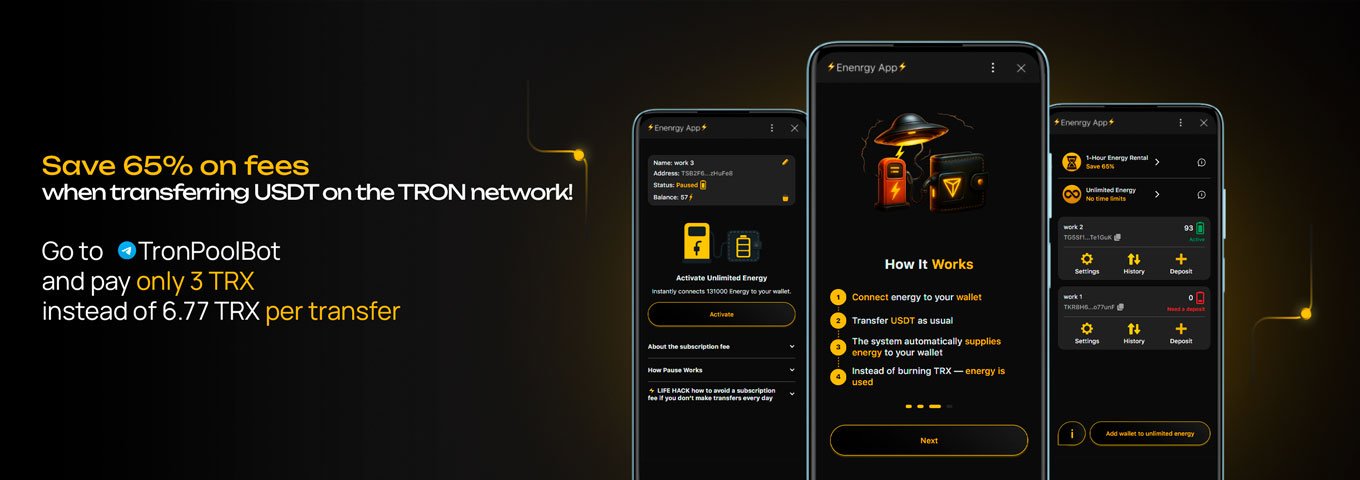
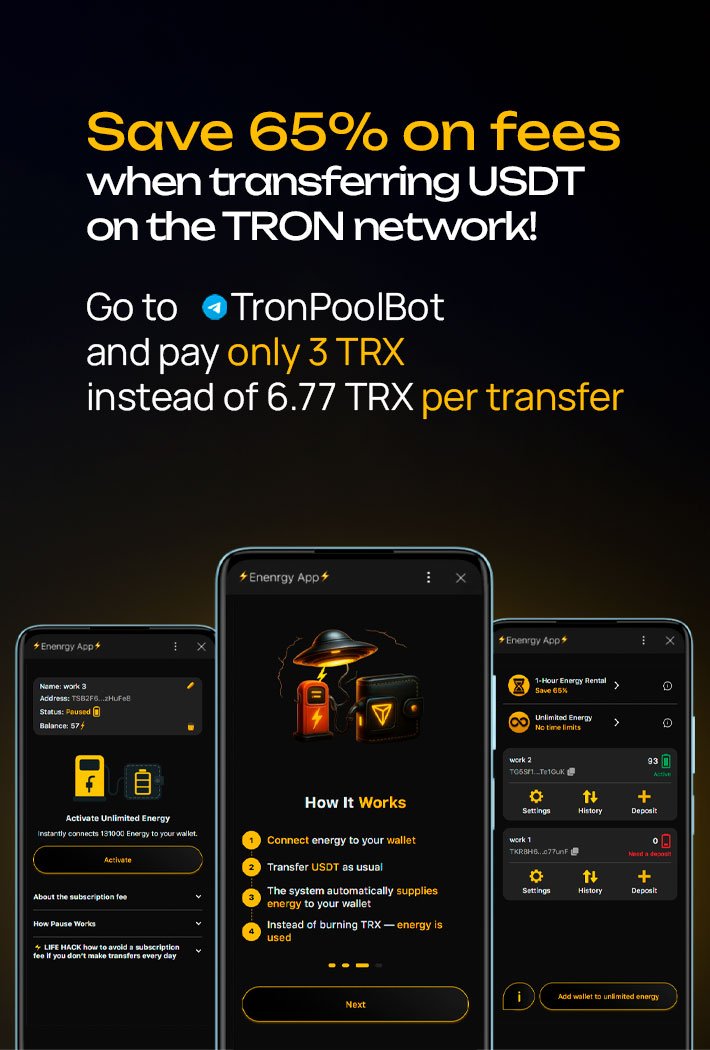
Energy rental via Tron Pool Energy. Here you pay only for the required amount of Energy and are not tied to any deposit. For example, 65000 Energy costs 3 TRX, and 131000 Energy costs about 6 TRX. This is enough for one or several transactions, depending on the scenario.
At a TRX price of around 0,27 $, renting 65000 Energy costs approximately 0,80$, and 131 000 Energy costs about 1,60$. This is slightly lower compared to the cost of a single fee in Gas Tank, but the difference is that Gas Tank first requires 10$, while Tron Pool Energy allows you to pay exactly for one operation.
Tron Pool Energy works as a TRON network resource rental service. You temporarily borrow Energy to your address and use it for transactions. This provides several obvious advantages
As a result, you continue using the same Ctrl Wallet, but shift fee payments from Gas Tank to cheaper Energy.
The Energy rental process via Tron Pool Energy looks simpler than it seems at first glance. The sequence of steps is as follows:
After one such cycle, the entire scheme is stored in memory and turns into a routine. As a result, you continue using the familiar Ctrl Wallet interface but pay for transfers like an advanced TRON user, not like someone who agrees to any conditions just for convenience.
Let us look at the same task. You need to send one USDT TRC-20 transfer.
Gas Tank first offers you to top up the balance with at least 10 $, and only then perform the transfer. At the same time, the real cost of the operation remains hidden inside the service.
Tron Pool Energy provides the same result for 3–6 TRX, that is approximately 0,80–1,60 $. You pay less than 2 $ instead of freezing 10 $ for an unknown period. The transaction takes place on the same TRON network, from the same T… address, inside the same Ctrl Wallet. Only the fee payment method changes.
Ctrl Wallet really does give a beginner a convenient start. There is no need to buy TRX, configure staking, or understand Energy and Bandwidth. It is enough to enable Gas Tank and send USDT TRC-20 like a regular bank transfer.
The price for such convenience turns out to be too high. The requirement to top up Gas Tank with at least 10 $ turns every first transaction into a series of unnecessary expenses. For those who do not make transfers every day, this is frankly an unprofitable scenario.
It is much more reasonable to separate tasks. Keep Ctrl Wallet as a convenient interface and TRON support, and move fee payments to Tron Pool Energy. Then you continue using your familiar wallet, but pay for a transfer not with a 10 $ deposit, but with regular 3–6 TRX.
Best Trust Wallet Alternatives: Top 8 Wallets for USDT TRC-20
8 reliable alternatives to Trust Wallet for USDT TRC-20: full TRON support, seed phrase import, energy management and minimal fees for USDT transfers.
2025-12-02
129

USDT Without Verification: How to Stay Anonymous on the TRON Blockchain
Want to keep your privacy when working with USDT TRC-20? We explain how the TRON blockchain exposes your activity, where your anonymity is lost, and how to use energy without verification or buying TRX.
2025-07-25
125

Web3 wallet security: how anti-phishing extensions protect you
We explain how Wallet Guard, ScamSniffer and built-in filters protect wallets from phishing, malicious websites and dangerous signatures.
2025-11-20
148