



 English (EN)
 Русский (RU)
 Українська (UK)
 español (ES)
 Türkçe (TR)


Best Trust Wallet Alternatives: Top 8 Wallets for USDT TRC-20
8 reliable alternatives to Trust Wallet for USDT TRC-20: full TRON support, seed phrase import, energy management and minimal fees for USDT transfers.
2025-12-02
129
Authorization is required only to use the service «Team energy»
Enter the e-mail you provided during registration and we will send you instructions on how to reset your password.
An error occurred while processing your request. Please try again later. If the problem persists, please contact our support team.
In this article we break down Exodus: a user-friendly multichain wallet with desktop and mobile apps, staking, built-in swaps and NFT support.
Exodus appeared in 2015 and from its very first versions focused on visual simplicity and a comfortable experience with crypto, which is why a review of the Exodus wallet usually starts with its interface and overall user experience. Exodus is a non-custodial crypto wallet for storing coins across dozens of networks, available on desktop, in the browser, and on mobile. This format allows it to be seen as one of the best multichain storage wallets for those who don’t want to deal with exchanges and complex infrastructure, and prefer to manage their portfolio through an intuitive interface.
In this article, we will take a detailed look at:
In a world where assets are scattered across different blockchains, a single wallet rarely covers all needs. Exodus aims to solve exactly this problem and offers a single control center with synchronization between PC, smartphone, and browser. In this review, we will examine how well the product meets expectations, what features and limitations it has, and who this format is best suited for.
To soberly assess Exodus — its capabilities and interface — it’s convenient to break the wallet down into several key metrics. This makes it easier to understand how it stands out against competitors and where its real limitations lie.
Important metrics and indicators of Exodus Wallet
| Criterion | Score (1–10) | Comment |
|---|---|---|
| Exodus supported networks and tokens | 9 | Hundreds of assets are supported, including Bitcoin, Ethereum, Solana, BNB Chain, and TRON. Convenient search and network filters. |
| Security and key control | 9 | Fully non-custodial model, private keys are generated locally and never leave the device. The seed remains only with the user; the source code is partially open. |
| Interface convenience | 10 | One of the most user-friendly and logical interfaces on the market, with neat charts and a clear portfolio structure. |
| Backup and recovery | 8 | Recovery via a single 12-word phrase; additionally, there is a password, Face ID, and reminders about the need to create a backup. An important nuance is that import is only possible once. |
| Fees and transaction optimization | 7 | Standard network fees are used; in a number of networks the user can change priority and speed. There are no special cost-saving schemes. |
| Integration with DeFi and Web3 | 7 | There is a DApp browser and WalletConnect support, but these features are only available on mobile devices. |
| Cross-platform support | 10 | There is a desktop Exodus wallet, mobile apps, and a Chrome extension, with synchronization configured between them. |
| Support and documentation | 9 | Detailed knowledge base, illustrated articles, chatbot, and email support. |
Taken together, this gives a fairly honest picture. The wallet focuses on convenience and versatility, sacrificing a bit in terms of advanced functionality for experienced DeFi users who need maximum customization.
For any user, it’s important to understand how safe Exodus is and what risks they are taking on. The security model here is classic for non-custodial solutions: all private keys and the seed phrase are generated locally on the device, and the developer does not gain access to them. The app only helps you sign transactions and visualize your portfolio.
The foundation of all protection is a 12-word seed phrase. It is what allows you to restore access to Exodus if you lose your phone, delete the app, or move the wallet to a new computer. If the phrase is not saved, it will be impossible to regain access to your funds. That’s why the app regularly reminds the user that the seed must be written down and stored in a safe place offline.
In day-to-day use, the wallet is protected by a local password, and on smartphones you can additionally enable login via Face ID or fingerprint. These mechanisms do not replace the seed, but they protect against curious eyes and accidental actions if someone gains physical access to the device.
For those who store large amounts and want an additional level of protection, Exodus supports connecting a hardware wallet. The user can link the interface to Trezor or Ledger and work with cold storage in a familiar design, without exposing private keys to the risk of malware on the main device. The downside is that the app remains only partially open-source, so some users rely on the team’s reputation and the product’s track record.
Let’s look at how to use Exodus on different devices and what nuances the user encounters at first launch. The developers offer three main options: a desktop app for Windows and macOS, mobile versions for iOS and Android, and a browser extension for Chrome. Functionality is similar across them, but it’s recommended to start with the platform you plan to use most often.
A critically important point is how seed phrase import is organized in Exodus. The user is allowed to enter an existing 12-word phrase only once, at the time of the wallet’s first installation. If at the start you chose to create a new wallet and then remembered another old seed, you won’t be able to roll things back. The add-new-portfolio button creates an additional independent key set instead of importing an external seed. To import a different seed, you must reset/reinstall and choose “Restore wallet”.
In practice, the setup process is simple, and it’s convenient to break it into several sequential steps.
What the basic Exodus installation scenario looks like:
After that, you can add coins, configure the portfolio, and enable the required network assets.
Already at this stage, it’s important to decide which specific wallet you are going to use in Exodus, because changing your decision later will be difficult — seed phrase import is only possible at first launch.
In everyday work, the key functions and features of the Exodus wallet come to the forefront. It’s important for the user not only to see their balance, but also to have tools for exchange, staking, and interacting with Web3 at hand.
Special attention should be paid to the capabilities that are often described in the documentation as Exodus staking and exchange. The built-in swap allows you to quickly move part of your portfolio from one coin to another without registering on an exchange. The app shows the expected rate, fee amount, and final total, and all that’s left for the user is to confirm the transaction.
Staking is implemented in the same visual style. In the yield section, you can see supported coins, approximate annual percentages, and minimum participation amounts. The user can delegate part of their balance in one click and watch how the expected reward changes. This format is especially convenient for those who don’t want to deal with validator interfaces and external staking platforms, but are ready to keep part of their portfolio long-term.
Exodus has built-in fiat gateways that let you buy crypto with a bank card. The minimum purchase amount usually starts at $20, and the process is familiar: choose a coin, enter the amount, provide payment details, and confirm the transaction. An important nuance is the geographic restrictions. For some countries, the feature is unavailable due to payment processor policies and local regulation; for example, in Ukraine, the card purchase option may not be displayed.
Selling crypto for fiat is also possible, but availability of specific routes depends on payment partners and the chosen country of residence. In any case, Exodus remains an interface, while the fiat operations themselves are handled by third-party services.
A separate block of features is related to NFTs and decentralized applications. The mobile version of Exodus includes a built-in gallery for NFT-format tokens, where you can view your collections in a visual way and track their main parameters.
The main difference from desktop is the presence of a Web3 browser. Through it, the user can connect to DeFi protocols, marketplaces, and other DApps, using the wallet as an authorization and transaction-signing tool. There is WalletConnect support, so you can work with apps that aren’t integrated directly. This is why the mobile version of Exodus often becomes the primary tool for those who actively interact with the Web3 ecosystem.
One of the key reasons for Exodus’s popularity is its focus on a multichain approach. The user can manage different networks in a single interface and doesn’t have to jump between multiple wallets. The interface lets you add needed coins via search, hide unused assets, and clearly see the share of each position in the portfolio.
A separate category of users relies on the wallet for working with TRON. It’s important that storing USDT and TRX in Exodus is implemented just as simply as with other assets. You just enable the needed coins in the list, generate an address, and you can receive transfers or withdraw funds from an exchange.
The sending process itself is intuitive. When the question arises of how to send crypto via Exodus, the scheme is usually the same. You select the desired coin, click the send button, paste the recipient’s address, add a memo or tag if required, check the amount and fee, and then confirm the transaction. The app shows a confirmation and allows you to track the transaction status on the blockchain.
As for fees, the Exodus transfer fee is always tied to the rules of a specific network. For Ethereum, this is gas in gwei; for TRON, payment in Energy/Bandwidth or TRX; for Bitcoin, a miner fee. In many cases, the wallet allows you to choose between a faster or cheaper transaction. This provides basic control over costs, although there are no special mechanisms for deep fee optimization.
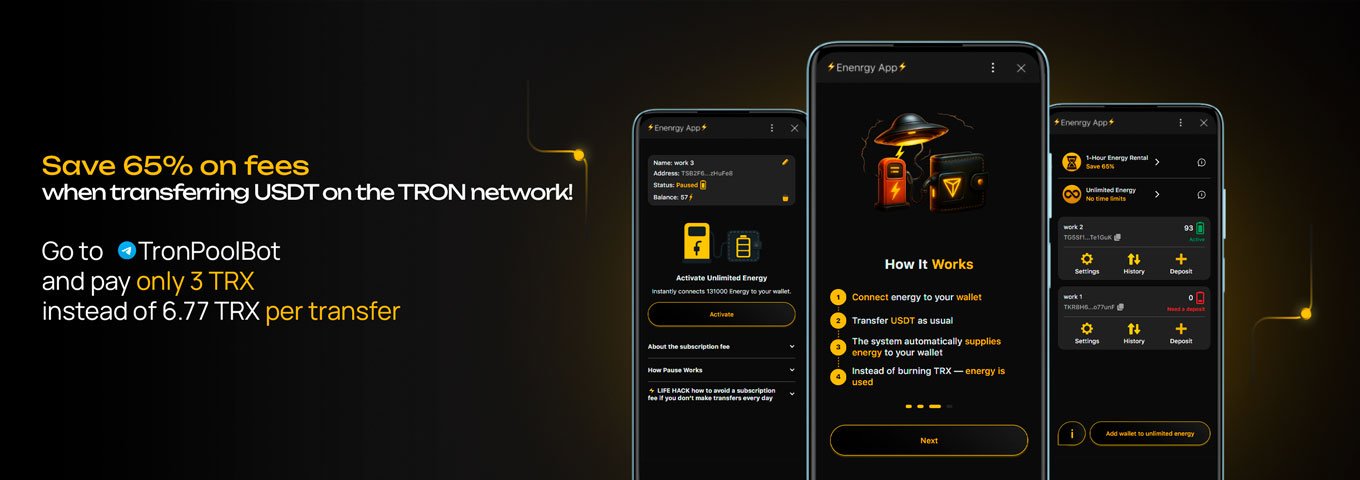
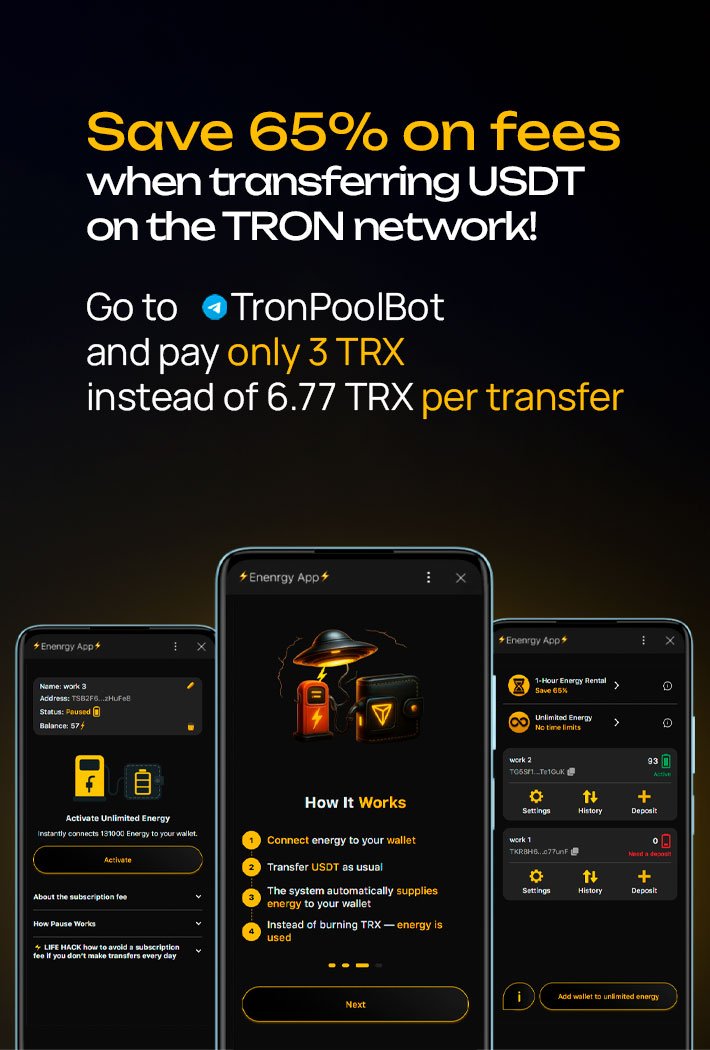
If you frequently send USDT TRC-20 from Exodus, it makes sense to further optimize costs by renting TRON energy through the Tron Pool Energy service. Energy is attached directly to your address, without access to the seed phrase (only the wallet’s public address is needed), USDT TRC-20 transfers cost on average 3–6 TRX, which is up to 65% savings compared to the standard fee, and predictable transaction costs plus 24/7 support make the Exodus + Tron Pool Energy bundle a convenient solution for those who regularly use the TRON network.
To evaluate the product as a whole, it’s helpful to lay out the pros and cons of the Exodus wallet and look at the balance of strong and weak points.
| Pros | Cons |
|---|---|
| Very convenient and visually intuitive interface, comfortable for beginners and experienced users alike | Source code is only partially open, with no way to independently audit all logic |
| Cross-platform support, works on PC, smartphones, and in the browser | Import of an existing seed phrase is only possible at the first launch of the current installation; afterwards, the interface only creates new portfolios |
| Versatility, support for many networks and tokens in a single app | DApp browser and Web3 functionality are only available on mobile devices |
| Built-in exchange and staking, the ability to earn yield without third-party services | Fiat gateways and some routes may be unavailable in certain regions |
| Integration with Trezor and Ledger, the ability to combine a convenient interface with cold storage | The built-in exchange rate is sometimes less favorable than on major exchanges, especially for large amounts |
This set of characteristics clearly shows that Exodus prioritizes convenience and versatility rather than maximum technical flexibility.
Exodus looks like an attractive solution for those who value design, clarity, and a unified space for portfolio management. The user gets access to dozens of networks, can store major layer-one coins, ERC-20 and BEP-20 tokens and their analogs in other ecosystems, and also work with TRON, NFTs, and staking without switching to third-party interfaces.
For everyday use, this wallet will suit those who don’t want a separate app for each network and prefer to see all assets in a single window. Investors will appreciate the built-in staking and the ability to quickly rebalance their portfolio through the integrated exchange. Those who are deeply immersed in DeFi and value fully open-source code may prefer more specialized solutions, but for a broad audience Exodus remains one of the most convenient options.
And if you use USDT TRC-20, move on to the second article to read how this wallet works with the TRON network and energy.
Exodus is a multichain non-custodial crypto wallet for storing, exchanging, and managing dozens of assets. It works on PCs, smartphones, and in the browser, providing a single interface for your entire portfolio.
Yes, because private keys and the seed phrase are generated locally and are not shared with the developers. Additionally, you can use a password, Face ID, fingerprint, and even connect a hardware wallet.
The wallet works with hundreds of assets — Bitcoin, Ethereum, Solana, BNB Chain, TRON, and others. You can add and hide coins individually, shaping a convenient portfolio.
Yes, Exodus supports buying and selling through third-party fiat providers. Availability depends on your country of residence and the connected payment services.
The fee in Exodus fully depends on the selected network and its rules. In Ethereum, gas (gwei) is used; in Bitcoin, you pay miners; in TRON, you spend Energy/Bandwidth or TRX. The wallet itself does not add its own markup.
Exodus itself does not provide advanced optimization tools, so savings are achieved through external network mechanisms. The best method is to connect energy via Tron Pool Energy to consistently pay 3–6 TRX instead of 6,77–13,37 TRX.
Best Trust Wallet Alternatives: Top 8 Wallets for USDT TRC-20
8 reliable alternatives to Trust Wallet for USDT TRC-20: full TRON support, seed phrase import, energy management and minimal fees for USDT transfers.
2025-12-02
129

An Exchange Is Not a Wallet: Why Your USDT Is at Risk
Many users keep USDT on exchanges, unaware of the risks: account freezes, asset locks, and loss of access. Here's why you should store crypto in a decentralized wallet and how to protect your funds.
2025-07-29
137

Crypto Regulation in 2025: GENIUS Act, MiCA, and New Rules
The GENIUS Act in the US and MiCA in the EU are reshaping the crypto market. Find out what this means for USDT TRC-20 holders and TRON services.
2025-10-17
141