Step by step, we show how to use USDT TRC-20 in Guarda Wallet: where to find your address and how to send and receive transfers on the TRON network
Content
Guarda Wallet works as one of the most convenient multichain wallets for the TRON network. Unlike many competitors, it is not limited to storing TRX and USDT but is deeply integrated with blockchain mechanics and displays Energy, Bandwidth, and smart contract behavior directly in the interface.
In this guide, we cover:
how to properly receive and send USDT TRC-20 using the Guarda Wallet interface;
what actually determines transaction fees and how Guarda helps control them;
how to use advanced features such as TRX staking and Energy rental to make transactions almost free.
This guide is intentionally practical. It focuses exclusively on working with USDT TRC-20 in Guarda, not on all 60+ networks supported by the wallet. The USDT mechanism is the same across the entire TRON network, but Guarda’s interface and its clear support for Energy and Bandwidth make it one of the most convenient tools for working with TRC-20.
Where to Find USDT TRC-20 in Guarda and How to Use It
To confidently work with USDT TRC-20, you first need to correctly locate and identify the token inside the Guarda interface. This determines whether transfers go through the correct network and prevents confusion between different USDT versions.
In Guarda Wallet, the base TRX token is usually visible immediately on the main screen. USDT TRC-20 may appear automatically after the first deposit, or you can enable it manually via the asset addition menu.
To ensure everything works correctly, check the following:
find USDT in the asset list and confirm it is labeled TRC-20 with the TRON network icon;
open the token page and check the address — a TRON address always starts with the letter T;
the same TRON address is used for TRX and all TRC-20 tokens, including USDT.
If the address starts with 0x or another character, it is not a TRON address. In that case, a different network version of USDT is selected, and sending USDT TRC-20 to that address is not possible.
Funding USDT TRC-20: How to Receive a Transfer
Receiving USDT TRC-20 in Guarda looks simple, but attention to detail is critical. Most mistakes at this stage are caused by the sender choosing the wrong network.
To receive USDT TRC-20:
open USDT with the TRC-20 label in the asset list;
tap Receive;
copy the TRON address or share the QR code with the sender.
It is crucial to clearly specify the network in advance. The sender must select TRON (TRC-20). If USDT ERC-20 is sent to your TRON address, the funds cannot be recovered.
Once the sender confirms the transaction, it appears in the USDT transaction history in Guarda. By tapping the transaction, the wallet shows details and offers a link to open it in Tronscan, where you can see the status, confirmation count, and exact amount.
If the transaction is missing in both Guarda and Tronscan, the issue is most likely related to the address or selected network.
Sending USDT TRC-20: Full Process Breakdown
Before sending USDT TRC-20, it is important to understand how Guarda’s interface behaves and what prompts it shows. This helps avoid mistakes and unexpected TRX deductions.
Sending USDT TRC-20 in Guarda follows a clear process:
select USDT with the TRC-20 label in the asset list;
tap Send;
paste the recipient’s address in the To field — it must start with T;
enter the transfer amount;
tap Next to reach the confirmation screen.
On the confirmation screen, Guarda displays the network fee and which resources will be used to pay it. You can see whether accumulated Energy and Bandwidth will be applied or whether the wallet plans to burn TRX to cover the fee.
If everything looks correct, confirm the transaction and enter your wallet password. Within seconds, the transaction appears in history and can always be checked in Tronscan using the hash.
TRON Fees: How Much Does a USDT Transfer Cost in Guarda
The cost of a USDT TRC-20 transfer depends solely on resources, not on the transaction amount. Guarda Wallet makes this transparent and allows you to estimate expenses in advance.
Before diving into specific cases, it is helpful to understand the basic mechanics of the USDT smart contract and why the wallet emphasizes Energy and Bandwidth.
How USDT Transfers Work at the TRON Level
A USDT TRC-20 transfer is essentially a call to the Tether smart contract. To execute it, the TRON network uses two types of resources:
Bandwidth, which handles data transmission;
Energy, which is required to execute the smart contract logic.
Part of the Bandwidth is provided for free, while Energy is obtained either through TRX staking or paid by burning TRX. The transaction amount does not affect the cost. Sending $100 or $10,000 costs the same if resource conditions are identical.
Main Fee Factor: Whether the Recipient Has USDT
Energy consumption depends on whether USDT has previously existed on the recipient’s address.
if the address has never held USDT, the operation requires more Energy — around 131000 Energy, equivalent to 13,37 TRX;
if the token already exists on the address, approximately 65000 Energy is sufficient, corresponding to 6,77 TRX.
These values do not depend on network load. A new address requires more resources, which results in a higher fee.
How This Looks in the Guarda Interface
Guarda Wallet clearly displays resources and the final transfer cost, allowing users to understand how the transaction is processed.
Before sending USDT TRC-20, the wallet shows:
the current Energy and Bandwidth balance in the TRX section;
how many resources the transaction will consume;
whether TRX will be burned and in what amount;
warnings if Energy or TRX is insufficient.
If enough Energy is available, the transfer uses accumulated resources and does not burn TRX. If Energy is insufficient, Guarda calculates how much TRX must be burned and shows it in the Network fee block.
Ways to Pay Fees in Guarda: TRX or Energy
Guarda offers two basic approaches to paying fees for USDT TRC-20 transactions. You can buy TRX and let the network burn it when Energy is insufficient, or you can configure Energy acquisition or rental once and almost eliminate per-transaction costs.
Before choosing an approach, it is useful to understand the pros and cons of each and assess how often you plan to send USDT.
Method 1. Buying TRX to Pay Fees
The most straightforward option is to buy TRX, keep it in the wallet, and allow the TRON network to burn it as needed.
In Guarda, this can be done directly in the app:
open the Buy section;
select TRX;
enter the amount and payment method.
Transactions are processed via Simplex or Guardarian. This is convenient but not always cost-efficient.
Main drawbacks:
KYC is usually required;
the minimum purchase amount is around $55;
payment provider fees and exchange rate markups result in an overall overpayment of approximately 4–6%.
This option suits users who send USDT TRC-20 occasionally and want to avoid exchanges, but it is inefficient for those who regularly move large volumes.
Method 2. Staking TRX to Obtain Energy
For users who constantly work with the TRON network, staking TRX may seem like a logical solution. In Guarda, it is configured via the Staking section or TRON resource management. The mechanism is simple:
you freeze part of your TRX balance;
in return, you receive votes and Energy;
the obtained Energy is used to pay for USDT TRC-20 transfers.
While staking is active, most transactions indeed proceed without direct TRX burning, and fees feel minimal. This format suits users who regularly send USDT between their own addresses and are willing to keep funds locked long term.
However, this approach has limitations. To obtain a meaningful amount of Energy, a significant TRX amount must be frozen and staking must be maintained constantly, even during periods with no transfers. This reduces flexibility: TRX cannot be quickly used, transferred, or sold, and staking efficiency depends on the frozen amount and current network parameters.
That is why for users who need one-time transfers, irregular activity, or management of multiple wallets, staking is often less convenient than renting Energy.
Saving on Fees: Energy Rental and Tron Pool Energy
For those who want to minimize fees without holding a large TRX balance, there is a third option — renting Energy, including via external services that work with your TRON address from Guarda.
This approach works well when you plan a series of USDT TRC-20 transfers or need to execute several large transactions at minimal cost.
Energy Rental via Built-in Solutions
In the web and desktop versions of Guarda, you can manage TRON resources and use integrations with protocols that provide Energy backed by TRX collateral. You select the Energy amount and rental period, and the wallet shows the cost and collateral return.
A typical flow looks like this:
open the TRX wallet;
go to resource management or staking;
choose an option to obtain Energy;
specify the amount and confirm.
As a result, an Energy balance appears on the address and is then used for USDT TRC-20 transfers. The collateral is returned at the end of the period, and the only real cost is the rental fee.
Tron Pool Energy as an External Alternative
Tron Pool Energy is worth considering separately as an external Energy rental service for TRON addresses, including those used in Guarda. This option is especially useful if you do not want to freeze TRX inside the wallet or buy TRX via partners with high fees.
The general workflow with Tron Pool Energy is as follows:
pay for Tron Energy according to the service instructions, depending on the selected format;
within seconds, Energy is linked to your address, and Guarda shows an increased Energy balance.
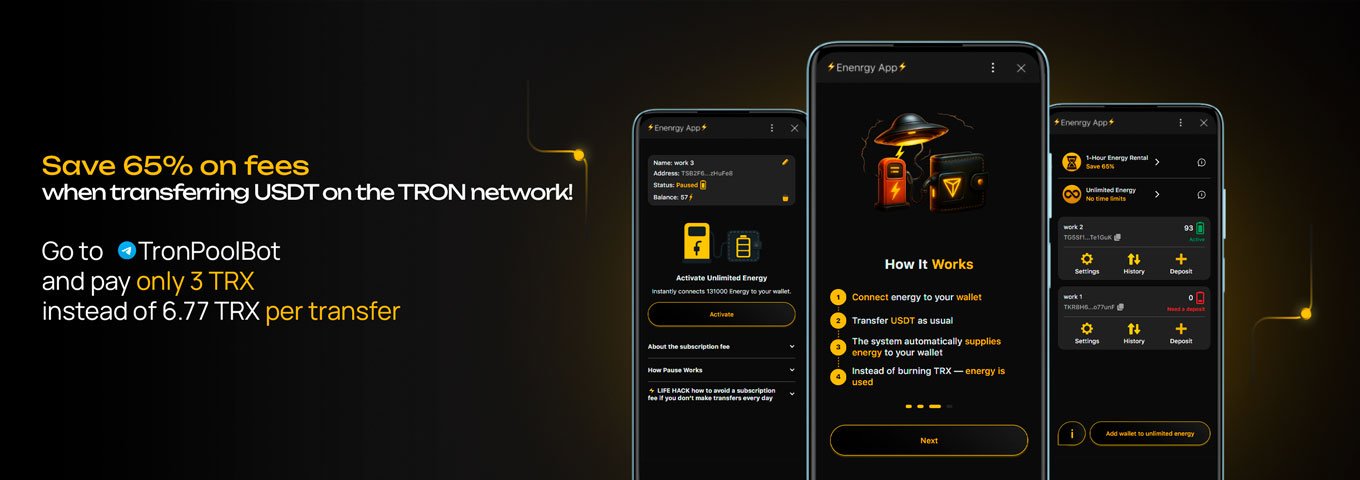
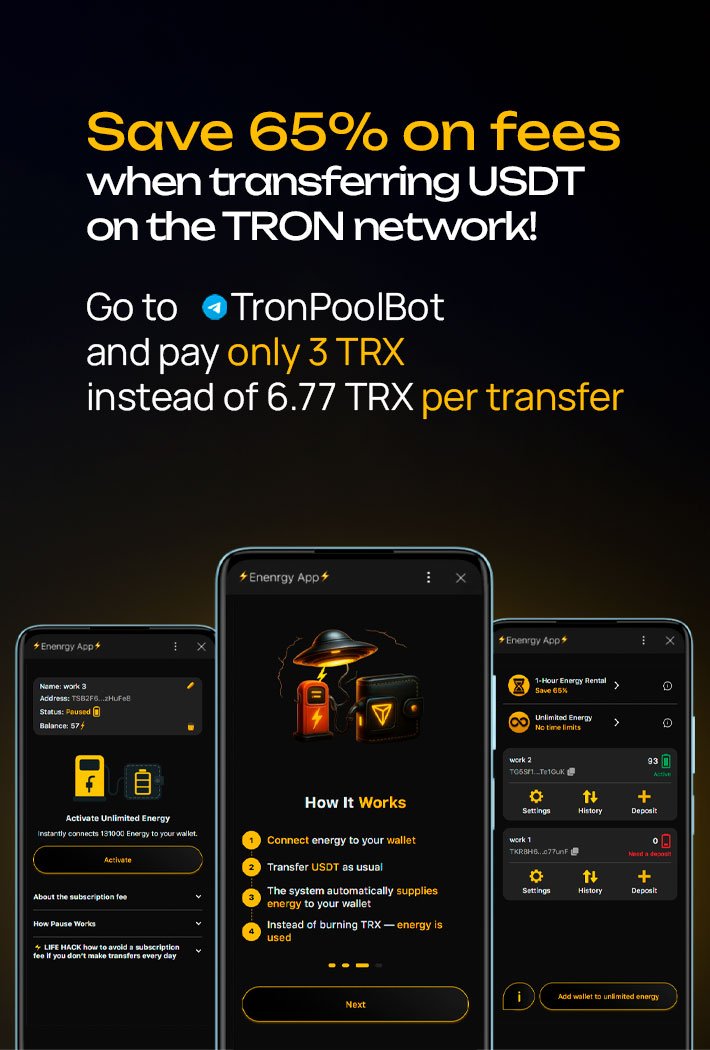
Up to 65% lower costs on USDT TRC-20 transfers. No wallet connection required, 24/7 support, and flexible formats — from one-time transfers to enterprise use.
Advantages of this approach:
no need to buy or stake TRX inside the wallet;
Energy rental options are always cheaper than directly burning TRX per transaction;
you can rent Energy precisely for a series of transfers without holding excess TRX.
On average, renting 65000–131000 Energy via Tron Pool Energy costs around 3–6 TRX, providing savings of up to 65 % compared to direct TRX burning for each transfer.
Conclusion
Guarda Wallet can confidently be considered one of the best wallets for everyday use with USDT TRC-20. Beginners benefit from a clear interface that makes it easy to select the correct network, verify that the address starts with T, and see the fee before sending.
Advanced users gain full cost management tools. The wallet displays Energy and Bandwidth, supports TRX staking, and easily integrates with external services such as Tron Pool Energy for Energy rental. As a result, USDT TRC-20 transfers stop being a “black box” and become a controllable operation with transparent economics and minimal fees, even during intensive activity on the TRON network.
Share
Link
Did you like the article?
FAQ
How to send USDT TRC-20 in Guarda Wallet without mistakes?
To send USDT TRC-20, select the token with the TRC-20 label, enter the recipient’s TRON address (it starts with the letter T), check the amount, and confirm the transaction. Before sending, Guarda shows the network fee and clearly indicates which resources will be used to pay it.
Where can I find my TRON address for USDT TRC-20 in Guarda Wallet?
The TRON address is displayed on the USDT TRC-20 receive screen in Guarda Wallet. This address is used for TRX and all TRC-20 tokens and always starts with the letter T.
Why can the USDT TRC-20 transfer fee in Guarda vary?
The fee depends on the state of the recipient’s address, not on the transfer amount. If USDT has already been used on that address, fewer TRON network resources are required; new addresses incur a higher fee due to smart contract activation..
Can I see the fee before sending USDT TRC-20 in Guarda Wallet?
Yes. Guarda Wallet displays the fee on the confirmation screen and shows whether Energy and Bandwidth will be used or if TRX will be burned. This allows you to evaluate the real cost before confirming the transaction.
What is Energy in the TRON network and why is it needed for USDT TRC-20?
Energy is a TRON network resource used to execute smart contracts, including USDT TRC-20 transfers. When Energy is available, the transaction fee is covered by network resources and TRX is not burned.
Where can I get Energy for USDT TRC-20 transfers in Guarda Wallet?
Energy can be obtained without freezing TRX through TRON resource rental services. For example, Tron Pool Energy allows you to connect Energy to your TRON address from Guarda and use it for USDT TRC-20 transfers without access to private keys.
TRX calculator
Find out how much you spend on commissions!
Enter your crypto wallet address and we'll calculate how much TRX you've spent on fees over the last 30 days.
Want to keep your privacy when working with USDT TRC-20? We explain how the TRON blockchain exposes your activity, where your anonymity is lost, and how to use energy without verification or buying TRX.
Three services that give traders an insider’s edge: Lookonchain, Whale Alert, and TRON Pool Energy. Whale tracking, market monitoring, and fee savings.



 English (EN)
 Русский (RU)
 Українська (UK)
 español (ES)
 Türkçe (TR)