




 English (EN)
 Русский (RU)
 Українська (UK)
 español (ES)
 Türkçe (TR)



How Bandwidth Works in TRON
Complete breakdown of TRON Bandwidth: calculation formula, usage order, delegation and fees when the resource is insufficient.
2026-02-20
191
Authorization is required only to use the service «Team energy»
Enter the e-mail you provided during registration and we will send you instructions on how to reset your password.
An error occurred while processing your request. Please try again later. If the problem persists, please contact our support team.
What Energy on the TRON network is and why it determines the cost of smart contract operations, including USDT TRC-20 transfers.
The TRON blockchain uses a unique resource model that fundamentally differs from networks with fixed fees. Instead of standard gas fees, two resources are used here: Bandwidth and Energy.
If Bandwidth is responsible for transmitting transaction data, then Energy is the key resource for executing smart contracts. It is precisely the lack of Energy that most often leads to TRX burning during USDT TRC-20 transfers, interactions with DeFi protocols, and other contracts on the TRON network.
Understanding Energy mechanics directly affects your costs. In this article, we will cover in detail: what Energy is, where it comes from, how much is needed for typical operations, how to obtain it, and how to avoid overpaying fees.
Energy is a blockchain resource of the TRON network that reflects the amount of computational resources (CPU) used by the TRON Virtual Machine (TVM) when executing smart contracts.
Simply put: Energy measures how much processor time was required to execute the contract code. The more complex the contract logic and the more operations it performs, the more Energy is consumed.
1 unit of Energy = 1 millisecond of CPU time spent by TVM. The transfer amount (10 USDT or 10,000 USDT) does not affect the consumption — only the complexity of the contract code matters.
Unlike Bandwidth, Energy is not used for transmitting transaction data. It is consumed exclusively for executing smart contract code — and that is precisely why Energy is not needed for a simple TRX transfer (which does not call any contracts).
Energy has no free daily quota. Every account in TRON receives 600 free Bandwidth units per day, but free Energy does not exist. It must be obtained through staking, delegation, or renting.
These two resources are responsible for different stages of transaction processing. Confusing them is not advisable — understanding the differences is essential for proper cost planning:
| Parameter | Bandwidth | Energy |
|---|---|---|
| Purpose | Transmission and storage of transaction data | Execution of smart contract code |
| Consumption depends on | Transaction size (bytes) | Complexity and duration of computations |
| Free quota | 600 units per day | None |
| Needed for TRX transfer | Yes | No |
| Needed for USDT TRC-20 | Yes (~345 units) | Yes (~64,285–130,285 units) |
| Obtained through staking | Yes | Yes |
| Delegation to another | Yes | Yes |
| Price when burning TRX | 1,000 sun (0.001 TRX/unit) | 100 sun (0.0001 TRX/unit) |
Key point: when transferring USDT TRC-20, both resources are required simultaneously. Bandwidth covers data transmission (~345 units), while Energy covers the execution of the USDT contract code (tens of thousands of units). It is Energy that forms the main portion of the fee — the difference in consumption is more than 100 times.
USDT on the TRON network is not a native coin like TRX. It is a TRC-20 standard token that exists as a smart contract. Every USDT transfer is a call to the transfer() function of that contract.
Here is what happens when sending USDT:
Step 1. The transaction is transmitted to the network — at this stage, Bandwidth is consumed (determined by the transaction size in bytes).
Step 2. The TVM virtual machine executes the USDT contract code — Energy is consumed (determined by the complexity of computations).
Step 3. Sender and receiver balances are checked, permissions are verified, events are emitted (Transfer event) — all of this is additional CPU time.
This is precisely why a USDT transfer always consumes Energy, even if the transfer amount is minimal. The contract performs the same set of operations regardless of the amount — meaning the Energy consumption for transferring 10 USDT and 10,000 USDT is absolutely identical.
| Operation | Energy Consumption (units) | Cost in TRX* |
|---|---|---|
| USDT to address with USDT balance | ~64,285 | ~6.43 TRX |
| USDT to new address (no USDT) | ~130,285 | ~13.03 TRX |
| DeFi operation (swap, stake) | 150,000 – 500,000+ | 15–50+ TRX |
| Complex multi-contracts | 1,000,000+ | 100+ TRX |
* when fully burning TRX (without staking or delegated Energy).
Note the difference in the first two rows: transferring USDT to an address that already has a USDT balance costs almost 2 times less. This is related to how the SSTORE instruction works in TVM:
— writing a new value to an empty storage slot (0 → non-zero value) costs 20,000 Energy;
— updating an existing slot (non-zero → non-zero) costs only 5,000 Energy.
When you send USDT to an address that already holds tokens, the contract updates an existing balance (cheap operation). To a new address — it creates a record from scratch (expensive operation).
An additional factor affecting Energy consumption is the Dynamic Energy Model. This mechanism was introduced to balance network load.
The concept: for popular contracts that are called very frequently (such as the USDT contract), Energy consumption may increase. The network automatically raises the execution cost for such contracts to incentivize optimization and load distribution.
Energy consumption for USDT transfers may fluctuate slightly on different days. The figures ~64,285 and ~130,285 are typical values, but actual consumption may differ by a few percent depending on the current load on the USDT contract.
If the wallet does not have a sufficient amount of Energy, the TRON network does not cancel the transaction. Instead, the Energy Fee Fallback mechanism is automatically activated — the missing Energy is compensated by burning TRX.
Burned TRX = missing Energy × Energy price. Current price: 100 sun = 0.0001 TRX per 1 unit of Energy.
Calculation example:
For a USDT transfer to an address with an existing USDT balance, ~64,285 Energy is required. If there is no Energy on the wallet at all:
64,285 × 0.0001 TRX = 6.43 TRX
For a transfer to a new address (without USDT balance):
130,285 × 0.0001 TRX = 13.03 TRX
This is exactly the fee you will see when sending USDT without Energy. At the current TRX exchange rate, this is approximately $1.5–$3.5 per transaction. With regular transfers, costs accumulate quickly: 10 transactions per day means 64–130 TRX, and per month — up to 4,000 TRX on Energy alone.
Energy Fee Fallback activates automatically, without warning. You will not receive an error — TRX will simply be deducted from your balance. If TRX is also insufficient, the transaction will fail with an error.
The primary method of obtaining Energy is freezing (staking) TRX. The mechanics are similar to obtaining Bandwidth through staking:
— you freeze TRX, specifying that you want to receive Energy (not Bandwidth);
— the network distributes the daily Energy pool among all stakers proportionally to their share;
— Energy is credited to your account and recovers daily.
The total daily Energy pool in the TRON network is fixed and distributed among all participants. The larger your stake share, the more Energy you receive.
Your Energy = (your staked TRX / all TRX staked for Energy in the network) × total daily Energy pool
The daily Energy pool in the TRON network: 180,000,000,000 (180 billion units). This is network parameter #19, set by committee vote.
Staking is a good option for those who hold TRX long-term and regularly perform transactions on the TRON network. However, this method has a limitation: to obtain a significant volume of Energy, you need to stake a sufficiently large amount of TRX.
For example, to obtain approximately 65000 Energy (which is required for one USDT TRC-20 transaction), you need to freeze approximately 6,985 TRX. At the rate of 0.2766 USDT per TRX as of 10.02.2026, this means freezing funds worth:
6,985 TRX × 0.2766 ≈ 1,932 USDT
Thus, staking becomes not the most efficient solution for users who need Energy occasionally or in small volumes.
Energy can be delegated to another address without transferring TRX coins. This is a key mechanism for resource management.
How it works:
— the TRX owner stakes coins and receives Energy;
— the received Energy is delegated to an operational wallet;
— the wallet uses this Energy for transactions;
— ownership of TRX remains with the owner;
— the owner can revoke the resource at any time.
Energy delegation costs ~283 Bandwidth units (this is the cost of the delegation transaction itself). It is precisely the delegation mechanism that Energy rental services are based on.
For most users and businesses, the most convenient and cost-effective option is renting Energy. This method does not require purchasing and freezing TRX — Energy is delivered to your wallet directly.
Advantages of renting:
— no need to buy and freeze TRX;
— Energy is delivered for a specific transaction or period;
— the cost is significantly lower than burning TRX;
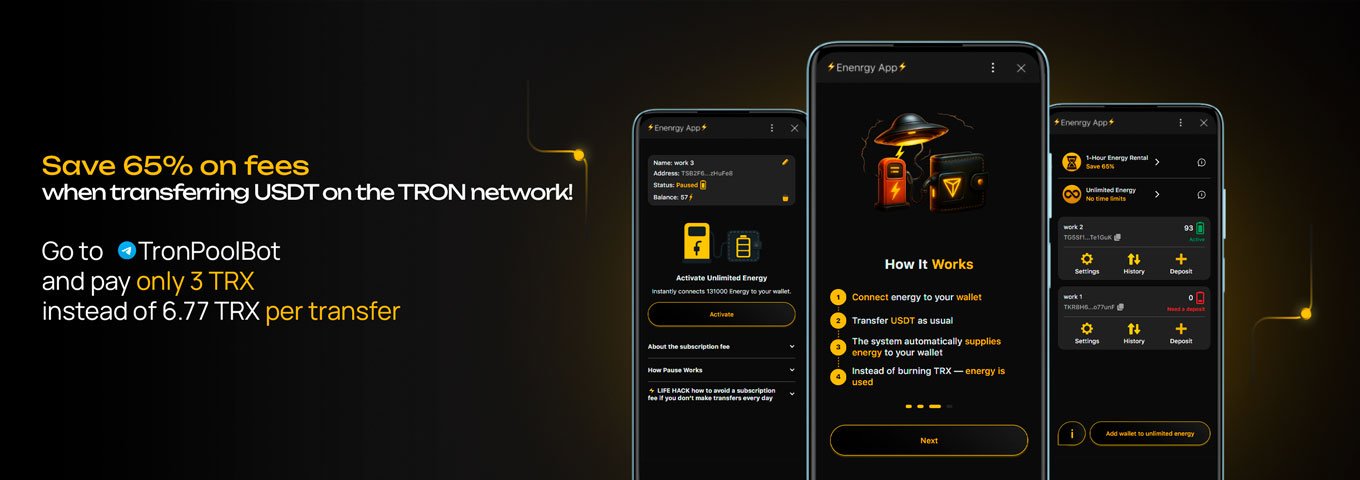
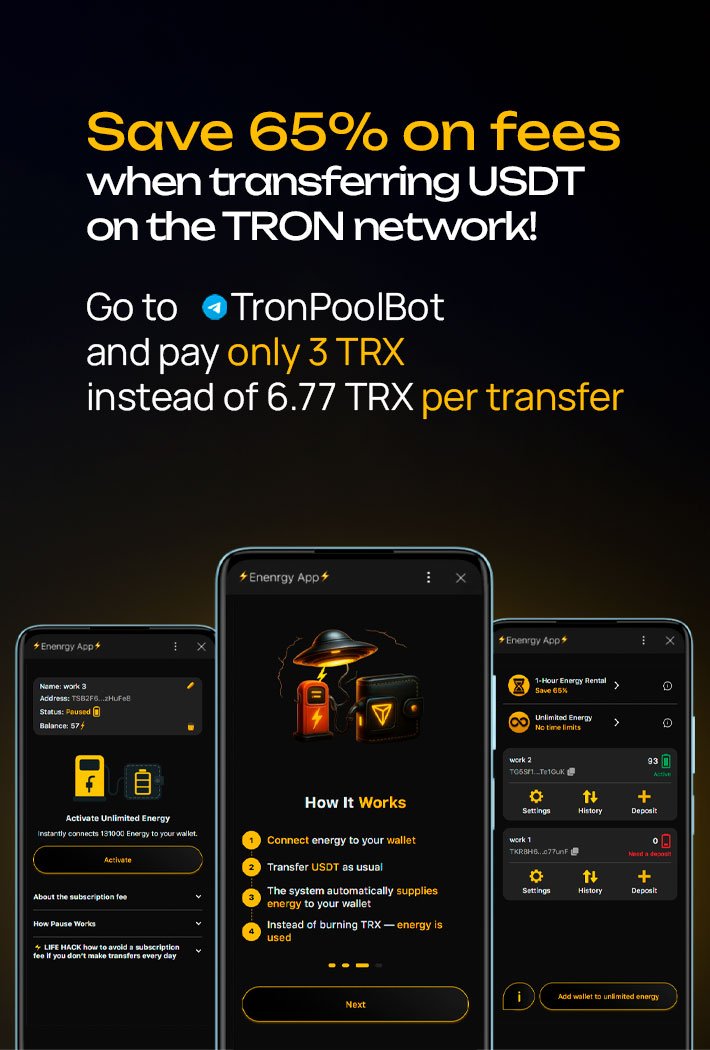
— savings on fees can reach 65%;
— private keys are not required — the public wallet address is sufficient.
Energy rental services, such as Tron Pool Energy, offer both one-time rental (for 1 hour for a specific transaction) and subscriptions with continuous Energy supply to the wallet. For users who send USDT daily, a subscription is the most convenient option.
| Priority | Energy Source | Comment |
|---|---|---|
| 1 (highest) | Delegated Energy | Including rented Energy |
| 2 | Energy from TRX staking | Your own staked resource |
| 3 (last resort) | TRX Burning | Automatically, if no resources are available |
Difference from Bandwidth: Energy has no free daily quota. Therefore, if the account has no delegated or staked Energy, the network immediately proceeds to burning TRX.
The TRON network has a unique mechanism — Contract Energy Sharing. It allows the developer (deployer) of a contract to take on part of the Energy costs when their contract is called.
Every smart contract has two parameters:
consume_user_resource_percent — the percentage of Energy paid by the user (from 0 to 100). The rest is covered by the contract deployer.
origin_energy_limit — the maximum volume of Energy the deployer is willing to spend per contract call.
In practice, most popular contracts (including USDT) set consume_user_resource_percent = 100%, meaning the user pays for all Energy. However, when developing your own DApps, this mechanism allows subsidizing users and attracting an audience.
Consumed Energy recovers linearly over 24 hours — similar to Bandwidth. But there are technical details worth knowing:
— TRON block time is ~3 seconds;
— approximately 28,800 blocks are created per day;
— with each block, approximately 1/28,800 of the consumed resource is returned.
Recovery happens continuously, not as a single daily jump. This means that even a short pause between transactions allows partial Energy recovery.
You spent all your Energy in the morning. After 6 hours, ~25% of the resource will be recovered. After 12 hours — ~50%. Full recovery — after 24 hours.
If you need to perform a series of USDT transfers, spread them out over time. This will allow Energy to partially recover between operations and reduce TRX consumption.
Several factors influence the volume of Energy consumed:
Contract complexity. A simple TRC-20 token transfer consumes ~64,000 Energy. A DeFi operation (swap, staking, claim) may require 150,000–500,000 Energy or more, because a chain of contracts with complex logic is called.
Storage state. As mentioned above, the SSTORE instruction (writing to storage) costs differently: 20,000 Energy for creating a new record and 5,000 Energy for updating. This is precisely what explains the twofold difference in the cost of USDT transfers to new versus existing addresses.
Dynamic model. Popular contracts (USDT, USDD) may have increased Energy consumption due to the Dynamic Energy Model mechanism.
Contract execution time. The TRON network has a contract execution limit of 80 ms. If the contract does not complete within this time, the transaction fails with an OUT_OF_TIME error, and all spent Energy is lost without refund.
Transaction fee_limit. This parameter limits the maximum Energy expenditure (in sun). If fee_limit is set too low, the transaction will fail with an error. The recommended value for USDT is at least 15,000,000 sun (15 TRX).
| Method | Cost per 1 transfer | Comment |
|---|---|---|
| TRX Burning | ~6,77 TRX | The most expensive option |
| TRX Staking | 0 TRX (no direct costs) | But TRX is frozen and unavailable |
| Energy Renting | 3 TRX | Savings up to 65% compared to burning |
| Delegation | 0 TRX (if donor available) | Requires an account with staked TRX |
As shown in the table, burning TRX is the most expensive way to cover Energy. Staking saves on direct costs but requires freezing significant sums. Energy renting is the optimal balance between convenience and cost.
For Regular Users
If you periodically send USDT, renting Energy before the transfer is almost always cheaper than burning TRX. Check the Energy balance on your wallet before sending: TronLink, Trust Wallet, and SafePal display Energy right on the screen. If Energy = 0, it’s better to use rental rather than relying on your TRX balance.
For Active Users and Traders
With daily transfers, it is more profitable to use one of two approaches:
— stake a sufficient volume of TRX to cover Energy for all transactions;
— or subscribe to Energy through a rental service — this is more convenient if you don’t want to freeze capital.
Remember: when staking TRX, you simultaneously receive TRON Power for voting for Super Representatives, which can generate additional income of ~3.26% annually.
For Business and Mass Operations
With dozens and hundreds of USDT transactions per day, Energy is the main fee expense item. Recommendations:
— do not hold TRX on every operational wallet — use delegated or rented Energy;
— plan transactions considering resource recovery — spread them out over time;
— separate wallets: operational (for transfers) and storage (for reserves);
— calculate daily needs: number of USDT transfers × ~65000 Energy for each;
— keep in mind that transfers to new addresses cost ~131000 Energy — 2 times more expensive.
Before sending a transaction, always check whether there is enough Energy on your wallet:
TronLink — displays TRX, Energy, and Bandwidth right on the main screen. Available as a mobile app and browser extension.
Trust Wallet — shows Energy and Bandwidth in TRC-20 token details.
Tronscan — open tronscan.org, paste the wallet address, find the “Resources” section. The “Total Energy” line will show the current balance.
SafePal — TRON resources are available in wallet settings.
If Energy = 0 and you plan to send USDT — take care of the resource in advance so you don’t burn TRX.
Energy is the key computational resource of the TRON network that determines the cost of most smart contract operations. Here are the essentials:
Energy = CPU time for smart contracts. 1 unit = 1 ms of TVM operation.
There is no free Energy. Unlike Bandwidth, a daily quota is not provided.
USDT TRC-20 always requires Energy — from ~64,285 to ~130,285 units per transaction.
Without Energy, the network burns TRX — automatically, at a price of 0.0001 TRX per unit.
Ways to obtain: TRX staking, delegation, or Energy renting.
Energy renting — savings of up to 65% compared to burning TRX.
Recovery in 24 hours — linearly, with each block (~3 seconds).
Control your Energy, choose the optimal coverage method — and don’t overpay for transactions on the TRON network.
How Bandwidth Works in TRON
Complete breakdown of TRON Bandwidth: calculation formula, usage order, delegation and fees when the resource is insufficient.
2026-02-20
191

Energy Rental on TRON: Save on USDT Transactions
What Energy Rental on TRON is and how it reduces fees for USDT TRC-20 transfers.
2026-03-05
112
Energy Rental on TRON: Save on USDT Transactions
What Energy Rental on TRON is and how it reduces fees for USDT TRC-20 transfers.
2026-03-05
112