What Energy Rental on TRON is and how it reduces fees for USDT TRC-20 transfers.
Content
Every USDT TRC-20 transfer on the TRON network requires Energy to execute the smart contract. If there is no Energy in your wallet, the network automatically burns TRX from your balance — and the fee for a single transaction can amount to 6–13 TRX.
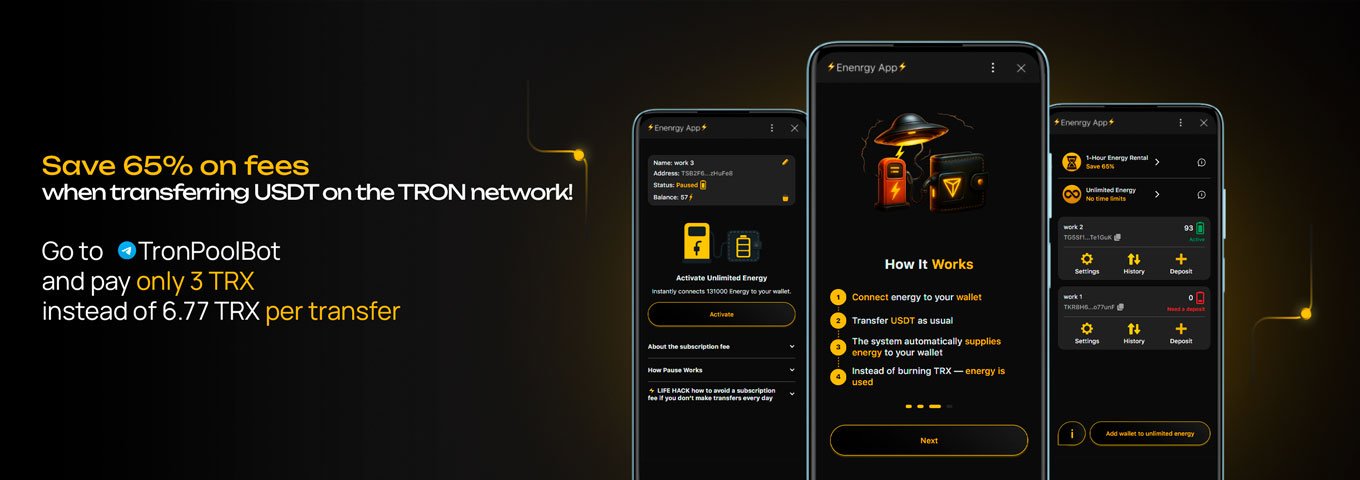
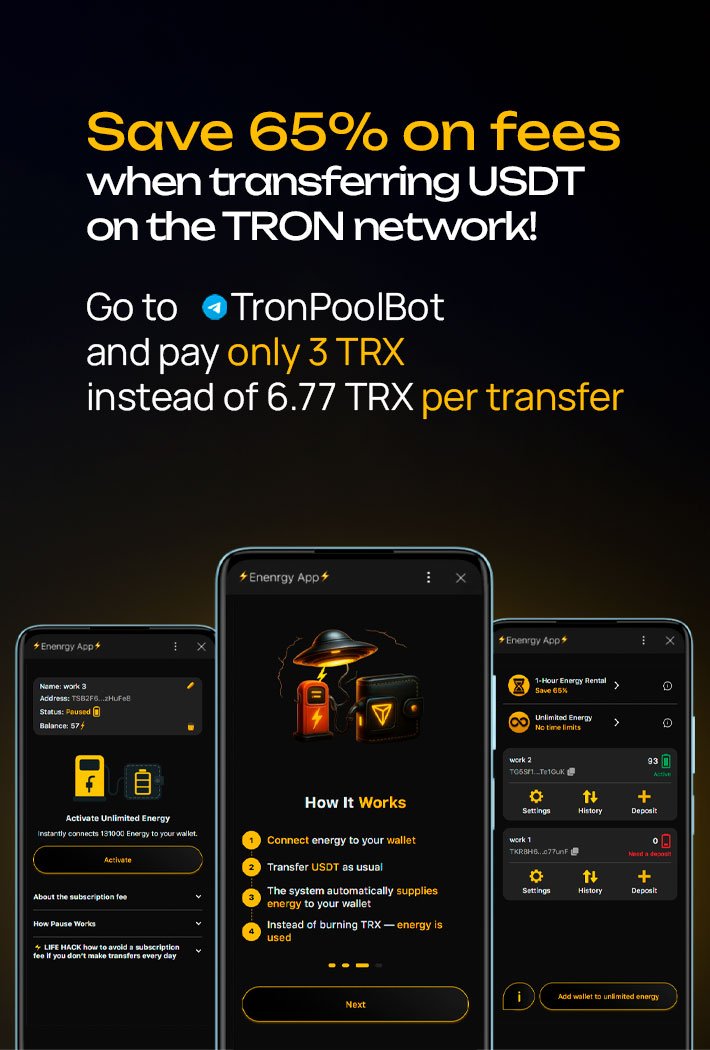
Energy Rental is a mechanism that allows you to obtain the required Energy without purchasing and freezing TRX. You pay a fixed amount for temporary use of the resource, and the service delegates Energy to your address via the standard TRON protocol. The result — savings of up to 65% on every transaction.
In this article, we will analyze in detail: how Energy rental works, what the savings are based on, what the process looks like from the user’s perspective, and for whom this method is especially beneficial.
Why Energy Is Required for Every USDT Transfer
USDT on the TRON network is not a native coin but a TRC-20 standard token that exists as a smart contract. Every USDT transfer is a call to the transfer() function of this contract, and the TVM virtual machine consumes computational resources to execute it.
These computational resources are Energy. A single USDT transfer consumes:
Operation
Energy Consumption
Cost in TRX*
USDT to an address with USDT balance
~64,285
~6.43 TRX
USDT to a new address (without USDT)
~130,285
~13.03 TRX
* with full TRX burning, without staking or Energy rental.
The transfer amount does not affect the cost — sending 10 USDT or 10,000 USDT costs the same. Only the contract logic and the state of the recipient’s address matter.
There are three ways to cover Energy consumption:
Burning TRX — automatically, at a price of 0.0001 TRX per Energy unit. The most expensive option.
Staking TRX — freezing TRX to obtain Energy. Requires significant capital and a 14-day unlocking period.
Energy Rental — obtaining the resource through delegation from a service. The optimal balance of price and convenience.
How Energy Rental Works
Energy rental is based on the standard resource delegation mechanism built into the TRON protocol (Stake 2.0). This is not a workaround or a hack — resource delegation is a native function of the blockchain.
Mechanics at the Blockchain Level
On the TRON network, any user can stake TRX and obtain Energy. The obtained Energy can be delegated to another address via a Delegate Resource Contract transaction — while the TRX themselves remain with the owner.
The recipient of delegated Energy uses it for their transactions exactly the same way as their own. When the rental period expires or the owner decides to recall the resource, they execute an UnDelegate Resource Contract transaction — and the Energy is returned.
Key Principle
Energy rental is the delegation of a resource from a staker to a user via the standard TRON protocol. Private keys are not transferred. Access to the wallet is not required. Everything happens at the blockchain level.
Process from the User’s Perspective
For the end user, Energy rental is as simple as possible:
Step 1. Enter the public address of your TRON wallet (starts with “T”). That’s all that’s needed — private keys are not required.
Step 2. Choose the Energy volume and rental period. For example, 65000 Energy for 1 hour for a single USDT transfer, or a package for a specific number of transactions.
Step 3. Pay for the rental. The cost is fixed and significantly lower than burning TRX.
Step 4. Energy is delegated to your address within seconds. You can see it in your wallet’s resource balance.
Step 5. Execute your transactions. Energy is consumed instead of burning TRX.
The entire process takes mere seconds. Energy appears on your address and is ready for use immediately after payment confirmation.
Why Energy Rental Is Cheaper Than Burning TRX
This is the main question new users ask: if Energy is obtained from staked TRX one way or another, how can rental be cheaper?
The answer lies in the economics of staking.
Logic for the Staker (Energy Provider)
An owner of a large volume of TRX freezes coins and receives Energy. If they don’t use this Energy themselves, it simply regenerates and goes to waste every 24 hours. For the staker, any income from delegating Energy is pure profit on top of voting rewards (TRON Power), which they receive anyway.
Logic for the User
For the user, when burning TRX the entire amount is gone irreversibly. With rental, they pay only a portion of this amount — because the staker already recoups the freezing through TRON Power and is willing to sell Energy at a discount.
Cost Comparison: One USDT Transfer
Let’s look at specific numbers for a USDT transfer to an address with an existing balance (~64,285 Energy):
Method
Cost
Savings
Burning TRX
~6.43 TRX
—
Energy Rental (1 hour)
3 TRX
up to 65%
Staking TRX
0 TRX (direct)
100%, but TRX are frozen
For a transfer to a new address (~130,285 Energy) the savings are even more significant:
Method
Cost
Savings
Burning TRX
~13.03 TRX
—
Energy Rental (1 hour)
6 TRX
up to 65%
Staking TRX
0 TRX (direct)
100%, but TRX are frozen
With 10 USDT transfers per day, the savings from Energy rental can amount to 30–60 TRX daily. Per month — from 900 to 1,800 TRX. For businesses with hundreds of transactions, the savings are measured in tens of thousands of TRX.
Total
Energy Rental vs TRX Staking: What to Choose
Both methods allow you to obtain Energy without burning TRX. But each has its own strengths and weaknesses:
Parameter
TRX Staking
Energy Rental
Initial investment
Need to buy and freeze TRX
Only rental payment
Liquidity
TRX are locked (14 days to unfreeze)
TRX remain free
Energy volume
Depends on stake amount and network share
Fixed, on demand
Suitable for
Long-term TRX holders
Everyone else
Additional income
TRON Power + voting rewards
None
Flexibility
Volume change in 14 days
Instant adjustment
Volatility risk
Yes (TRX price may drop)
Minimal
For example, to obtain approximately 130,290 Energy (required for a USDT TRC-20 transfer to an address without a USDT balance), you need to freeze approximately 14,002 TRX.
At the rate of 0.2766 USDT per TRX as of 02/10/2026, this means freezing funds in the amount of:
14,002 TRX × 0.2766 ≈ 3,872.95 USDT
Staking makes sense if you already hold TRX long-term and want to receive additional rewards. For everyone else — Energy rental is more convenient and cheaper because it does not require freezing capital.
Conclusion
Energy Rental Formats
Energy rental services offer several models designed for different usage scenarios:
Hourly Rental
You rent Energy for 1 hour for a specific transaction. This is the simplest format — pay, receive the resource, execute the transfer. Suitable for one-time USDT transfers.
Cost: 3 TRX = 65000 Energy sufficient for one transaction to a wallet with a USDT balance.
Transaction Packages
You purchase a package for a specific number of transfers — for example, 10, 50, or 1,000 transactions. 131,000 Energy is connected to the wallet and automatically recharges after each transaction.
Advantages: no need to open the app and purchase Energy each time. Convenient for regular transfers.
Suitable for: businesses, exchanges, active traders — anyone who sends USDT daily.
API Integration
APIs are available for developers and platforms to automate Energy rental. You can integrate rental into your system: automatically request the required Energy volume before each transaction.
One of the main questions is security. Let’s analyze it in detail.
What Is Required for Rental
To receive Energy through delegation, you only need the public address of your TRON wallet — a 34-character string starting with “T”. This is the same address you provide to receive a transfer.
A legitimate Energy rental service NEVER requests private keys, seed phrases, wallet passwords, or Web3 authorization connections. If a service asks for any of these — it is a scam.
Critical Rule
Why Delegation Is Safe
Energy delegation is a standard transaction on the TRON network (Delegate Resource Contract). It is executed on the staker’s side, not on the recipient’s side. You don’t sign or approve anything — the resource simply appears on your address.
This is analogous to how someone can send you TRX without your permission — only instead of coins, you receive Energy.
How to Verify Delegation
All resource delegations are recorded on the TRON blockchain and are publicly available. You can check the status on Tronscan:
— open tronscan.org and enter the wallet address;
— go to the “Resources” section;
— you will see the current Energy balance, delegation source, and terms.
Who Energy Rental Is Suitable For
Regular Users
If you send USDT a few times a month — hourly rental before each transfer will save 3–9 TRX per transaction. No need to understand staking, buy TRX for freezing, or wait 14 days for unlocking.
Active Traders
For daily USDT transfers, transaction packages are the optimal choice. You don’t think about fees before each send: Energy is already connected to the wallet and recharges automatically.
Businesses and Exchangers
For companies conducting dozens and hundreds of transactions per day, fee control is a critical task. Energy rental via API allows:
— automating resource acquisition before each transaction;
— not holding TRX on operational wallets;
— accurately forecasting fee expenses;
— separating wallets: storage and operational.
DApp Developers
If your application executes contract calls on behalf of users — integrating Energy rental via API allows you to subsidize fees and improve user experience. Users don’t think about resources — everything happens on the backend.
How to Calculate Your Energy Needs
To choose the right rental plan, you need to understand how much Energy you will require. Here is the formula:
Daily Energy = number of transactions × Energy consumption per transaction
Daily Needs Formula
Calculation Examples
Scenario
Transactions/day
Energy/day
TRX when burning*
Personal use
1–2
~65000–130,000
6.5–13 TRX
Active trader
5–10
~325,000–650,000
32.5–65 TRX
Small business
20–50
~1,300,000–3,200,000
130–320 TRX
Exchanger / exchange
100–500
~6,500,000–32,500,000
650–3,250 TRX
* for transfers to addresses with an existing USDT balance (~64,285 Energy per transaction).
As the table shows, even for a small business with 20 transactions per day, the cost of burning TRX is 130+ TRX daily. With Energy rental, this amount drops to 40–80 TRX — savings of over 50 TRX per day, or 1,500+ TRX per month.
What to Consider When Choosing a Rental Service
The Energy rental market is actively growing — more services are appearing. Here are the criteria to pay attention to:
Security. The service must operate through standard TRON resource delegation. No private keys, seed phrases, or Web3 connections. A public wallet address is sufficient.
Delegation speed. Energy should appear on your address within seconds of payment. A delay of minutes is a reason to look for another service.
Price transparency. The cost should be fixed and clear before payment. Beware of hidden fees.
Rental formats. Availability of different models: hourly, packages, API. The more options — the easier to find the optimal one.
API for automation. If you plan integration — make sure the service has a documented API.
Reputation. Check reviews, time on the market, activity on social media.
There are platforms that promise free or ultra-cheap Energy but actually try to gain access to your wallet. Never enter private keys or seed phrases on third-party websites. A legitimate service requires only a public address.
Warning: Fraudulent Services
Is Bandwidth Needed When Renting Energy
An important nuance that is often forgotten: Energy rental covers only the computational part of the transaction. Bandwidth is still needed to transmit transaction data to the network.
The good news — every activated account on TRON receives 600 free Bandwidth units per day. A single USDT TRC-20 transfer requires ~345 Bandwidth units, meaning the free quota is sufficient for 1 transaction per day.
If you make 1 USDT transfer per day — Energy rental + free Bandwidth fully covers all resources. For more transactions, additional Bandwidth through staking or delegation may be required.
What This Means in Practice
If Bandwidth is insufficient, the network will automatically burn TRX at a rate of 0.001 TRX per unit. For one USDT transaction, this is ~0.345 TRX — a small amount, but it accumulates with mass operations.
How to Check Your Energy Balance Before a Transaction
Before sending USDT, always verify that your wallet has sufficient Energy:
TronLink — shows Energy and Bandwidth on the main screen. If Energy > 65000, you are ready for a USDT transfer to an address with a balance.
Trust Wallet — displays resources on the TRC-20 token details screen. If Energy = 0, the transfer will burn TRX.
Tronscan — open tronscan.org, paste the address, check the “Resources” → “Total Energy” section.
If Energy = 0 and you don’t want to burn TRX — activate rental before sending the transaction.
Summary
Energy Rental is a practical and secure way to reduce fees on the TRON network.
Here are the key points:
Energy Rental = resource delegation. A standard TRON protocol mechanism, without wallet access.
Savings of up to 65% compared to burning TRX on every transaction.
Only a public address is needed. No private keys, seed phrases, or connections.
Formats for any case: hourly rental, transaction packages, subscription, API.
For everyone: from one-time transfers to hundreds of transactions per day.
Safe and transparent. Delegation is recorded on the blockchain and verified on Tronscan.
Don’t overpay for transactions — use Energy rental and keep TRX in your wallet.
Share
Link
Did you like the article?
TRX calculator
Find out how much you spend on commissions!
Enter your crypto wallet address and we'll calculate how much TRX you've spent on fees over the last 30 days.
TRON Energy rental for 1 hour is a way to reduce USDT TRC-20 transfer fees by up to 65%. Learn how to save money without buying TRX or dealing with staking. Step-by-step guide and key benefits via Telegram.




 English (EN)
 Русский (RU)
 Українська (UK)
 español (ES)
 Türkçe (TR)