




 English (EN)
 Русский (RU)
 Українська (UK)
 español (ES)
 Türkçe (TR)



Energy Rental on TRON: Save on USDT Transactions
What Energy Rental on TRON is and how it reduces fees for USDT TRC-20 transfers.
2026-03-05
112
Authorization is required only to use the service «Team energy»
Enter the e-mail you provided during registration and we will send you instructions on how to reset your password.
An error occurred while processing your request. Please try again later. If the problem persists, please contact our support team.
We explain USDT TRC-20 transfer fees on TRON: Energy usage, Bandwidth, cost in TRX, and ways to reduce the fee.
TRON is one of the most popular blockchains for USDT transfers. Fast transactions, high throughput, compatibility with major wallets — all of this attracts millions of users. But one question keeps coming up: how much does it cost to send USDT TRC-20?
The answer is not as simple as it seems. The USDT transfer fee is not a fixed amount — it is a function of two network resources consumed: Bandwidth and Energy. Whether you pay 0 TRX or 13+ TRX per transaction depends entirely on whether you have these resources available.
In this article, we break down in detail: what makes up the fee, why it differs across addresses, what factors affect it, and — most importantly — how to reduce costs when transferring USDT on the TRON network.
A simple TRX transfer between wallets is a basic transaction. It requires only Bandwidth (~268 points) and does not invoke any smart contracts. With 600 free daily Bandwidth points, such a transfer is effectively free.
With USDT, things are different. USDT on the TRON network is not a native coin — it is a TRC-20 standard token. It exists as a smart contract. Every USDT transfer is a call to that contract’s transfer() function, and the TVM virtual machine expends computational resources to execute it.
Therefore, a USDT transfer requires two resources simultaneously:
Bandwidth — covers the transmission of transaction data to the network. ~345 points.
Energy — covers the execution of the USDT contract code. ~64,285 – 130,285 units.
Key Difference TRX transfer = Bandwidth only (free with 600 pts/day). USDT TRC-20 transfer = Bandwidth + Energy. Energy accounts for the bulk of the fee, because there is no free Energy on TRON.
The USDT transfer fee is the sum of two components: the Bandwidth cost and the Energy cost. Let’s break down each one.
Bandwidth determines the “weight” of a transaction in bytes. 1 byte of data = 1 Bandwidth point. A USDT TRC-20 transfer occupies ~345 bytes, consuming ~345 Bandwidth points.
Bandwidth sources (in priority order):
With 600 free Bandwidth points, a single daily USDT transfer (~345 Bandwidth) is enough to keep the Bandwidth component at zero.
Energy is a computational resource consumed when executing smart contract code. For USDT, this is the primary cost driver.
Important Energy has no free daily quota. If your account has no Energy, the network will automatically burn TRX to cover the cost. Rate: 0.0001 TRX per Energy unit.
Energy consumption for a USDT transfer depends on one key factor — whether the recipient address already holds USDT:
| Scenario | Energy | Bandwidth | Fee in TRX* |
|---|---|---|---|
| Recipient already holds USDT | ~64,285 | ~345 | ~6,77 TRX |
| Recipient has no USDT (new address) | ~130,285 | ~345 | ~13,37 TRX |
* Full fee when burning TRX: Energy × 0.0001 + Bandwidth × 0.001. Without staking or resource rental.
Note: the transfer amount does not affect the fee. Sending 10 USDT or 100,000 USDT costs the same — only the contract logic and the recipient address state matter.
This is one of the most frequently asked questions: why is the fee for transfers to an address without USDT nearly double? The answer lies in how the TVM virtual machine handles data storage.
The USDT contract stores all holder balances in a storage table. When you send USDT:
To an address with a USDT balance — the contract updates an existing record in storage. The SSTORE instruction for updating a non-zero slot costs 5,000 Energy.
To a new address (no USDT) — the contract creates a new record from scratch. The SSTORE instruction for writing to an empty slot costs 20,000 Energy.
The SSTORE difference is 15,000 Energy. But the actual difference between the two scenarios is ~66,000 Energy. The additional costs are explained by several factors:
Dynamic Energy Model. USDT is one of the most frequently called contracts on TRON. For such contracts, a dynamic penalty coefficient (energy_factor) applies, which increases the cost of all operations, amplifying the base SSTORE difference.
Additional contract logic. Tether’s USDT contract includes a blacklist check, a pause mechanism, a fee calculation (basis points), and a deprecation check. Each of these checks accesses storage via SLOAD, and for a new address, some lookups hit uninitialized slots.
For comparison: with a simple TRC-20 token like BTT, the difference is exactly ~15,000 Energy (13,253 vs. 28,253), precisely matching SSTORE. But USDT is a more complex contract, so the gap is larger.
Practical Takeaway If you regularly send USDT to the same addresses, the fee will be lower (~6,77 TRX). The first transfer to a new address is always more expensive (~13,37 TRX). Factor this into your cost planning.
The full USDT TRC-20 transfer fee when burning TRX is calculated as follows:
Fee = (Energy × 0.0001 TRX) + (Bandwidth × 0.001 TRX)
Where:
— Energy = the number of Energy units consumed by the contract (~64,285 or ~130,285);
— 0.0001 TRX = the price of one Energy unit (100 sun);
— Bandwidth = the number of Bandwidth units (~345 for a USDT transfer);
— 0.001 TRX = the price of one Bandwidth unit (1,000 sun).
Example 1: To an address holding USDT
Energy: 64,285 × 0.0001 = 6.4285 TRX
Bandwidth: 345 × 0.001 = 0.345 TRX
Total: 6.4285 + 0.345 = 6,77 TRX
Example 2: To a new address without USDT
Energy: 130,285 × 0.0001 = 13.0285 TRX
Bandwidth: 345 × 0.001 = 0.345 TRX
Total: 13.0285 + 0.345 = 13,37 TRX
At the current rate of 1 TRX = 0.2766 (02/10/2026), this is approximately $1.9–$3.7 per transaction. For comparison: several years ago, at a lower TRX price, the same fee was under $1.
| Component | Resource | Cost in TRX | Share of Fee |
|---|---|---|---|
| Energy | ~64,285 units | ~6.43 TRX | ~95% |
| Bandwidth | ~345 units | ~0.345 TRX | ~5% |
| TOTAL | — | ~6,77 TRX | 100% |
* For a transfer to an address holding USDT.
Conclusion: ~95% of the fee is Energy. Bandwidth accounts for just ~5%. This means that to reduce fees, you need to address the Energy question first. If you have Energy (through staking, delegation, or rental), the bulk of the fee drops to zero.
Yes, the USDT transfer fee on the TRON network can be zero. To achieve this, you need to cover both resources:
Energy — via TRX staking, delegation, or rental. You need ≥ 64,285 units (or ≥ 130,285 for a new address).
Bandwidth — via the free 600 daily points (enough for 1 USDT transfer), staking, or delegation.
Key Principle If your wallet has enough Energy and Bandwidth, the TRON network does not burn TRX. Fee = 0. You only pay for resources (staking or rental), not for each individual transaction.
The default option: you simply hold TRX in your balance, and the network burns the required amount with each USDT transfer. No additional steps required, but this is the most expensive method.
| Parameter | Value |
|---|---|
| Cost per transfer | 6,77 – 13,37 TRX |
| Actions required | None — automatic |
| Best for | One-off transfers |
| Drawback | Highest fee |
By freezing TRX, you receive Energy (and/or Bandwidth) that covers the fee. If Energy is sufficient, no TRX is burned.
| Parameter | Value |
|---|---|
| Cost per transfer | 0 TRX (no direct cost) |
| Actions required | Freeze TRX in your wallet |
| Best for | Long-term TRX holders |
| Drawback | TRX is locked; 14-day unstaking period |
Additional staking bonus — TRON Power. You earn the right to vote for Super Representatives and receive rewards.
Limitation: to cover ~65000 Energy for a single USDT transfer, you need to stake 6,985 TRX (data as of 02/10/2026). The amount depends on the total network stake.
| Parameter | Value |
|---|---|
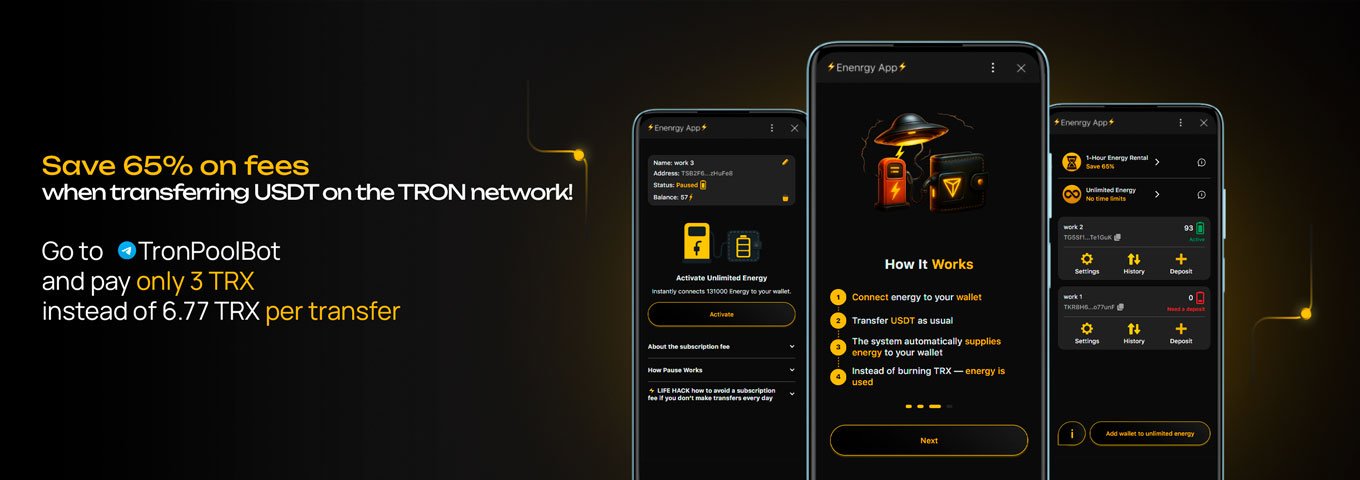
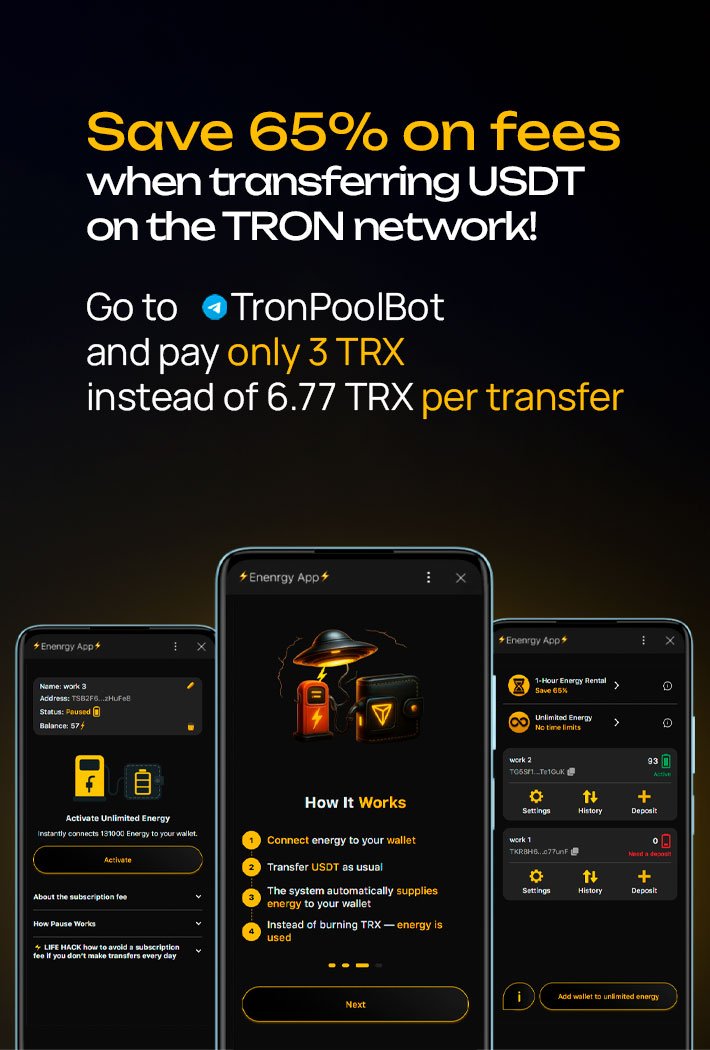
| Cost per transfer | 3 TRX |
| Savings | Up to 65% vs. burning |
| Actions required | Provide your address, pay |
| Best for | Everyone — from one-off to bulk transfers |
| Drawback | Must be activated before each transfer* |
* With a subscription or transaction bundle, activation happens automatically.
Only your public wallet address is needed for rental. No private keys are required — Energy delegation operates at the blockchain level.
If you have a second account with staked TRX (or a partner willing to help), Energy and Bandwidth can be delegated directly to your operational wallet.
| Parameter | Value |
|---|---|
| Cost per transfer | 0 TRX |
| Actions required | Delegate the resource from another account |
| Best for | Businesses with multiple wallets |
| Drawback | Requires a donor account with staked TRX |
| Method | Fee | Savings | Convenience |
|---|---|---|---|
| TRX Burn | ~6,77 TRX | — | Maximum |
| Energy Rental | 3 TRX | Up to 65% | High |
| TRX Staking | 0 TRX* | 100% | Medium |
| Delegation | 0 TRX* | 100% | For advanced users |
* TRX remains frozen and unavailable for use.
For transfers to a new address (~130,285 Energy), the proportions remain the same but absolute amounts are higher:
| Method | Fee | Savings |
|---|---|---|
| TRX Burn | ~13,37 TRX | — |
| Energy Rental | 6 TRX | Up to 65% |
| Staking / Delegation | 0 TRX* | 100% |
| Transfers/day to wallet with USDT | Monthly cost (burn) | With Energy rental | Savings |
|---|---|---|---|
| 1 | 203.1 TRX | 90 TRX | 113.1 TRX |
| 5 | 1,015.5 TRX | 450 TRX | 565.5 TRX |
| 20 | 4,062 TRX | 1,800 TRX | 2,262 TRX |
| 50 | 10,155 TRX | 4,500 TRX | 5,655 TRX |
| 100 | 20,310 TRX | 9,000 TRX | 11,310 TRX |
* Calculated for transfers to addresses holding USDT (~6,77 TRX when burning, 3 TRX with rental).
For a business processing 100 transactions per day, Energy rental saves 11,310 TRX per month. At a rate of $0.2766 per TRX, that’s $3,128 in monthly savings.
The USDT TRC-20 fee is not a static value. Here’s what can affect it:
Recipient’s USDT balance. The primary factor. If the recipient already holds USDT — fee is ~6,77 TRX. If not — ~13,37 TRX. A 2x difference.
Dynamic Energy Model. For popular contracts (USDT is one of the most active on TRON), Energy consumption may fluctuate slightly due to the dynamic energy_factor coefficient. It is recalculated every network maintenance cycle (6 hours).
TRX price. The fee is fixed in TRX, but its dollar equivalent depends on the current exchange rate. When TRX rose from $0.05 to $0.25, the same transaction became 5x more expensive in dollars.
Available resources. If the wallet has Energy (via staking, delegation, or rental), that portion of the fee drops to zero. The same applies to Bandwidth.
fee_limit parameter. This is the maximum Energy spending cap (in sun) that you set when sending. If fee_limit is too low, the transaction will fail. Recommended for USDT: at least 15,000,000 sun (15 TRX).
New account activation. If you transfer TRX to an address that has not yet been activated on the TRON network (has never received a transaction), an activation fee is added: 1 TRX + additional Bandwidth.
| Network | Typical fee | Speed | Note |
|---|---|---|---|
| TRON (TRC-20) | ~6,77 TRX (~$1.5–2.5) | ~3 sec | With Energy rental — ~$0.75–1.2 |
| Ethereum (ERC-20) | $0.35–$1+ | ~15 sec | Depends on gas price |
| BSC (BEP-20) | ~$0.10–$0.30 | ~3 sec | Cheaper but less liquid |
| Solana (SPL) | ~$0.01–$0.05 | ~0.4 sec | Very cheap, different ecosystem |
| Polygon (PoS) | ~$0.01–$0.10 | ~2 sec | Cheap, Layer 2 |
TRON holds the top position by cost, but leads in USDT transfer volume thanks to broad exchange, exchanger, and wallet support. With Energy rental, the cost of a USDT TRC-20 transfer drops dramatically.
To avoid overpaying, check the following before every transfer:
For Regular Users
If you send USDT a few times per month, the simplest option is renting Energy before each transfer. It’s faster and cheaper than burning TRX. No need to learn about staking or freeze your funds.
For Active Traders
For daily transfers, consider transaction bundles or Energy subscriptions. This eliminates worrying about fees before each send — Energy will be connected to your wallet automatically.
For Businesses and Exchangers
With dozens or hundreds of transactions per day, fee management is a critical task:
— Calculate your daily Energy demand: number of transfers × ~65000;
— Use delegation or API-based rental for operational wallets;
— Separate wallets: storage (no spending) and operational (with resources);
— Keep in mind that transfers to new addresses cost ~130,000 Energy — plan your budget with a buffer.
The USDT TRC-20 fee is not a fixed charge — it is the result of TRON network resource consumption. Here’s the bottom line:
Two components: Energy (~95% of the fee) + Bandwidth (~5%).
Address with USDT: ~6,77 TRX. Address without USDT: ~13,37 TRX. A 2x difference.
Transfer amount doesn’t matter. 10 USDT and 100,000 USDT cost the same.
The fee can be = 0. If Energy and Bandwidth are covered through staking or rental.
Energy rental saves up to 65% compared to burning TRX.
TRX price = your cost in $. As the TRX price rises, the dollar cost of a transaction increases.
Monitor your wallet resources, choose the optimal Energy coverage method — and pay dramatically less for USDT transfers.
Energy Rental on TRON: Save on USDT Transactions
What Energy Rental on TRON is and how it reduces fees for USDT TRC-20 transfers.
2026-03-05
112

AML and USDT TRC-20: how crypto compliance checks detect tainted funds
Deposit freezes often happen when funds come from tainted or flagged addresses. This article explains how AML filters work for USDT TRC-20 and how to identify high-risk wallets.
2025-10-16
148

USDT Without Verification: How to Stay Anonymous on the TRON Blockchain
Want to keep your privacy when working with USDT TRC-20? We explain how the TRON blockchain exposes your activity, where your anonymity is lost, and how to use energy without verification or buying TRX.
2025-07-25
138