Full Trustee Wallet review: supported networks, security, TRON fees, staking, cashback, and Web3 tools. Pros, cons, and tips for optimizing USDT TRC-20.
Content
Many users choose crypto wallets that give them full control over their assets, support different blockchains, and allow them to work with crypto without using centralized exchanges. Against this backdrop, the question trustee wallet what is it and how it differs from regular mobile wallets appears more and more often.
In essence, this is a non-custodial, open-source tool that combines asset storage, fiat withdrawal, staking, cashback, and access to Web3. Our trustee wallet review helps evaluate its capabilities and understand whether it suits users who need a transparent and functional open-source solution.
In this article we will cover:
How the wallet is built, how it differs from other solutions, and why it is considered a convenient tool without the need to turn to exchanges.
What opportunities withdrawal/exchange of cryptocurrencies, staking, and cashback provide, and who these features can be useful for in daily work.
What the app looks like and why this guide helps those who need a clear trustee crypto wallet guide.
Demand for mobile and exchange-independent solutions continues to grow. Trustee offers a format in which the user gets multichain support, local key storage, and a set of tools for continuous work with assets. This approach makes it a convenient choice both for beginners and experienced crypto holders who care about combining simplicity, functionality, and open code.
Key metrics and indicators of Trustee Wallet
To objectively evaluate the wallet, let’s look at its main parameters across ten key metrics. This approach makes it possible to see the overall picture and understand how well the app suits different categories of users. It is important that the ratings refer specifically to Trustee Wallet, and not to the custodial service Trustee Plus.
Criterion
Score (1–10)
Comment
trustee wallet supported networks
8
Support for Bitcoin, Ethereum, TRON, BNB Chain, Polygon, Solana, Avalanche, and other popular networks. A sufficient set for everyday work.
Security and key control
9
The seed phrase is stored by the user, keys are generated and remain locally. Login protection via PIN/FaceID. A separate advantage is that the project is fully open-source, the wallet code is open on GitHub.
Interface usability
9
4 tabs, simple design, language support, configurable notifications, dark theme. The interface is comfortable for beginners.
Backup and recovery
9
Convenient “Backup” and “Restore wallet” items. The user does not need to perform complex steps; everything is clear and visual.
Fees and transaction optimization
7
Standard network fees are used. Payment providers have their own fees and minimum limits that should be taken into account.
Integration with DeFi and Web3
8
WalletConnect and a built-in DApp section are available, which favorably distinguishes the app among mobile wallets of the same class.
Cross-platform support
3
The wallet is only available on mobile devices. There is no desktop version and no web version either.
Reputation and transparency
10
Full code transparency on GitHub, active updates, public discussion of critical changes.
Support and documentation
8
There is a built-in FAQ, support section, and fast responses via the app. The documentation is not the most extensive, but it is clear.
Features and bonuses
9
Financial operations “Cash/Card”, ETH staking, cashback program, Wallet/Plus integration, multichain, and DApps.
These indicators show that Trustee is aimed at serious users who value the combination of mobility, open code, an exchange, and Web3. It is not just a key storage, but a full-fledged tool that can be used on a daily basis.
Security of Trustee Wallet
When users choose a mobile crypto wallet, one of the first questions sounds like trustee wallet is safe or not. This question can be answered as follows: the security level corresponds to the capabilities of the mobile environment and fully depends on how the owner treats the storage of their seed phrase.
The wallet operates in a non-custodial model where private keys are created on the device and remain only with the user. The app does not create cloud backups and does not send private data to servers, so control over access remains entirely in the owner’s hands.
The basis of protection is the seed phrase that appears when the wallet is created. The user can save it using the backup function, and the app periodically reminds about this to minimize the risk of losing access. As long as this phrase is stored in a safe place, the assets remain securely protected.
An additional level of security is provided by a PIN code, FaceID, and TouchID. These tools help lock the interface and prevent unauthorized users from opening the app.
Special attention should be paid to the open-source code. The developers have made all the business logic available on GitHub, and any specialist can check the key generation processes, interaction with the network, and the app’s behavior when processing transactions. This approach significantly increases trust and becomes an important argument for those who choose fully transparent solutions in the crypto space.
Installing and setting up Trustee
To start working with the app, it is enough to install it from the official stores. Therefore, when a user asks where to download trustee wallet, the only correct options remain the App Store and Google Play. Downloading an APK from third-party sites is not suitable, as this creates a direct risk of loss of funds and data leaks.
After installation, the app offers two options. You can create a new wallet or restore a previously saved one. Restoration is straightforward: you need to select “Restore wallet”, enter a seed phrase of 12 or 24 words, and wait for the balances to appear. The interface is designed so that even a beginner understands how to use the trustee wallet and can perform basic actions without searching for instructions.
When the wallet is created or restored, the initial settings remain to be completed. The user selects the interface language, sets the display currency, enables dark mode, configures deposit notifications, and chooses how often the app will update data on assets.
Additional features of Trustee
One of the app’s strengths is considered to be its versatility. Within a single mobile interface, several tools are combined that allow you to work with cryptocurrency without switching to other services. This approach makes asset management easier and is suitable for both beginners and experienced users.
Cryptocurrency exchange
This feature is particularly in demand because the trustee wallet crypto exchange works as an aggregator. The app selects the most favorable options among different providers and helps perform an exchange in a few steps. The user does not waste time searching for the best rate and can quickly swap assets inside the wallet.
Financial operations
Users often ask how to withdraw money from trustee, and the app offers several options. You can choose cash withdrawal via Any.Cash or a card transfer via KASSA, as well as other available methods. KYC is required for such operations, and the minimum amount is quite high, so this tool is suitable for those who withdraw medium and large amounts.
Staking and cashback
In the “Earn” section, there is ETH staking with a yield suitable for long-term holding of coins. Cashback works separately and returns part of the exchange fee if the user actively performs transactions or invites others.
Wallet and Plus
The Trustee ecosystem is divided into two products. The non-custodial Wallet leaves the keys with the device owner, so all operations are carried out under their control. In parallel, there is Plus, which is a custodial service with extended financial capabilities. This division helps the user choose the work format that suits them best.
Working with TRON and USDT TRC-20 in Trustee Wallet
Trustee Wallet supports several popular networks, including TRON, so it can be used as a primary wallet for stablecoins. Inside the app, the user chooses in which format to store USDT: ERC-20, BEP-20, or USDT TRC-20 on the TRON network. Most often, it is TRC-20 that is chosen for regular transfers and working with customizable fees.
The logic of working with transfers in the app is simple: the user selects an asset, enters an address, and confirms the action. If the question arises of how to send crypto via Trustee, the process is the same across all networks — first, the correct USDT format is selected, then the app shows trustee wallet fees and network resource consumption. On TRON, this is Energy/Bandwidth or TRX; on Ethereum it is gas; on BNB Chain it is a fee in BNB. It is important that the wallet shows all parameters in advance — this helps avoid accidental overpayments.
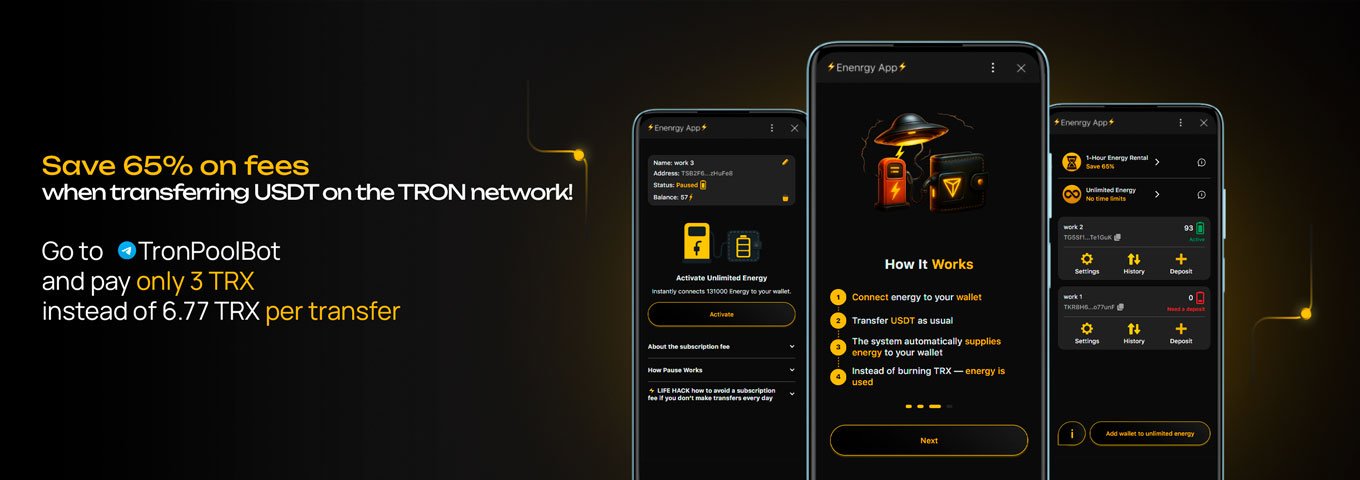
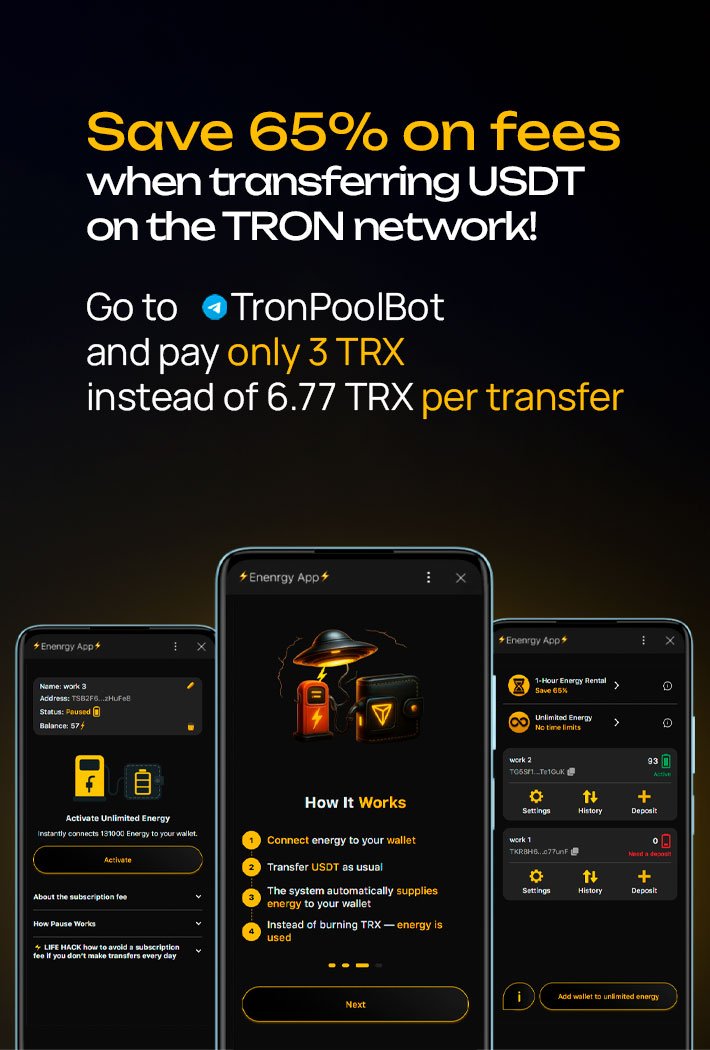
If you actively use USDT TRC-20, it makes sense to think separately about optimizing fees on the TRON network. One option is to use the blockchain’s internal resources (Tron energy) through external services such as Tron Pool Energy. This method allows you to pay for transactions with Tron energy instead of TRX, and therefore reduce the actual costs of transfers.
Activate Tron energy in seconds, save up to 65%, and send USDT TRC-20 with minimal fees — fully secure and transparent.
The advantages of this approach are especially noticeable with constant operations:
you can reduce fee costs by 65%, since energy covers transfer expenses;
connection is carried out without complex settings — energy is activated in the wallet instantly and works with all non-custodial apps, including Trustee Wallet USDT TRC-20;
the system does not require access to the seed phrase, it works only with the public address, so the connection is safe for the user;
if you use an Unlimited energy package, you can completely avoid buying TRX — transfers will be covered by resources automatically.
This approach is suitable for those who send USDT TRC-20 on a regular basis and want to reduce costs without changing the usual workflow in Trustee Wallet.
Pros and cons of Trustee Wallet
The main advantages and disadvantages of the wallet can be structured in a table to simplify comparison.
Pros
Cons
Open-source code
Mobile version only
DApp browser and WalletConnect
Long initial synchronization
Staking
Withdrawal requires mandatory KYC
Cashback program
Cash withdrawal threshold is around 5250 USD
Wallet/Plus separation
In some regions, exchanges are limited
Based on trustee wallet user reviews, we can say that the app is aimed at those who often use a mobile wallet in everyday scenarios and want to combine exchanges, staking, and Web3 in a single interface.
Conclusion
Trustee Wallet is suitable for users who need a mobile open-source solution for asset storage, exchange, and working with payment providers. The app combines ease of use, protection via a seed phrase, support for popular networks including TRON, and also offers staking, cashback, and the ability to connect to Web3. This set of features makes the wallet a convenient choice for those who want to manage cryptocurrency without relying on centralized exchanges.
The wallet is especially convenient because in a single interface you can learn how to send crypto via trustee and understand how to store USDT in trustee while maintaining full control over your keys and a high level of privacy. All features are collected in one app, so working with assets remains simple even for those who are just starting to understand cryptocurrency.
If you work with TRON and actively use USDT TRC-20, then the following material may be useful for you, where the specifics of the network, TRX fees, and ways to optimize transfers are described in detail. In a separate article, we have already explained how TRON works in Trustee and which tools help save money when sending stablecoins.
Share
Link
Did you like the article?
FAQ
Is USDT TRC-20 supported?
Yes, the wallet works correctly with the TRON network, so trustee wallet usdt trc-20 is fully supported. The user can send, receive, and store this stablecoin without restrictions. The interface displays the balance and fees as reliably as in other supported networks.
What are the fees?
Trustee wallet fees consist of two parts. The base is the network fee itself, which is calculated in gas or TRX depending on the blockchain. Additional costs may arise when working with payment systems, since providers set their own conditions and percentage for processing the operation.
How to restore access?
Users who want to understand how to restore access to trustee can do this via a seed phrase. You need to open the app, select “Restore wallet”, and carefully enter 12 or 24 words. After that, the system will restore the account structure and pull balances from the network.
Why is the transfer not going through?
When trustee wallet does not process a transfer, it is most often due to a lack of the native coin to cover the fee or a synchronization delay. The situation can also occur under high network load when the transaction goes into a queue. In such cases, you should check the balance, refresh the data, and wait for confirmations from the blockchain. If errors occur when sending in the Tron network, you can contact Tron Pool Energy support for consultation.
What is the difference between the “Staking” and “Earn” features?
Staking makes it possible to receive passive income, for example by holding ETH with a fixed yield. The “Earn” section works differently and offers cashback for activity inside the app. These are two different mechanics, so the user can use them in parallel.
What is the difference between Wallet and Plus?
Wallet is a non-custodial version where keys are stored only by the user and operations are carried out locally. Plus is a custodial service that offers additional financial tools and works as a full-fledged financial platform. The division helps choose the model that best matches the user’s working style and desired level of control over assets.
TRX calculator
Find out how much you spend on commissions!
Enter your crypto wallet address and we'll calculate how much TRX you've spent on fees over the last 30 days.
Deposit freezes often happen when funds come from tainted or flagged addresses. This article explains how AML filters work for USDT TRC-20 and how to identify high-risk wallets.
Many users keep USDT on exchanges, unaware of the risks: account freezes, asset locks, and loss of access. Here's why you should store crypto in a decentralized wallet and how to protect your funds.
Want to keep your privacy when working with USDT TRC-20? We explain how the TRON blockchain exposes your activity, where your anonymity is lost, and how to use energy without verification or buying TRX.




 English (EN)
 Русский (RU)
 Українська (UK)
 español (ES)
 Türkçe (TR)