Análisis completo de Bandwidth en TRON: fórmula de cálculo, orden de uso, delegación y comisiones cuando el recurso no es suficiente.
Contenido
La blockchain de TRON opera con dos recursos clave: Bandwidth y Energy. Mientras que Energy se encarga de la ejecución de contratos inteligentes, Bandwidth es la base fundamental. Se requiere para absolutamente cualquier transacción en la red: transferencias de TRX, envíos de USDT TRC-20, delegación de recursos y votación por Super Representatives.
Si tu saldo de Bandwidth es insuficiente, la transacción se ejecutará de todos modos, pero la red quemará TRX automáticamente de tu balance para cubrir el costo. Por eso, comprender cómo funciona el Bandwidth impacta directamente en tus costos operativos dentro de la red TRON.
Qué es el Bandwidth
Bandwidth (ancho de banda) es un recurso de red de la blockchain TRON que mide el tamaño de la transacción en bytes. Cada transacción en la red se transmite y almacena como un array de bytes, y es precisamente su tamaño lo que determina el consumo de Bandwidth.
1 byte de datos de transacción = 1 unidad de Bandwidth. El monto de la transferencia (10 USDT o 10.000 USDT) no afecta el consumo — lo único que importa es el volumen de datos de la transacción.
Regla fundamental
Cada transacción en TRON consta de tres partes, y todas se incluyen en el cálculo de Bandwidth:
raw_data — el cuerpo principal de la transacción: direcciones del remitente y destinatario, monto, parámetros de llamada al contrato, reference block y otros datos. Es la parte más voluminosa y su tamaño depende del tipo de operación.
signature — la firma digital que confirma la autoría de la transacción. Cada firma ocupa 67 bytes. Con esquemas de multi-firma (multi-signature), se agregan 67 bytes por cada firmante, lo que incrementa el consumo de Bandwidth.
result — el resultado de la ejecución de la transacción. Tamaño fijo: 64 bytes.
A diferencia de Energy, el consumo de Bandwidth no depende de la complejidad del contrato inteligente. Una transferencia simple de TRX y una interacción con un protocolo DeFi complejo pueden requerir un volumen comparable de Bandwidth si el tamaño de la transacción en bytes es aproximadamente el mismo.
Cuánto Bandwidth consumen las operaciones habituales
El consumo exacto depende del tamaño de cada transacción. A continuación, los valores aproximados para las operaciones más comunes en la red TRON:
Operación
Consumo de Bandwidth (uds.)
Transferencia de TRX
~268
Envío de USDT TRC-20
~345
Delegación de Energy
~283
Delegación de Bandwidth
~281
Revocación de Energy delegado
~281
Revocación de Bandwidth delegado
~279
Dato importante: incluso una transferencia simple de TRX consume más de 250 unidades. Un envío de USDT TRC-20 requiere ~345 unidades porque la transacción incluye datos adicionales de la llamada al contrato inteligente (dirección del contrato USDT, parámetros de la función transfer y dirección del destinatario).
Cómo obtener Bandwidth
Bandwidth diario gratuito
Cada cuenta activada en la red TRON recibe automáticamente 600 unidades gratuitas de Bandwidth por día. No se requiere ninguna acción — el recurso se acredita de forma automática.
Bandwidth mediante staking de TRX
Para obtener un mayor volumen de Bandwidth, puedes congelar (stakear) TRX. Este es el método principal para usuarios activos y empresas.
El volumen de Bandwidth asignado depende de dos factores: la cantidad de TRX que hayas stakeado y el total de TRX stakeados por todos los usuarios de la red. TRON distribuye un pool fijo de recursos diariamente entre todos los participantes en proporción a su participación.
Fórmula de cálculo Tu Bandwidth = (tus TRX stakeados / total de TRX stakeados en la red) × 43.200.000.000
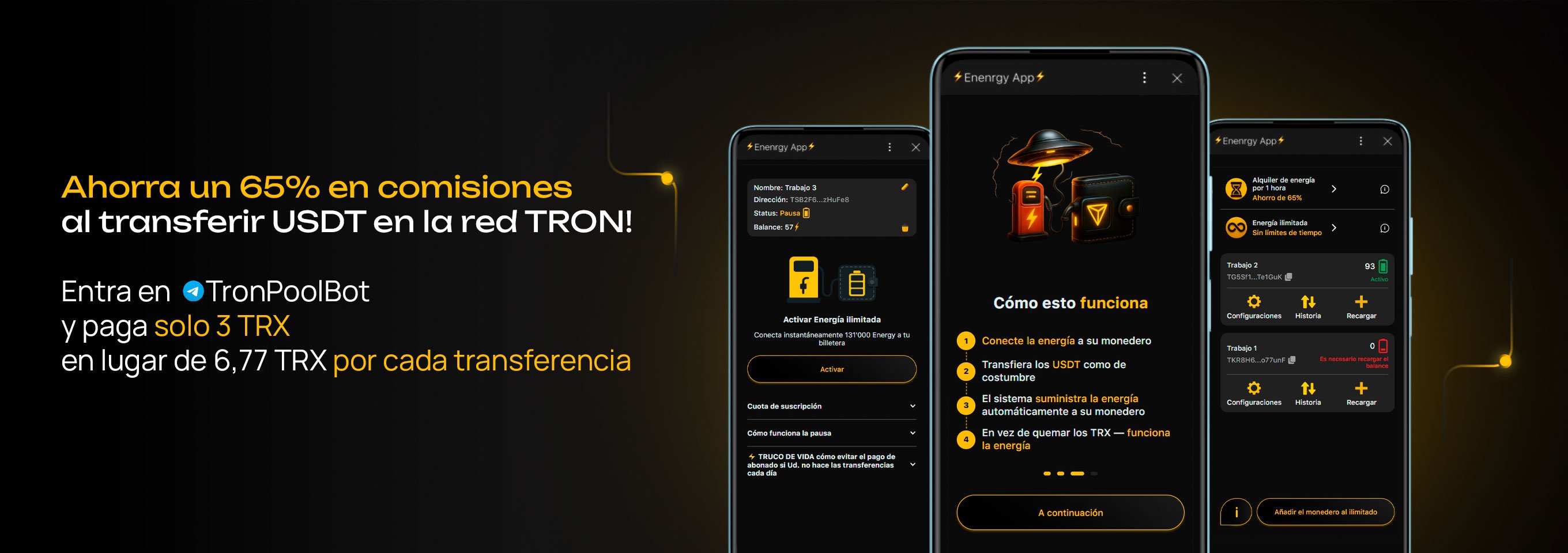
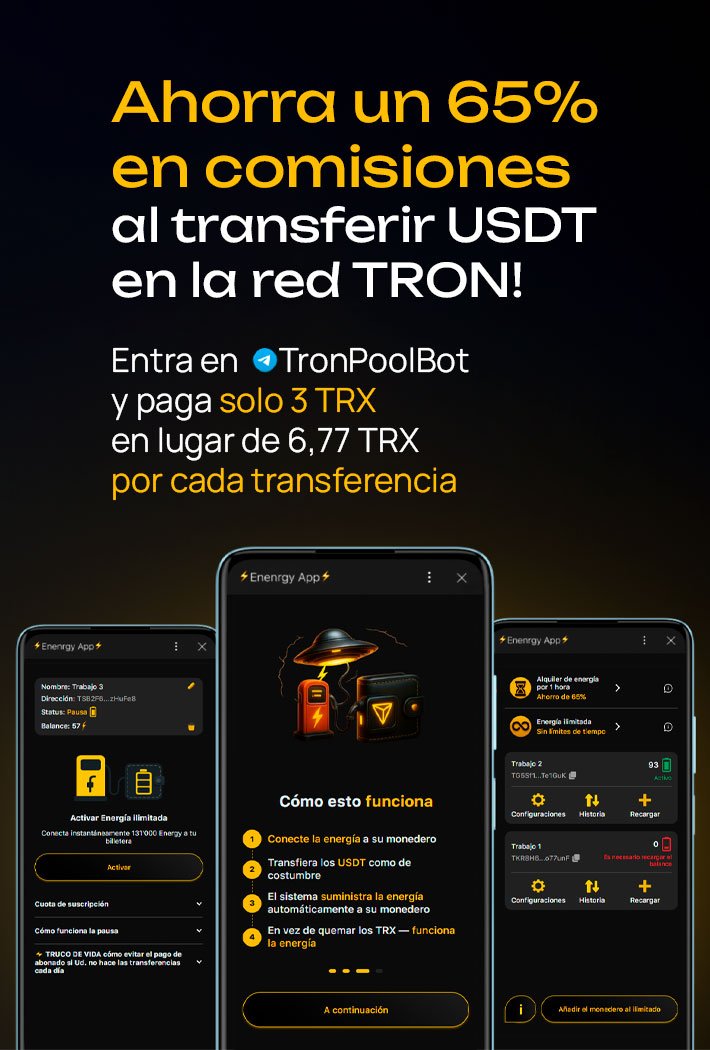
Si envías USDT TRC-20 con frecuencia y no quieres congelar TRX para obtener Bandwidth, puedes conectar los recursos a través de Tron Pool Energy. La activación tarda segundos, puedes gestionar varias carteras desde una sola cuenta y reducir los costos de las transacciones.
Tron Pool Energy
El pool diario total de 43,2 mil millones de unidades de Bandwidth se distribuye entre todos los stakers. Cuanto mayor sea tu participación, más Bandwidth recibirás.
Por ejemplo, para obtener 1.000 Bandwidth es necesario congelar aproximadamente 1.608 TRX.
Al tipo de cambio de 0,2766 USDT por TRX del 10.02.2026, esto implica inmovilizar fondos por: 1.608 TRX × 0,2766 ≈ 444,77 USDT
Delegación de Bandwidth
Si no tienes TRX stakeados pero necesitas Bandwidth, puedes obtenerlo mediante delegación. Es un mecanismo en el que otra cuenta te transfiere su Bandwidth sin transferir tokens TRX.
Cómo funciona:
— el propietario congela TRX y recibe Bandwidth;
— el Bandwidth obtenido se delega a tu dirección;
— tú utilizas este recurso para tus transacciones;
— la propiedad de los TRX permanece con el delegador.
Orden de prioridad del consumo de Bandwidth
Al procesar cualquier transacción, la red TRON deduce Bandwidth en un orden de prioridad estricto. Comprender esta jerarquía es esencial para controlar los costos:
Prioridad
Fuente de Bandwidth
Detalle
1 (máxima)
Bandwidth delegado
Se consume primero
2
Bandwidth por staking de TRX
Tu propio recurso stakeado
3
Cuota gratuita diaria (600 uds.)
Última fuente gratuita
4 (último recurso)
Quema de TRX
Automático si no hay recursos disponibles
El sistema recorre esta lista de arriba a abajo. Si una fuente cubre completamente el volumen necesario, la transacción se ejecuta con cargo a ella. Si no, la red pasa a la siguiente.
El Bandwidth no se acumula de diferentes fuentes
El Bandwidth diario gratuito y el Bandwidth por staking de TRX NO se suman para cubrir una sola transacción. Todo el volumen necesario debe ser cubierto completamente por una única fuente.
¡Importante!
Esta es una de las características menos intuitivas del modelo de recursos de TRON y provoca regularmente quemas inesperadas de TRX.
Ejemplo
Una transacción requiere 350 unidades de Bandwidth. Tu wallet tiene:
— 100 unidades de Bandwidth diario gratuito;
— 300 unidades de Bandwidth por staking de TRX.
En total hay 400 unidades disponibles — aparentemente más que suficiente. Sin embargo, la red no puede combinar estas dos fuentes para una sola transacción. Ni la cuota gratuita (100) ni la stakeada (300) son individualmente suficientes para cubrir las 350 unidades requeridas.
Resultado: la red compensa automáticamente el faltante quemando TRX de tu balance.
Cómo evitar esta situación
Asegúrate de que al menos una de tus fuentes de Bandwidth cubra completamente el tamaño de la transacción:
— incrementa tu staking de TRX para que el Bandwidth stakeado sea suficiente;
— u obtén Bandwidth mediante delegación desde otra cuenta;
— o distribuye la carga de modo que las 600 unidades gratuitas sean suficientes para tus operaciones.
Esto es especialmente crítico para empresas que operan con múltiples wallets y realizan transferencias masivas.
Qué sucede cuando el Bandwidth es insuficiente: Bandwidth Fee Fallback
El Bandwidth Fee Fallback es un mecanismo integrado de la red TRON que garantiza la ejecución de la transacción incluso con ausencia total de Bandwidth, pero a cambio de un costo.
Si ninguna de las fuentes de Bandwidth disponibles cubre el tamaño de la transacción, la red calcula automáticamente la comisión y deduce TRX:
TRX quemados = Bandwidth consumido × precio de Bandwidth. Precio actual: 1.000 sun = 0,001 TRX por 1 unidad de Bandwidth.
Fórmula de cálculo de la comisión
Cuántos TRX se queman en operaciones habituales
Operación
Bandwidth
Costo en TRX
Transferencia de TRX
~268
~0,268 TRX
Envío de USDT TRC-20
~345
~0,345 TRX
Delegación de Energy
~283
~0,283 TRX
Delegación de Bandwidth
~281
~0,281 TRX
A primera vista, los montos parecen pequeños. Si no hay Bandwidth en tu wallet:
345 Bandwidth × 0,001 TRX = 0,345 TRX — esa es exactamente la comisión que verás al enviar USDT sin Bandwidth. Pero con alta actividad, los costos se acumulan rápidamente: 100 transacciones USDT por día equivalen a 34,5 TRX solo en Bandwidth. Al mes, esto supera los 1.000 TRX. Y eso sin contar los costos de Energy.
El Bandwidth Fee Fallback se activa automáticamente. No recibirás ningún error ni advertencia — los TRX simplemente se deducirán de tu balance. Por eso es fundamental planificar los recursos con anticipación.
Recuperación de Bandwidth
El Bandwidth consumido — tanto gratuito como obtenido por staking — se regenera continuamente con cada nuevo bloque producido en la red TRON. El período de recuperación total es de 24 horas, sin embargo, el proceso ocurre de manera fluida y lineal a nivel de bloques, no de forma discreta por horas.
Esto significa que el Bandwidth se restaura en pequeñas fracciones de forma prácticamente continua, a medida que se producen nuevos bloques.
Cómo funciona a nivel técnico
En la red TRON, el tiempo de bloque es de ~3 segundos
En 24 horas se producen aproximadamente 28.800 bloques
Cada nuevo bloque restaura aproximadamente 1 / 28 800 del Bandwidth gastado
Velocidad de recuperación:
idéntica para todas las cuentas
independiente del monto de staking
independiente del tipo de operaciones o historial de transacciones
Consejo práctico
Si necesitas ejecutar una serie de transacciones, distribúyelas a lo largo del tiempo. Incluso una pausa de unos minutos permitirá que el Bandwidth se recupere parcialmente gracias a los nuevos bloques, lo que puede ayudarte a evitar la quema de TRX.
Ejemplo
Si agotaste completamente tu Bandwidth por la mañana:
en ~6 horas se habrá recuperado aproximadamente el 25% del recurso
la recuperación ocurre no de golpe, sino de manera gradual — cada ~3 segundos
recuperación total — aproximadamente en 24 horas
Bandwidth vs. Energy: diferencias clave
Estos dos recursos se confunden con frecuencia, pero cumplen funciones completamente diferentes. Estas son las diferencias clave:
Parámetro
Bandwidth
Energy
Función
Transmisión y almacenamiento de datos de transacción
Ejecución de código de contratos inteligentes
De qué depende el consumo
Tamaño de la transacción (en bytes)
Complejidad computacional del contrato
Cuota gratuita
600 unidades por día
No
Necesario para transferencias de TRX
Sí
No
Necesario para USDT TRC-20
Sí (~345 uds.)
Sí (~65000–131000 uds.)
Se obtiene mediante staking
Sí
Sí
Precio de quema de TRX
1.000 sun (0,001 TRX/ud.)
100 sun (0,0001 TRX/ud.)
Punto clave: para enviar USDT TRC-20 se requieren ambos recursos simultáneamente. Bandwidth cubre la transmisión de datos de la transacción, mientras que Energy cubre la ejecución del código del contrato USDT. Energy representa el componente de costo principal (decenas de miles de unidades), mientras que Bandwidth es un componente relativamente menor pero obligatorio.
Factores que afectan el consumo de Bandwidth
Varios factores influyen en el volumen de Bandwidth consumido:
Tipo de operación. Una transferencia simple de TRX pesa menos que una llamada a un contrato inteligente. Las operaciones de delegación, votación y gestión de recursos tienen cada una su tamaño característico.
Datos adicionales. Los campos Memo (notas de texto en transacciones), parámetros de llamada al contrato y argumentos adicionales incrementan el tamaño de la transacción en bytes y, por consiguiente, el consumo de Bandwidth.
Multi-firmas. Cada firma adicional agrega 67 bytes a la transacción. Si tu cuenta utiliza un esquema de multi-firma con 3 firmantes, son +201 bytes = +201 unidades de Bandwidth adicionales respecto a una transacción estándar.
Estructura de la transacción. Las transacciones complejas con múltiples parámetros (por ejemplo, interacciones con protocolos DeFi) pueden generar un mayor volumen de raw_data.
Recomendaciones prácticas
Para usuarios habituales
Si realizas 1–2 transferencias por día, las 600 unidades gratuitas de Bandwidth probablemente serán suficientes. Monitorea el saldo de recursos en tu wallet. Trust Wallet muestra el Bandwidth disponible directamente en la pantalla principal. También puedes verificar tus recursos en Tronscan, en la sección "Resources" de tu página de wallet.
Para usuarios activos y traders
Con varias transacciones USDT diarias, el Bandwidth gratuito no será suficiente. La mejor opción es stakear una cantidad moderada de TRX para obtener recursos adicionales. Recuerda que el staking también te otorga TRON Power para participar en la votación.
Para empresas y operaciones de alto volumen
Al procesar decenas o cientos de transacciones diarias, la gestión del Bandwidth se vuelve crítica. Recomendaciones:
— calcula tu necesidad diaria: número de transacciones × consumo promedio por operación;
— asegura un nivel de staking donde una sola fuente de Bandwidth cubra completamente cada transacción;
— utiliza delegación para wallets operativos — no necesitas mantener TRX en cada uno;
— distribuye las transacciones a lo largo del tiempo para que el Bandwidth tenga tiempo de recuperarse.
Bandwidth y activación de nuevas cuentas
Si envías TRX o tokens TRC-10 a una dirección que aún no ha sido activada (nunca ha recibido transacciones), ten en cuenta los costos adicionales:
— comisión por activación de cuenta — 1 TRX;
— si el remitente no tiene Bandwidth por staking, se queman adicionalmente 0,1 TRX para cubrir Bandwidth.
En distribuciones masivas a nuevas direcciones, esto puede incrementar significativamente los costos.
Resumen
Bandwidth es un recurso fundamental de la red TRON — ninguna transacción puede procesarse sin él. Estos son los puntos clave:
1 byte = 1 Bandwidth. El consumo depende del tamaño de la transacción, no del monto transferido.
600 unidades gratuitas por día — suficiente para 1–2 transferencias de TRX.
¿Necesitas más Bandwidth? Stakea TRX o recurre a la delegación.
¿Qué es la energía TRON y cómo ayuda a ahorrar en comisiones al transferir USDT TRC-20? Explicamos cómo usar TRON ENERGY en lugar de quemar TRX: alquiler, staking y paquetes de transacciones.
Alquiler de energía TRON por 1 hora es una forma de reducir las comisiones por transferencias USDT TRC-20 hasta en un 65%. Descubre cómo ahorrar sin comprar TRX ni complicarte con el staking. Instrucciones, ventajas y conexión paso a paso vía Telegram.




 English (EN)
 Русский (RU)
 Українська (UK)
 español (ES)
 Türkçe (TR)