AI Startup Idea for Procurement: Processing PDFs, Excel Files, Photos, and Messages, Matching Products with CRM Data, and Analyzing Supplier Prices
Content
The procurement department receives commercial proposals from suppliers every day. Some arrive in Excel, others in PDF, and still others as a photo of a price list in WhatsApp. Each one needs to be opened, read, the data entered into a table, the right product found in the database, and compared with previous prices. With 30–100 CPs a week, this is no longer operational work — it's a systemic waste of specialists' time.
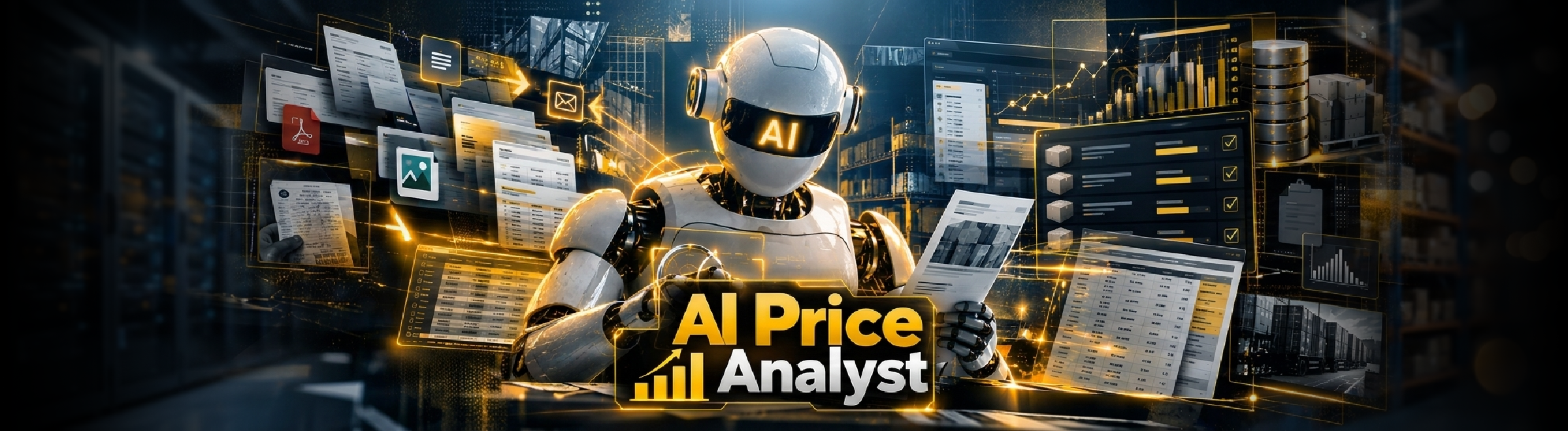
Tron Pool Energy has developed an AI agent that takes over this work: it automatically reads incoming CPs from suppliers in any format, extracts data on products and prices, links it to the CRM product database, and accumulates the history of offers for analytics. The procurement specialist makes the decision — the AI collects all the necessary information for this.
In this article: how this tool differs from other AI solutions in the blog, the full functionality of the agent, a practical case study, and an implementation FAQ.
1. Important Navigation: This is Not the Same as AI for Sales
The Tron Pool Energy blog has already covered AI tools for the sales department: CP generation for clients, AI co-pilot for replies in the CRM chat, AI support assistant. All of them work in the "company → client" direction. This article is about the opposite direction: "supplier → procurement department". Different departments, different processes, different analytics.
AI in sales vs AI in procurement: key differences
Parameter
AI in sales (previous articles)
AI in procurement (this article)
Data flow direction
Company → Client (outgoing)
Supplier → Company (incoming)
Department
Sales, support, presale
Procurement, supply
What AI processes
Client requests, briefs, replies
Offers, price lists, supplier conditions
Result
CP to client, reply, lead
Offer base, price history, analytics
Main metric
Reply speed, conversion
Optimal purchase price, savings
Decision maker
Sales manager
Procurement specialist
2. Why Manual Processing of Supplier CPs is a Systemic Problem
A company works with dozens and hundreds of suppliers. Each sends proposals in its own format and at its own pace. The procurement employee is forced to:
Open every email or message manually
Figure out the attachment format (PDF, Excel, scan, price photo)
Manually transfer product and price data into tables
Search for the required product in the database and match the names
Separately maintain a price history to compare dynamics
The result is predictable: errors during data transfer, lack of a unified offer base, procurement decisions are made based on the latest price list rather than accumulated analytics. Meanwhile, the most profitable purchase periods are determined intuitively, not based on data.
3. What the AI Agent Can Do: Full Functionality
3.1. Analysis of incoming CPs in any format
The agent is connected to the company's email and messengers. All incoming messages are analyzed automatically: the system determines whether the email or file is a supplier's commercial proposal. If not, it ignores it. If yes, it launches data extraction.
Formats of incoming CPs processed by AI
Format
Processing method
What is extracted
Text email / message
NLP — text analysis
Product name, price, supplier, date, conditions
PDF document
PDF parsing + NLP
All document fields, price tables, conditions
Excel / CSV table
Parsing structured data
Price list rows: article, name, price, volume
Image / price photo
OCR + NLP
Text recognition on photo, subsequent parsing
Scanned document
OCR + structuring
Text from scan, key fields extraction
3.2. Automatic matching with the CRM product database
After data extraction, the AI matches the product names from the CP with the company's product base in the CRM. Suppliers call the same product differently — the agent takes this into account: compares by keywords, articles, category. If the matching confidence is below the threshold, human-in-the-loop is triggered: the employee confirms or corrects the link.
3.3. Offer history and supplier table for each product
Every offer is attached to the corresponding product in the CRM. For each item, a table of all received proposals is formed: date, supplier, price, conditions. The specialist sees not just one latest proposal, but the full history of offers — who offered what, when, and at what price.
3.4. Price and seasonality analytics
Based on the accumulated database, the AI builds analytics for each product:
Price change charts: minimum, maximum, average price in dynamics
Supplier comparison: who offers the best conditions for a specific item
Seasonality analysis: periods of profitable purchases, price trends by season
Long-term trends: price increase or decrease for a product over a period
4. How the Agent Works: The Journey from Supplier CP to Analytics
Full CP processing cycle — 9 steps:
The supplier sends a CP. Email or messenger — it doesn't matter. The message with the attachment automatically enters the system.
The AI receives a notification. The agent launches the analysis process immediately after receipt.
Recognizing the document type. The system determines: is this a CP or a regular message? If regular, it ignores it.
Data extraction. The AI reads: product name, price, supplier, date, delivery conditions.
Matching with the CRM base. The agent searches for the corresponding product in the company's internal database.
Matching verification. If the AI's confidence is below the threshold, the task goes to an employee for confirmation.
Adding the offer. The CP is attached to the product in the CRM: date, supplier, price.
Updating statistics. The system recalculates analytics: average price, dynamics, range.
Procurement department makes a decision. The specialist sees the full picture of offers and analytics — and chooses the optimal supplier.
5. Case Study: Austrian Wholesale and Retail Company (Alcoholic Beverages)
Situation. An Austrian company deals in the wholesale and retail trade of alcoholic beverages. It works with a large number of suppliers — wineries, distributors, importers. Commercial proposals for products arrive daily in various formats: emails with PDF price lists, Excel tables, photos of price lists on WhatsApp, text messages. A procurement department of 6 people manually processed the incoming CPs: transferred data to Excel, matched it with the assortment, and kept a separate price record. Without a unified price history database, identifying profitable purchasing periods was based on the specific manager's experience, not on data.
What Tron Pool Energy implemented (8 weeks):
The AI agent is connected to the company's corporate email and WhatsApp Business.
It processes all formats of incoming CPs: PDF, Excel, images, scans, text.
Integrated with the internal CRM: every offer is automatically linked to a product item.
Accumulates the offer history for each product with the ability to compare suppliers.
Price analytics: dynamic charts with minimum, maximum, and average values, analysis of purchasing seasonality.
Results 3 months after launch
Metric
Before implementation
After implementation
Change
Processing time for 1 CP
15–30 minutes manually
< 2 minutes automatically
−90%
CPs processed per day
20–30 (team's manual limit)
100+ (no limits)
×3–5 capacity
Errors in data transfer
5–8% (human factor)
< 0.5% (employee check)
-85% errors
Availability of product price history
No (or in scattered tables)
Full history from day one
From zero to 100%
Time to find the best price
1–2 hours (searching tables)
Instantly (in CRM product card)
−95%
Identifying seasonal discounts
Intuitively
Based on analytics data
Qualitative shift
Additional effect: thanks to seasonality analytics, the company received data for the first time on which periods specific suppliers offer the most favorable conditions. This allowed them to adjust their procurement strategy and increase the volume of planned orders during optimal periods.
6. Who Needs an AI Agent for Processing Supplier CPs
Company profile and typical use cases
Company type
Problem
What the AI agent provides
Wholesale and distribution trade
100+ suppliers, different formats, no unified database
Automatic collection of all offers, unified price history
Retail and chains (FMCG)
Seasonal offers, price dynamics, tenders
Analytics of profitable purchase periods, supplier comparison
Manufacturing (raw materials)
Prices in PDF and Excel, manual transfer to ERP
Automatic data filling, matching with nomenclature
Construction and development
Tender proposals, estimates, subcontractor prices
Structuring of offers, item-by-item comparison
HoReCa and catering
Weekly price lists from 20–50 suppliers
Up-to-date prices for every menu item without manual reconciliation
Importers and agents
Offers in foreign languages, different currencies
Multilingual processing, conversion, and data unification
7. Honestly: Advantages and Growth Points
Pros and growth points of the AI agent for analyzing supplier CPs
Advantages
Growth points (resolved during implementation)
Processes any CP format: PDF, Excel, photo, scan, text
Price and seasonality analytics available in real time
For non-standard offers (complex conditions, discounts) — human check
Frees up purchasers for analytics, not data transfer
Requires regular updating of the product base in the CRM
Human-in-the-loop during uncertain matching
Multilingual CPs require additional tuning of language models
Bottom Line: Procurement Based on Data, Not Intuition
The decision on choosing a supplier must rely on data: price history, offer dynamics, seasonal patterns. As long as this data is collected manually, it is either incomplete or outdated. The AI agent turns the incoming flow of CPs from suppliers into a structured analytical database — automatically, in real time, without transfer errors. Tron Pool Energy implements such turnkey solutions: from setting up OCR recognition to full integration with your CRM and building analytical dashboards.
What if the supplier calls the same product differently than it is in our database?
This is exactly why the matching mechanism with human verification exists. The AI compares names by keywords, synonyms, articles, and categories. If the matching confidence is below a set threshold, the task is sent to the purchaser for confirmation. Once confirmed, the system remembers this match and will do it automatically next time.
How does this AI agent differ from the AI agent for generating CPs?
Fundamentally different direction: the AI agent for CP generation (described in blog article 17) creates documents that the company sends to its clients. This agent analyzes documents that suppliers send to the company. Different departments (sales vs. procurement), different tasks, different analytics — although both work with the term "CP".
Is it possible to work with CPs in foreign languages?
Yes. The language models the agent is built on support many languages. This is especially relevant for companies working with international suppliers. Additionally, currency conversion can be set up: the agent brings all prices to a single currency for proper comparison.
What happens if a supplier sends a CP with 200 items in one Excel file?
The agent processes multi-line price lists completely: it extracts data item by item, matches it with the CRM base, and attaches the offer to each corresponding product. Processing the file takes seconds — unlike hours of manual transfer.
How does the AI determine that an email is a commercial proposal and not a regular message?
The classification module analyzes the message content: presence of price lists, mentions of products and prices, attachments in characteristic formats. The agent ignores regular operational emails (confirmations, questions, agreements). The classification threshold is adjusted during implementation to fit the specific communication of a particular company.
TRX calculator
Find out how much you spend on commissions!
Enter your crypto wallet address and we'll calculate how much TRX you've spent on fees over the last 30 days.
ChatGPT can make things up because it doesn’t know your business. A RAG-powered AI agent knows your pricing, case studies, and internal procedures, delivering accurate answers in seconds.
How does artificial intelligence help sales teams close more deals in less time? We explore how an AI agent automates information search, prepares responses and sales proposals, supports managers during presales, and reduces routine work with clients.
An AI assistant for customer support helps businesses respond to inquiries 24/7, qualify leads, create tickets, and automate presales. We explore the key use cases, integration channels, a SaaS company case study, implementation results, and the steps to launch an AI assistant.






 English (EN)
 Русский (RU)
 Українська (UK)
 español (ES)
 Türkçe (TR)