 English (EN)
 Русский (RU)
 Українська (UK)
 español (ES)
 Türkçe (TR)



How to Build a Successful AI Startup Based on AI Agents in 2026
An AI agent finds clients, creates demos, and closes deals without human involvement. How to build a startup like this in 2026: principles and real-world ideas.
2026-05-21
107





Support
Authorization is required only to use the service «Team energy»
Ваш аккаунт заблокирован. За детальной информацией обращайтесь в службу поддержки.
Enter the e-mail you provided during registration and we will send you instructions on how to reset your password.
An error occurred while processing your request. Please try again later. If the problem persists, please contact our support team.
Lean Canvas: One Page Instead of a 30-Page Business Plan. How to Find Out in One Evening Whether Your Idea Has the Potential to Become a Real Business.
Most startups fail not because people are lazy or "the idea wasn't brilliant enough."
Usually, the problem is much more mundane: founders start building the product before they understand who actually needs it.
A person comes up with an app, service, or platform, gets inspired by their idea, and immediately jumps into development:
And a few months later, an unpleasant truth emerges: the market wasn't waiting for this product.
Lean Canvas was created precisely as a way to avoid this trap. It is a simple tool that helps you quickly organize your business idea, check for weak spots, and understand whether the idea has a chance of becoming a real business.
And most importantly—to do this before incurring major costs in time and money.
Lean Canvas is a one-page business model diagram for a startup.
It was created by Ash Maurya as an adaptation of the classic Business Model Canvas, specifically tailored for startups and new projects.
Unlike a traditional 30-page business plan, Lean Canvas helps you quickly answer the main questions:
The main value of Lean Canvas is that it forces you to look at your startup soberly, rather than through the lens of "I think this is a cool idea."
Most novice entrepreneurs make the exact same mistake: they think about the product's features before thinking about the customers' problems.
For example:
But this is not a business idea yet. It's just a description of a tool.
Lean Canvas helps shift the focus to what matters most:
Sometimes, after filling out the Canvas, it turns out the idea is weak. And that is a good result.
It's better to realize this in one evening than after a year of development.
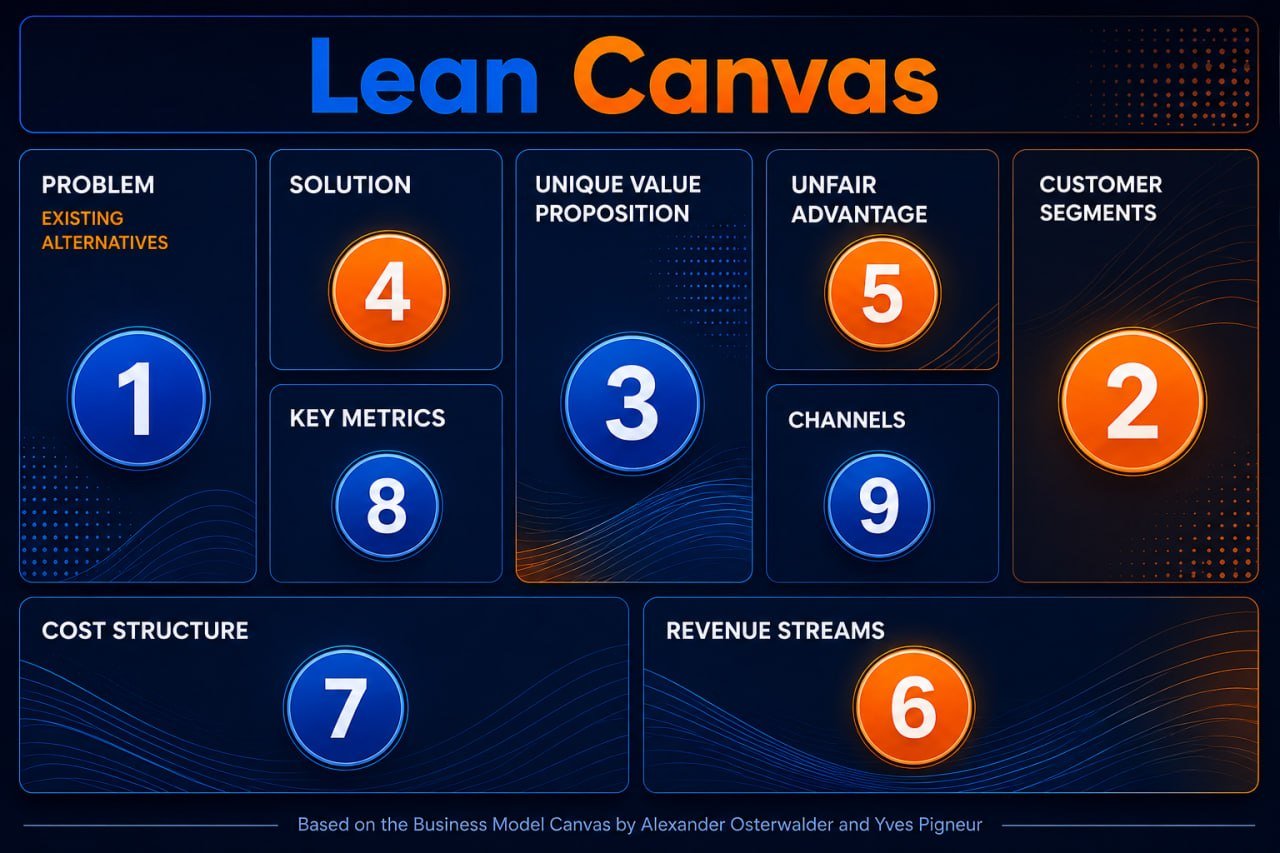
1. Problem
The first block is the most important.
You need to identify 1–3 specific problems the customer has.
This is where many people make mistakes. They write too vaguely:
These are not problems. These are general statements.
A good problem usually:
It's also important to list existing alternatives.
If a problem has no solutions at all, that's not always a good thing. Sometimes it means the problem isn't important enough.
Control question: What real customer pain points are we solving right now?
2. Customer Segments
Now you need to understand who has this problem.
A common mistake is trying to make a product "for everyone." When a product suits everyone, it usually means nobody needs it.
You must highlight a specific audience and, especially, Early Adopters.
These are people who:
Bad example: "Our service is needed by businesses."
Good example: "Small e-commerce stores with a monthly turnover of up to $50,000."
Control question: Who will want to try our product first?
3. Unique Value Proposition (UVP)
This is a short answer to the question:
"Why should a customer choose you?"
No complex phrasing or marketing fluff.
Bad UVP: "an innovative next-generation AI ecosystem."
Normal UVP: "A TRON energy rental service that reduces USDT TRC-20 fees without freezing TRX."
The more specific, the better.
Control question: What clear benefit does the customer get?
4. Solution
Only now can you talk about the product.
And this is a crucial point: Lean Canvas intentionally places the "Solution" block after the "Problem" block.
Because most startups do the exact opposite.
At this stage, you don't need to detail dozens of features. The core mechanics are enough:
Control question: How exactly does the product solve the customer's problem?
5. Channels
Even a good product is useless if no one knows about it.
Here you need to determine:
These can include:
A beginner's mistake is to list all channels at once.
At the start, it's better to focus on 1–2 traffic sources.
Control question: How will we get our first customers?
6. Revenue Streams
Now—the money.
You need to honestly answer:
Options can vary:
If the monetization looks vague, it's a red flag.
Control question: How exactly does the business make money?
7. Cost Structure
Many people vastly underestimate launch costs.
Especially:
It is crucial to understand: a startup might look profitable "on paper" but collapse due to unit economics.
Control question: What costs will arise first?
8. Key Metrics
If you don't understand which metrics matter, you don't know if the business is growing.
For a startup, the following are usually important:
The mistake is to only look at likes, views, and "interest."
Interest doesn't always translate into money.
Control question: What numbers will show us we are moving in the right direction?
9. Unfair Advantage
This is the most unpleasant block in the Lean Canvas.
Because this is where it becomes clear whether the project actually has a strong edge.
Bad options:
These are not advantages. Competitors can do that too.
A true unfair advantage is something that is hard to copy quickly:
Sometimes the honest answer here is:
"Right now, there is no advantage."
And that's okay.
Control question: What will be difficult for competitors to replicate?
Let's assume you are launching a booking service for private dentists.
Unfair Advantage: Partnerships with local clinics and a patient review database.
It is important to understand: Lean Canvas does not guarantee startup success.
It simply helps you see the weak spots of your idea faster.
Sometimes after filling it out, it becomes obvious that:
And that is completely normal.
A bad idea discovered early is much more useful than a beautiful illusion you've already poured months of work into.
Lean Canvas is one of the best tools for validating a business idea at an early stage.
It helps you:
The main thing is to approach it honestly.
Don't try to "prove the idea is brilliant," but actively look for weak spots. Because that is exactly what distinguishes real business building from startup fantasies.
Once the idea has passed the initial check, the next stage is an MVP and testing on real users. We help with the development of IT products: from Telegram Mini Apps to full-fledged web services.
Sometimes a 15-minute discussion saves months of unnecessary development. If you want to break down an idea or understand the best way to approach a launch—reach out to our support team.
Lean Canvas is a one-page diagram for describing a startup's business model. It helps quickly validate an idea, understand customer problems, and spot project weaknesses without writing a complex business plan.
A business plan is a large, detailed document often created for investors or an already operating business. Lean Canvas is needed for rapid idea testing and can change as the startup evolves.
Lean Canvas is suitable for startups, aspiring entrepreneurs, online services, mobile apps, and any new projects. It is especially useful for those who want to test an idea before investing heavily in development and advertising.
Most often, entrepreneurs describe the problem too vaguely, try to make a product "for everyone," and don't understand how they will make money. Another common mistake is focusing on product features instead of real customer problems.
Yes, Lean Canvas helps structure the idea and see risks even before the product is launched. It is one of the easiest ways to test a startup's viability without spending a lot of time and money.
The most important blocks are the Problem, Customer Segments, and Value Proposition. If people don't have a strong pain point or aren't willing to pay for a solution, even a great product might end up being useless to everyone.
Yes, Lean Canvas is suitable not only for startups but also for operating companies. You can use it to test new products, find growth points, and review your current business model.

How to Build a Successful AI Startup Based on AI Agents in 2026
An AI agent finds clients, creates demos, and closes deals without human involvement. How to build a startup like this in 2026: principles and real-world ideas.
2026-05-21
107

FoxWallet: Using USDT in the TRON Network
How to use USDT TRC-20 in FoxWallet: where to find your TRON address, how to receive transfers, and send USDT without extra fees.
2026-03-02
137

What Telegram Bots Can Be Built with Cocoon: Practical Use Cases for Durov’s Private AI
Data privacy has become a new competitive advantage. Cocoon + Telegram: use cases for legal, HR, healthcare, finance, and crypto.
2026-05-09
172

Reduce USDT TRC-20 transaction fees for frequent transfers from a single wallet with no time limits

Quick activation for one-time and occasional USDT TRC-20 transfers

Fund a shared balance and distribute TRON Energy and Bandwidth across multiple wallets

Automatic TRON Energy delegation for exchanges, swap services, and payment platforms

Quick access to Tron Pool Energy services directly in Telegram

Fast USDT TRC-20 to TRX swap, no exchange or registration required

Get all the benefits of Telegram at up to 15% less than through the App Store and Google Play

Gifts, reactions, and digital content with USDT TRC-20 — no registration required

Get a custom TRON address with your name, brand, or nickname