For seafarers, money transfers are more than transactions — they’re a way to care for loved ones. In this article, we explore the best transfer options, from banks to modern digital tools.
Content
A sea contract lasts for months, home is far away, and the family expects regular support. Transfers for seafarers become part of the routine—like watches and scheduled communication. It’s important that funds arrive in full and on time, without overpayment or surprises. We’ll figure out how seafarers send money home, where fees hide, and how to keep more of what’s honestly earned.
Key points of the article
How to choose a transfer method that fits your family’s real situation.
How to calculate fees and avoid losses on conversion and delays.
How to use the TRON network to make payments cheaper.
Over a year, you can unwittingly give up a significant amount in fees, especially if transfers are regular and large. Many seafarers know how to send money home from a voyage, but don’t notice that tens of dollars are lost to fees.
This article was prepared together with the JobMarineman team—the largest job-matching portal for seafarers. We collected real examples and tips on how to send money home safely and without unnecessary losses.
Popular ways to send money and their pitfalls
There are many ways to send money home, each with its pros and pitfalls. It’s important to choose an option that’s convenient and doesn’t eat into your earnings through fees. Promises of international transfers without fees often turn out not entirely true, because part of the costs is hidden in the exchange rate or additional charges.
Everyone wants transfers without intermediaries to go smoothly and without delays, but you need to look carefully at tariffs and limits so that the money reaches your family in full.
Bank transfers
This is the most familiar method, especially if salary is credited to an account via SWIFT or SEPA. The fee often reaches 3–5%, and currency conversion adds extra costs. Funds take 2–5 business days, and sometimes both the sender’s and the recipient’s banks charge a fee on their respective sides.
As a result, the family receives less than expected. It’s better to check the rate in advance and verify whether there are any intermediary banks—then the transfer will arrive without unnecessary losses.
Western Union and MoneyGram
A good solution if the family doesn’t have a bank account and needs to quickly receive cash. Everything seems simple, but the rate and fees make this one of the most expensive options. Total costs often reach 3–7%, and sometimes a fixed amount of $10 to $30 is added.
Before sending, carefully check the tariffs and the exchange rate, and also choose the currency in which the family will receive the money. Otherwise, part of the amount will go to conversion, and the real loss will be greater than planned.
Cash via colleagues
At first glance this is free, but in reality it’s the riskiest path. Formally the fee may be 0%, but the real price of such transfers is the risk of loss, theft, or an error in the amount. There’s no confirmation or operation history, so in case of a shortfall it’s hard to prove anything.
For a family waiting to pay for housing or school, such a handover turns into a lottery with an unpredictable outcome. It’s better to use methods that leave a transparent trail and provide exact confirmation of receipt.
Crypto transfers (USDT TRC-20)
Today more and more seafarers are switching to USDT TRC-20 transfers—this is a modern way to send money to family without banks and intermediaries. Transfers over the TRON network are completed within seconds, regardless of country, time of day, or weekends. The USDT transfer fee is known in advance and doesn’t depend on the amount, which is especially convenient for regular payouts.
To send USDT TRC-20, you only need the recipient’s wallet address that starts with the letter T. The system automatically charges the TRC-20 fee—this is the internal payment for the TRON network’s operation, usually 6,77–13,37 TRX (at the current rate of 1 TRX = $0.34, that’s roughly $2–4). The amount is predictable, so seafarers can easily plan expenses and see every operation right in the crypto wallet.
Such a fast USDT transfer lets you send money without country or currency restrictions. Funds arrive directly, without bank calls and unnecessary formalities. For the family ashore, this is a reliable way to receive support on time, even when the sender is at sea.
If you need cash, USDT crypto transfers can be easily exchanged into local currency—via online exchangers, official P2P platforms, or trusted services. Many note that it’s no more complicated than regular online banking, just without delays and hidden charges.
Thus, bankless transfers over the TRON network are becoming a familiar tool for seafarers: everything is transparent, fees are known in advance, and control over money is entirely in your hands.
Comparing different money transfer methods available to seafarers
Method
Average fee
Transfer time
Limits & convenience
Risks & downsides
Who it suits
Bank transfer (SWIFT / SEPA)
2–5% + possible FX conversion
1–5 business days
Bank accounts needed for both sides
High fees, delays, possible blocks
For those whose salary goes directly to an account
Western Union / MoneyGram
3–7% (sometimes fixed $10–30)
5 min – 24 hrs
Can send without an account, but recipient must visit a location
Expensive rate, manual cash-out, data entry errors
If the family has no card or account
Cash handover via colleagues
0% formally
Depends on voyages
No fees, but unofficial
Loss, theft, unverifiable amount, no confirmation
Only with complete trust
Crypto transfer USDT TRC-20 (fee in TRX)
6,77–13,37 TRX (~$2–4) per transfer
5–10 seconds
24/7, borderless, no banks
Need basic crypto skills, keep TRX balance
For everyone
Crypto transfer USDT TRC-20 with Tron Pool Energy
3–6TRX (~$1–2) per transfer
5–10 seconds
Instant activation, ~80% fee savings
Requires learning a simple service interface
For those who want to keep more
Let’s compare the options by key criteria to choose a solution tailored to your family and voyage schedule. The table will help you quickly assess cost, speed, and convenience, and then you can draft a personal transfer plan for the month ahead.
USDT is always roughly equal to one US dollar, so the family receives a clear and stable amount. Transfers follow the TRC-20 standard on the TRON network, where everything works quickly and without delays. With each send, TRX (the internal coin of the Tron blockchain) is charged by default—this is the fee for network operation.
Useful safety rules
Always double-check the first and last characters of the recipient’s address—an erroneous transfer cannot be returned.
Make sure the correct network is selected; a TRC-20 address does not match other networks.
Make a small test transfer before a large one—it’s more reassuring for everyone.
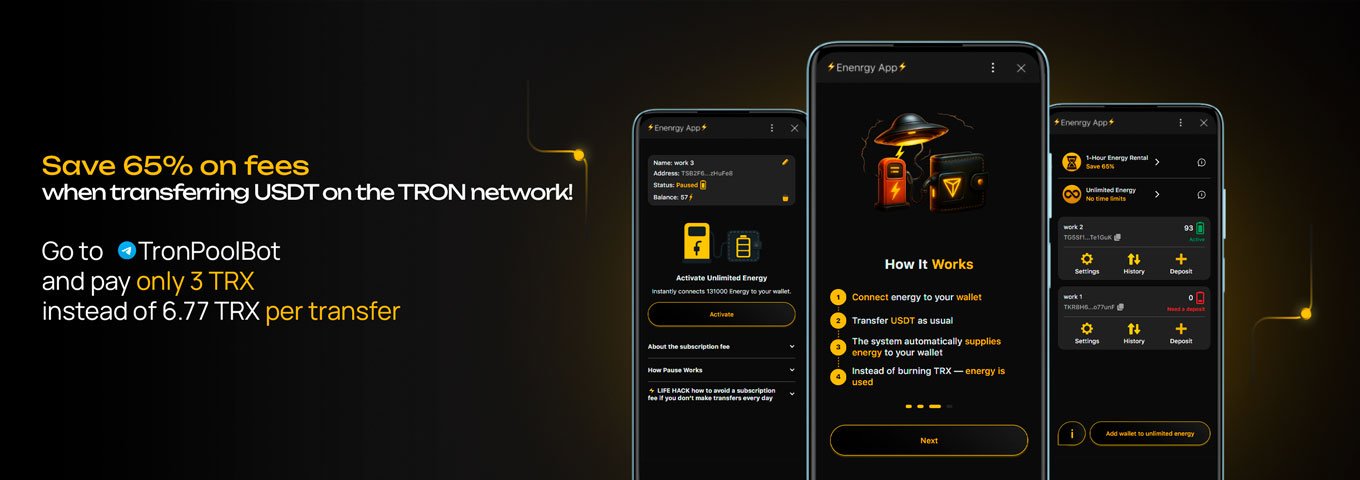
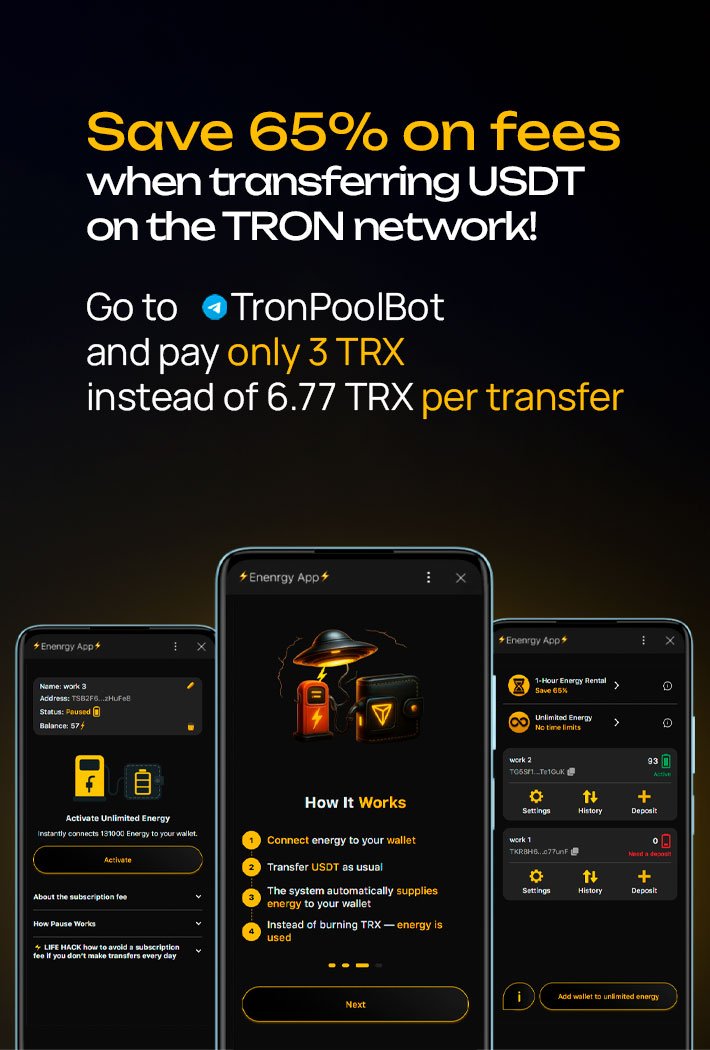
Many face the question of how to send USDT without TRX if there’s none in the wallet. The solution is simple—use the Tron Pool Energy service.
The company’s operating principle is based on using the Tron blockchain’s official internal resources, and the transfer fee is reduced by more than half.
If you’re just starting and want to understand how everything works, check out our guide “How to create your first USDT TRC-20 wallet”—it shows, step by step, how to install a wallet, connect the TRON network, and make your first transfer.
If you already have USDT in your wallet but no TRX, write to our support—we’ll help you make the transfer. Note that our operators never ask for your seed phrase or private keys, which grant access to your funds. A public wallet address (starting with T…) is sufficient.
How to make transfers as cheaply as possible
The simplest way to pay fees on the TRON network is to buy and burn TRX with each transfer. But there’s a more cost-effective option. Instead of constant purchases, you can use the blockchain’s internal resources—TRON Energy and Bandwidth. These resources do the same job but let you avoid burning coins and extra expenses.
To avoid buying TRX for every send, many users choose renting Energy via Tron Pool Energy. In this case, transfers go through without gas costs, and the TRC-20 fee becomes significantly lower. This approach is especially beneficial for seafarer transfers that are made regularly and aim to preserve more of the earned funds.
If you already have a wallet and use crypto, just try the Tron Pool Energy calculator. It shows how much TRX your transfers currently consume and how much you can save by activating Energy. This helps plan expenses in advance and control the budget.
Advantages of renting TRON Energy
the TRC-20 fee drops by roughly 80%;
transfers over the TRON network proceed without burning TRX;
Energy and Bandwidth resources activate instantly;
it’s convenient to plan transfers in advance and not worry about topping up the wallet.
For seafarers, this is not just a way to save, but a tool for confidence that funds arrive without delays and intermediaries. This approach makes transfers over the TRON network simple, fast, and cost-effective even with frequent sends. It helps keep the rhythm of payouts stable and protects against unexpected expenses.
Conclusion
Seafarers work in tough conditions, far from home and family. Each of their transfers is not just a transaction, but care for loved ones, school fees for children, help for parents—the life that continues ashore.
That’s why it’s so important that honestly earned money arrives in full, without extra fees and intermediaries.
Modern technology already allows sending funds directly—fast, safe, and transparent. The main thing is to understand how such transfers work and choose the method that truly works for you.
If you’re hearing about transfers over the TRON network for the first time or don’t know where to start, our team is always ready to help. We’ll explain how fees, Energy, and wallets work, and show how to set everything up without mistakes.
Contact support—and you’ll be able to send money home with confidence, without overpaying and without unnecessary complications.
Share
Did you like the article?
TRX calculator
Find out how much you spend on commissions!
Enter your crypto wallet address and we'll calculate how much TRX you've spent on fees over the last 30 days.
Top-10 and Top-50 altcoins — from Ethereum and Solana to Chainlink and NEAR. We break down which cryptocurrencies lead the market and how to choose promising tokens.





 English (EN)
 Русский (RU)
 Українська (UK)
 español (ES)
 Türkçe (TR)