Complete guide to Stake 2.0 on TRON: how to get Energy and Bandwidth, delegate resources, and reduce fees without burning TRX.
Content
On the TRON network, transaction fees are not paid directly but through network resources — Bandwidth and Energy. If there are no resources on the wallet, the network automatically burns TRX. One of the key ways to obtain these resources without burning coins is TRX staking.
Stake 2.0 is the current staking model on the TRON blockchain, which replaced the outdated Stake 1.0 and became the network standard. Through Stake 2.0, users receive Bandwidth, Energy, and TRON Power — three key elements of the entire TRON economic model.
In this article, we will examine in detail: how Stake 2.0 works, what happens when TRX is frozen, how delegation, unstaking, and voting work, and why this model is fundamentally better than the previous version.
What Is Stake 2.0
Stake 2.0 is an updated TRX staking mechanism that serves as the standard for the TRON network. The concept is simple: you temporarily lock (freeze) your TRX and in return receive network resources.
When staking, you do not spend TRX — you lock them. TRX remain your property and can be unlocked at any time (with a 14-day waiting period). In return, you receive resources that replace the fee.
Key Principle
When staking TRX in Stake 2.0, you simultaneously receive:
— A network resource (Bandwidth or Energy — your choice);
— TRON Power (TP) — voting power for participating in network governance;
— Delegation capability — the ability to transfer resources to other accounts without transferring coins.
Resources are credited instantly after freezing. There is no need to wait — you can use Bandwidth or Energy right away.
Three Resources Provided by Staking
1. Bandwidth
Bandwidth is the basic resource for transmitting and storing transaction data. It is required for any operation on the network: transferring TRX, sending USDT TRC-20, delegation, voting. 1 byte of a transaction = 1 unit of Bandwidth.
Each account receives 600 units of Bandwidth per day for free. Staking allows you to obtain more — proportional to your share of the total stake on the network.
Your Bandwidth = (your TRX staked for Bandwidth / all TRX staked for Bandwidth on the network) × 43,200,000,000
Bandwidth Calculation Formula
The daily Bandwidth pool of the TRON network is 43.2 billion units (network parameter #62).
2. Energy
Energy is a computational resource for executing smart contracts. It is the main cost when transferring USDT TRC-20, interacting with DeFi, NFTs, and dApps. 1 unit of Energy = 1 millisecond of TVM CPU time.
Important
Energy has no free daily quota. If there is no Energy on the wallet, the network automatically burns TRX at a rate of 0.0001 TRX per unit. Staking is one of the ways to obtain Energy without burning.
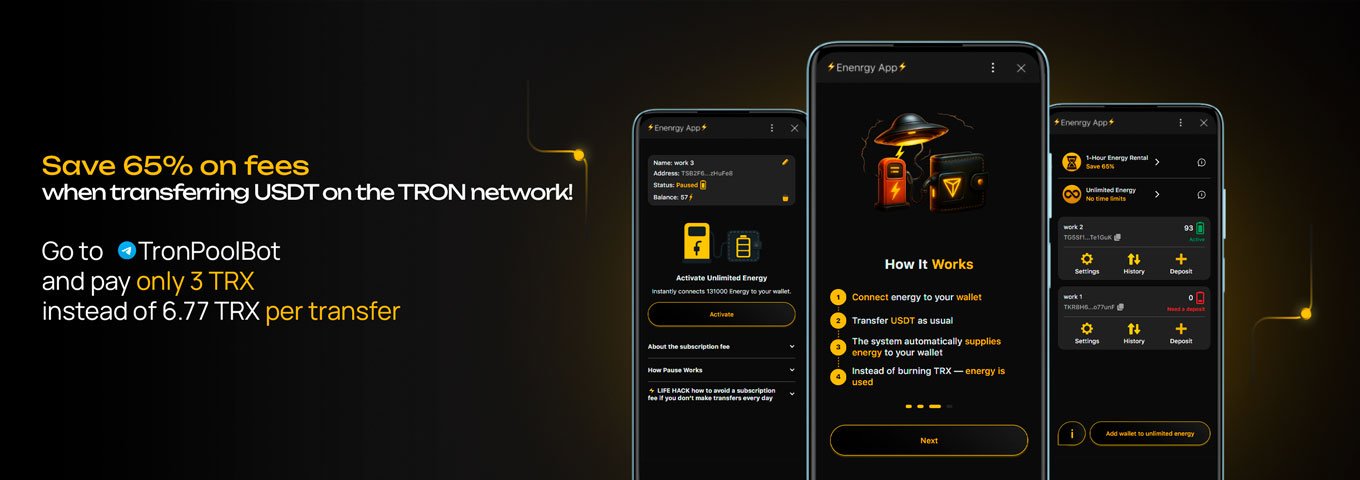
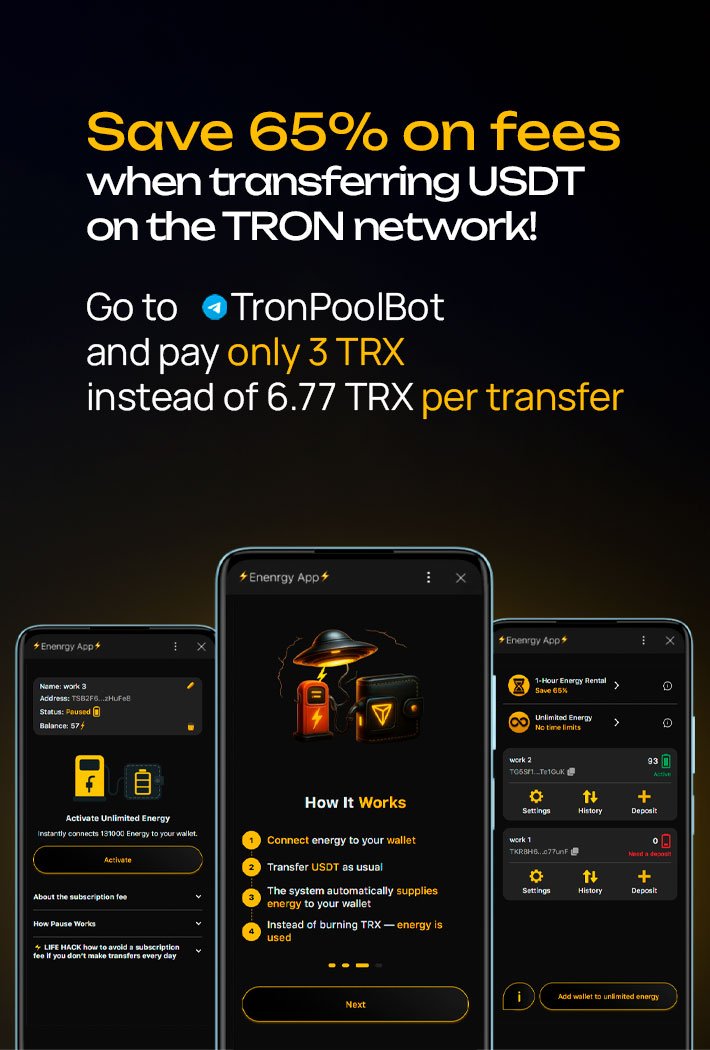
Save 65% on USDT transfer fees, enjoy secure connection and full automation — Tron Pool Energy activates energy in seconds, lets you forget about your TRX balance, and is perfect for frequent transfers.
Your Energy = (your TRX staked for Energy / all TRX staked for Energy on the network) × 180,000,000,000
Energy Calculation Formula
The daily Energy pool of the TRON network is 180 billion units (network parameter #19).
3. TRON Power (TP)
TRON Power is voting power in the TRON network governance system. TP is credited automatically with any staking, regardless of the chosen resource (Bandwidth or Energy).
1 staked TRX = 1 TRON Power.
TRON Power is used to vote for Super Representatives (SR) — 27 nodes that produce blocks and manage network parameters. By voting for SRs, you can receive a share of block production rewards.
Resource
Purpose
Free Quota
Daily Network Pool
Bandwidth
Transaction data transmission
600 units/day
43.2 billion
Energy
Smart contract execution
None
180 billion
TRON Power
Voting for SRs
None
= stake volume
How Staking Works in Stake 2.0: Step by Step
Step 1: Choosing a Resource
When staking, you specify which resource you want to receive — Bandwidth or Energy. This is important: a single staking operation provides only one type of resource. If you need both — perform two separate staking operations.
TRON Power is credited automatically in both cases.
Step 2: Freezing TRX
You send a FreezeBalanceV2 transaction, specifying the amount of TRX and the resource type. TRX are deducted from your balance and transferred to a frozen state. They remain on your account but are unavailable for transfers.
Step 3: Receiving Resources
Resources are credited instantly after the transaction is confirmed. The amount depends on your share of the total network stake — the more TRX you freeze, the more resources you receive.
Step 4: Usage
The received resources are consumed when executing transactions. Consumed Bandwidth and Energy recover linearly over 24 hours.
Step 5: Delegation or Usage
You can use the resources yourself or delegate them to another account. More details on delegation are in the next section.
Staking is available through TronLink (browser extension and mobile app), Trust Wallet, SafePal, Tronscan (the “Stake 2.0” section), as well as programmatically via the API: wallet/freezebalancev2.
Where to Perform Staking
Resource Delegation in Stake 2.0
Delegation is one of the key advantages of Stake 2.0. You can transfer your Bandwidth or Energy to another account without transferring the TRX themselves.
How It Works
You stake TRX and receive a resource (Bandwidth or Energy).
Through a Delegate Resource Contract transaction, you transfer the resource to another address.
The recipient uses the delegated resource for their transactions.
You revoke the resource at any time through an UnDelegate Resource Contract.
If you have delegated Bandwidth or Energy to another wallet, the recipient cannot re-delegate these resources further. Delegated resources are available for use only — they can be spent on transactions and smart contract execution but cannot be transferred to third parties.
Note
Delegation Rules
Rule
Description
What can be delegated
Only Bandwidth and Energy
TRON Power
Cannot be delegated
Recipient requirement
Account must be activated
TRX transfer
No — TRX remain with the owner
What can be delegated
Only unused resources
Delegation cost
~281–283 Bandwidth per transaction
Delegation with Timelock
Stake 2.0 allows you to set a lock_period — a time during which the delegation cannot be revoked. The period is specified in blocks (1 block ≈ 3 seconds).
— business partnerships — predictable resource provision;
— contractual obligations — automatic enforcement at the blockchain level.
Delegation without a timelock (lock_period = 0) allows the resource to be revoked immediately.
Revoking Delegation and Resource Reclamation
When revoking delegation (UnDelegateResource), resources are returned to the owner. However, there is an important nuance — reclamation:
Resource Reclamation
If the recipient has consumed part of the delegated resource, upon revocation a proportional share is reclaimed (deducted) from the owner. Resources recover linearly over 24 hours.
TRX can be withdrawn from staking at any time — but not instantly. Stake 2.0 provides a 14-day waiting period.
Unstaking Process
Step 1. You send an UnfreezeBalanceV2 transaction, specifying the amount of TRX to unfreeze.
Step 2. Resources (Bandwidth/Energy) and TRON Power corresponding to that amount are immediately revoked.
Step 3. TRX enter a 14-day waiting state.
Step 4. After 14 days, you can withdraw TRX to your balance via a WithdrawExpireUnfreeze transaction.
Parameter
Value
Waiting period
14 days (network parameter #70)
Max. parallel unstakes
32 operations simultaneously
Delegated TRX
Cannot be unstaked while delegation is active
Unstaking cancellation
Possible via CancelAllUnfreezeV2
Resources after unstaking
Revoked immediately
TRON Power
Revoked proportionally, votes are removed automatically
Cancelling Unstaking
If you change your mind, you can cancel all pending unstaking operations via a CancelAllUnfreezeV2 transaction. TRX will return to the frozen state, and resources and TRON Power will be restored.
This is useful if you accidentally initiated an unstake or your resource needs have changed.
What Happens to Votes During Unstaking
During unstaking, the corresponding amount of TRON Power is revoked. If you have already voted with that TP, the votes are automatically removed.
Mechanics: if there is enough free (unused) TRON Power, it simply decreases. If not, votes are proportionally removed from all SRs you voted for.
Stake 2.0 and Voting for Super Representatives
Each staked TRX provides 1 TRON Power, which can be used to vote for Super Representatives (SR). SRs are the 27 nodes that produce blocks and manage the parameters of the TRON network.
Why Vote
Network governance.
SRs vote on proposals to change network parameters: Energy price, Bandwidth pool size, unstaking period, and others.
Rewards.
SRs receive rewards for block production: 16 TRX per block (8 TRX block reward + 8 TRX voting reward) and 160 TRX in voting rewards for the 27 SRs. SRs distribute a portion of the rewards among their voters.
Ecosystem support.
By voting for reliable SRs, you support the stability and development of the network.
How to Vote
Stake TRX (Bandwidth or Energy — it doesn’t matter, TP is credited in both cases).
Go to the voting section (TronLink → Vote, or Tronscan → Voting).
Select one or more SRs and distribute your votes (TP).
Confirm the transaction. Votes are counted in the next maintenance cycle (every 6 hours).
Vote counting and SR elections occur every 6 hours (4 times per day). Cycle starts are at 00:00, 06:00, 12:00, 18:00 UTC. The results determine which 27 nodes will produce blocks until the next cycle.
Maintenance Cycle
How Much TRX to Stake: Practical Calculations
The amount of resources you receive from staking depends on your share of the total network stake. The more other users stake, the fewer resources each TRX provides.
Here are approximate calculations for typical tasks:
Energy (for USDT TRC-20 transfers)
Task
Energy Required
Approximate Stake*
1 USDT transfer (address with USDT)
~65000
~7,000 TRX
1 USDT transfer (new address)
~130,000
~14,000 TRX
5 USDT transfers per day
~325,000
~35,000 TRX
20 USDT transfers per day
~1,300,000
~140,000 TRX
* approximate values, depending on the current stake volume on the network. Up-to-date data is available at tronscan.org.
Bandwidth (for data transmission coverage)
Task
Bandwidth Required
Coverage
1 TRX transfer
~268
Free 600 units/day
1 USDT transfer
~345
Free 600 units/day
2+ USDT transfers
~690+
Staking or burning required
As you can see, staking for Energy requires significant amounts. For most regular users, renting Energy is more cost-effective than freezing capital. Staking is optimal for those who already hold TRX long-term.
Differences Between Stake 2.0 and Stake 1.0
Stake 2.0 replaced the outdated Stake 1.0 model and solved several fundamental problems:
Parameter
Stake 1.0
Stake 2.0
Resource delegation
Limited (1 address)
Full-featured (multiple addresses)
Delegation timelock
None
Available (configurable)
Management flexibility
Low
High
Partial unstaking
No (full only)
Yes (any amount)
Parallel unstakes
No
Up to 32 simultaneously
Unstaking cancellation
No
Yes (CancelAllUnfreezeV2)
Resource reclamation
No
Proportional
Relevance
Outdated
Network standard
Key Improvements of Stake 2.0:
Flexible delegation.
In Stake 1.0, resources could only be delegated to one address during staking. In Stake 2.0, they can be delegated to any number of addresses at any time, independently of staking.
Partial unstaking.
In Stake 1.0, you had to unfreeze the entire amount at once. In Stake 2.0, you can unstake any portion.
Timelock.
The ability to lock delegation for a specific period is the foundation for Energy rental services.
Stake 1.0 is still supported by the network for backward compatibility, but all new staking operations are recommended to be performed only through Stake 2.0.
Important
Stake 2.0 and Multi-Signature
If your account uses multi-signature, there is an important nuance: accounts activated before the implementation of Stake 2.0 may not have permissions for Stake 2.0 operations in their permission settings.
Symptom: when attempting to execute FreezeBalanceV2, DelegateResource, or other Stake 2.0 operations, you receive a “Permission denied” error.
Solution: update your multi-signature settings via TronLink or API, adding the new Stake 2.0 transaction types to the operations field of your Active permissions.
API for Working with Stake 2.0
The following API endpoints are available for developers and automation:
Operation
API Endpoint
Description
Staking
wallet/freezebalancev2
Freezing TRX to receive resources
Unstaking
wallet/unfreezebalancev2
Initiating the 14-day unfreezing period
TRX withdrawal
wallet/withdrawexpireunfreeze
Withdrawing TRX after the period ends
Unstake cancellation
wallet/cancelallunfreezev2
Cancelling all pending unstakes
Delegation
wallet/delegateresource
Transferring a resource to another address
Delegation revocation
wallet/undelegateresource
Returning a resource from the recipient
All operations are also available through TronWeb (JavaScript SDK) and Trident (Java SDK). A TRON-PRO-API-KEY is required for TronGrid public nodes.
Practical Recommendations
For Regular Users
If you hold TRX and periodically transfer USDT, stake a portion of your TRX to receive Energy. Even a small stake reduces fees. The remaining demand can be covered by renting Energy.
Don’t forget to vote for SRs — this is additional income on top of staking.
For Active Traders
Calculate your daily Energy needs and decide: staking or renting. Staking is beneficial when you have available capital in TRX. Renting is better if TRX are needed for trading and freezing is unacceptable.
Use staking for Bandwidth if you make more than 2 transactions per day — the free 600 units will not be enough.
For Businesses
With dozens or hundreds of operations per day:
— centralize staking on a single account and delegate resources to operational wallets;
— use timelocks for delegations that must be guaranteed;
— separate wallets: TRX storage (staking + delegation) and operational wallets (receiving resources);
— monitor reclamation: when revoking delegation, consider that some resources may be temporarily unavailable;
— combine staking and Energy rental for an optimal balance of cost and flexibility.
Staking vs Energy Rental: What to Choose
Parameter
TRX Staking
Energy Rental
Initial investment
Need to buy TRX
Rental payment only
Liquidity
TRX locked (14 days)
TRX are free
Energy volume
Depends on amount and network share
Fixed, on demand
Additional income
TRON Power + SR rewards
None
Flexibility
Changes after 14 days
Instant adjustment
TRX volatility risk
Yes
Minimal
Suitable for
Long-term TRX holders
Everyone else
Optimal strategy: if you already hold TRX, stake and receive resources + rewards. If TRX are needed for other purposes or you don’t want to freeze capital, rent Energy. Many businesses combine both approaches.
Summary
Stake 2.0 is the foundation of the TRON economic model. Here are the key points:
Staking = locking, not spending.
TRX remain yours and are returned after 14 days.
Three resources simultaneously:
Bandwidth or Energy (your choice) + TRON Power (always).
Instant crediting.
Resources are available immediately after staking.
Flexible delegation.
Bandwidth and Energy can be transferred to others without transferring TRX.
Unstaking — 14 days.
Up to 32 parallel operations, cancellation is possible.
Voting and rewards.
TRON Power gives voting rights for SRs and additional income.
What is TRON Energy and how does it help save on USDT TRC-20 transfer fees? We explain how to use TRON ENERGY instead of burning TRX: rental, staking, and transaction packages.





 English (EN)
 Русский (RU)
 Українська (UK)
 español (ES)
 Türkçe (TR)