 English (EN)
 Русский (RU)
 Українська (UK)
 español (ES)
 Türkçe (TR)



Lean Canvas: How to Validate a Business Idea Before Wasting Months on It
Lean Canvas: One Page Instead of a 30-Page Business Plan. How to Find Out in One Evening Whether Your Idea Has the Potential to Become a Real Business.
2026-05-25
169





Support
Authorization is required only to use the service «Team energy»
Ваш аккаунт заблокирован. За детальной информацией обращайтесь в службу поддержки.
Enter the e-mail you provided during registration and we will send you instructions on how to reset your password.
An error occurred while processing your request. Please try again later. If the problem persists, please contact our support team.
A jacket, dress, cap, or sneakers—customers build them themselves and see the result instantly. We break down how online configurators are changing the economics of the fashion business.
Today’s shopper arrives at an online store with high expectations: they don’t just want to look at a product — they want to feel like it’s already theirs. Yet most online storefronts offer the same thing: static photos from two or three angles and a size chart. The result is predictable: hesitation, abandoned carts, and record-high return rates.
The solution is a 2D/3D clothing and footwear configurator. This tool lets customers build their own product — choosing material, color, cut, and hardware — and instantly see the result in an interactive visualization. Tron Pool Energy develops these configurators for fashion brands, online retailers, and manufacturers across any niche and budget.
A configurator is a web application embedded in a website or mobile app, where the user customizes a product in real time. Depending on the business’s needs, it is implemented in one of two formats.
2D Configurator
Works with a flat image of the product. The user changes the color, texture, or print — and sees the result on a static model. It integrates quickly into any website, puts minimal load on the browser, and is ideal for straightforward customization.
Example: an online corporate t-shirt store implemented a 2D configurator where the purchasing manager selects a color, uploads the company logo, and immediately sees a mockup of the finished product. The number of client approval rounds dropped from 5–7 iterations to just 1–2, and the time from order to production was cut in half.
3D Configurator
Provides full three-dimensional visualization: the model can be rotated, viewed from any angle, modified in real time, and placed on a virtual mannequin. Web3D graphics are especially effective where volume and detail matter.
Example: a leather jacket manufacturer integrated a 3D configurator into their website. Shoppers choose the style (biker, bomber, classic), material (genuine or eco-leather), color, zipper type, and hardware. Conversion to purchase increased by 34% — customers stopped leaving to “think it over” after viewing the model in full detail from every angle.
Outerwear and Formal Suits
The configurator allows customers to adjust the cut (slim-fit, classic, tailored), lapel style, fabric (wool, cashmere, blended), lining, buttons, and pocket detailing.
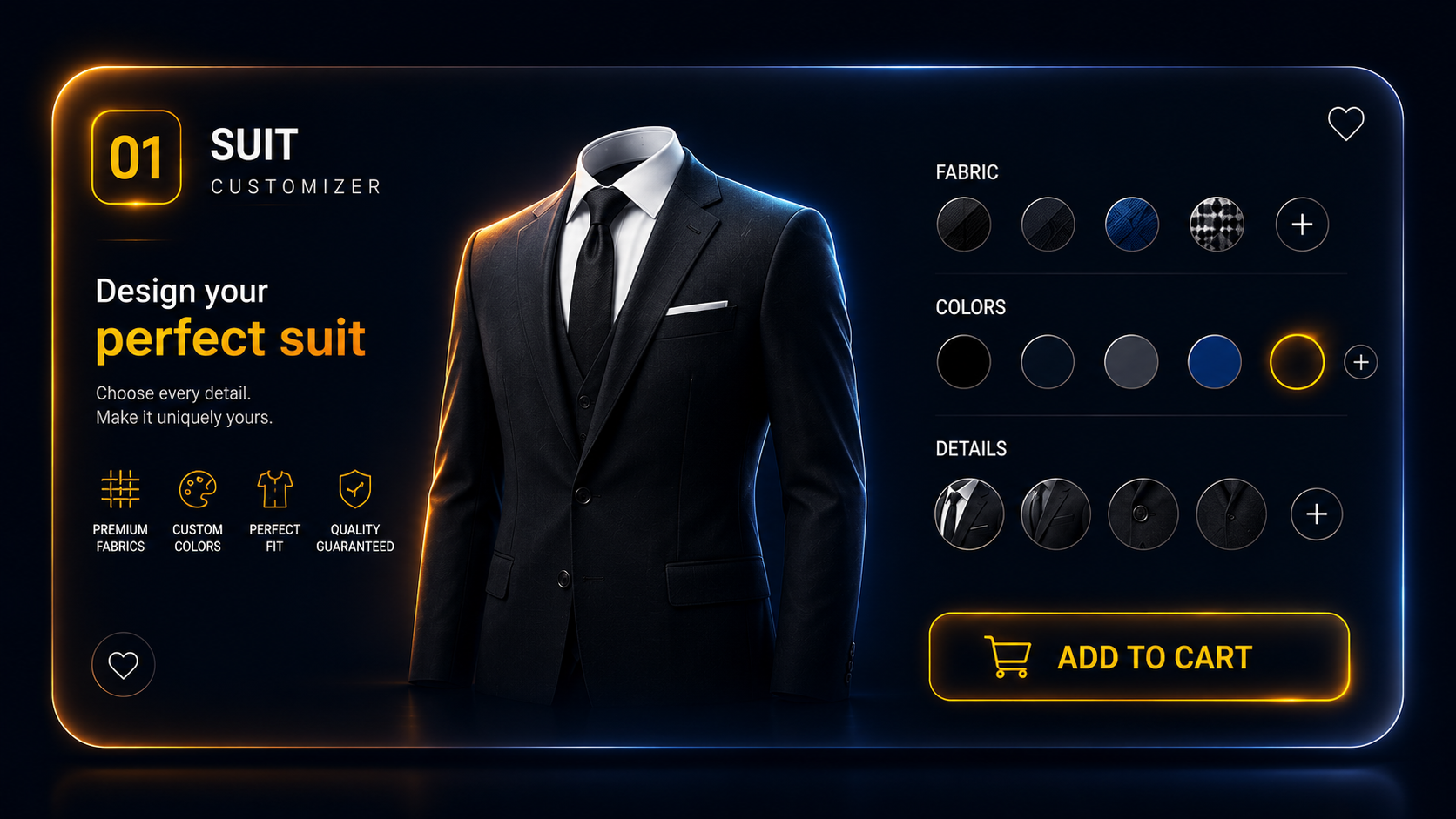
Example: a brand of premium men’s formal suits launched a configurator where clients choose the jacket cut, trouser style (tapered, classic, pleated), fabric and color, lapel type, and hardware. Customers receive a full-look visualization before placing an order — the number of alterations after fitting was reduced by 65%.
Footwear
The shoe configurator covers model selection, upper material and color (leather, suede, patent leather), toe shape, sole, lining type, logo, or personalized engraving on the insole.
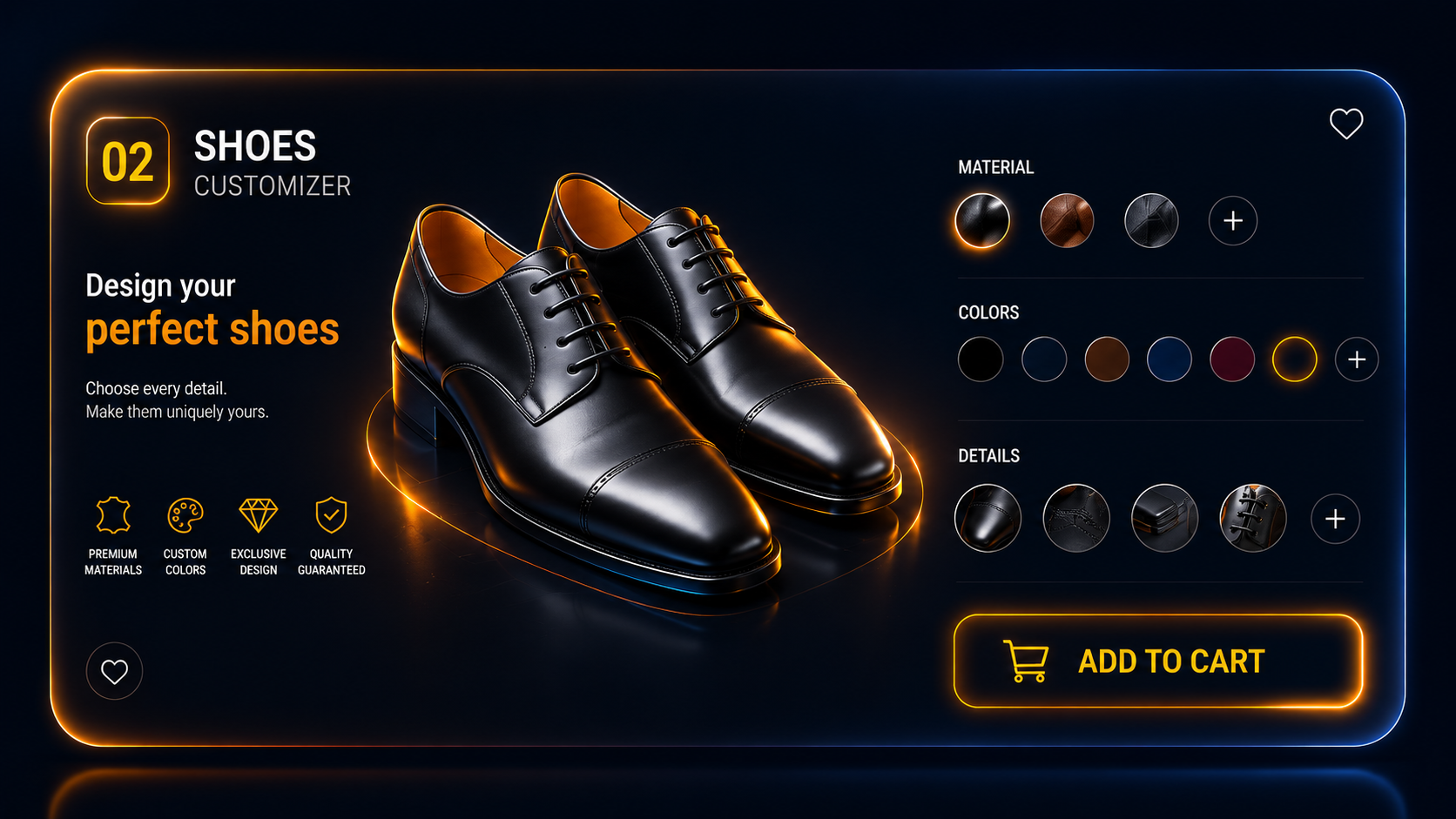
Example: a manufacturer of premium men’s dress shoes integrated a configurator with options for last selection, upper material (cordovan, suede), color, sole type (leather, rubber, Goodyear welt), and monogram. Average order value increased by 38% — customers in the premium segment are happy to pay more for personalization.
Caps and Headwear
The online cap configurator covers material, color scheme for all elements (visor, button, eyelets), branding type (embroidery, heat transfer, patch), and closure style.
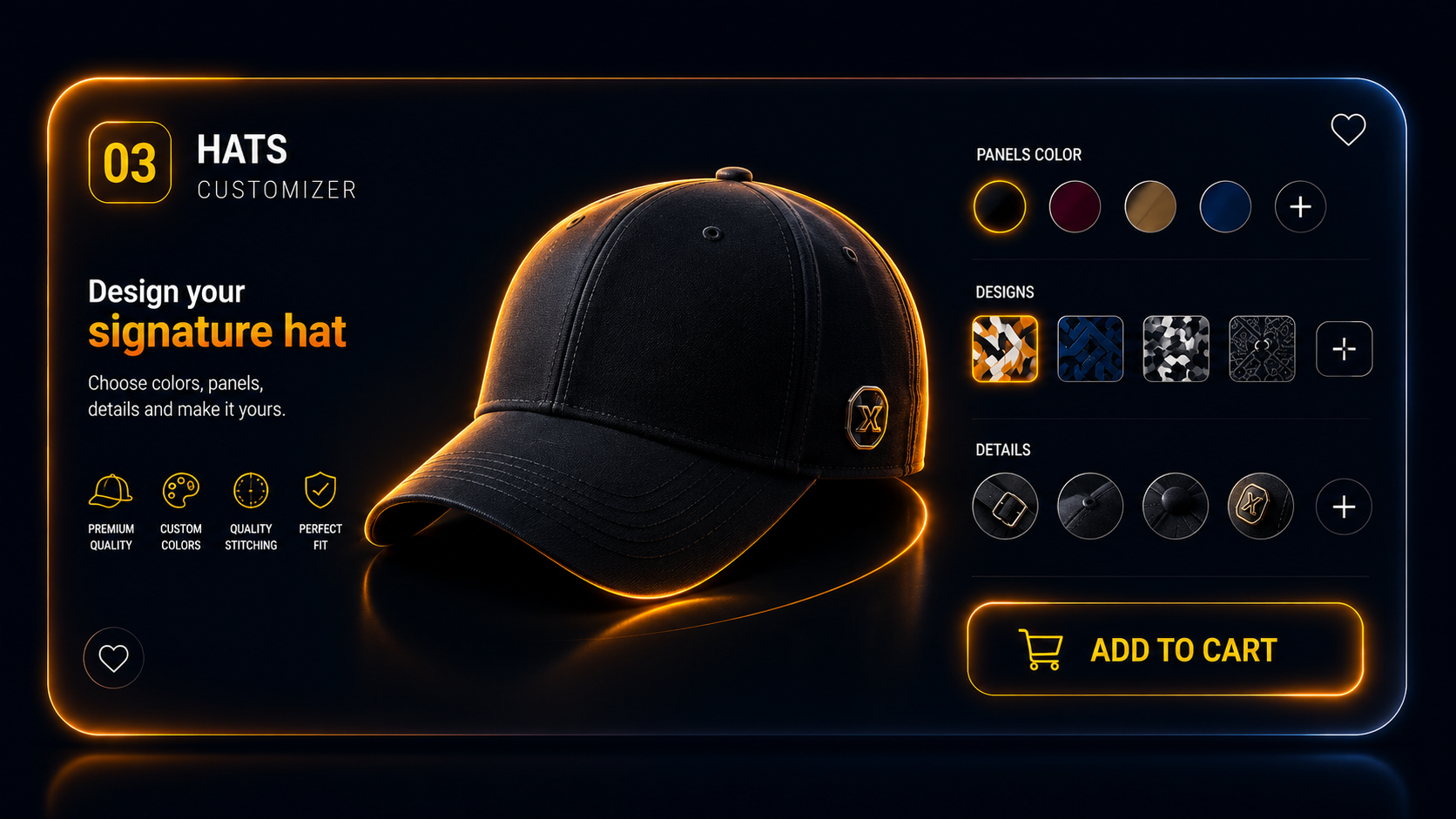
Example: a premium men’s cap brand implemented a designer where shoppers choose the material (wool, tweed, cotton), crown shape, visor style, and embroidery. The configurator became the primary sales tool — 70% of orders are now placed through it without any involvement from a sales manager.
Sunglasses
The eyewear configurator lets users choose the frame shape (aviator, wayfarer, oval, rectangular), material (acetate, titanium, stainless steel), frame and temple color, lens type and tint (polarized, mirrored, gradient), and temple engraving.

Example: a men’s sunglasses brand launched an online designer: customers build a model suited to their face shape, choose a frame and lens color combination, and add a personal engraving. Returns due to “not a good fit” dropped by 45% — buyers can see exactly what they’re getting before purchase.
Accessories: Belts
The leather accessories configurator covers leather type (smooth, pebbled, crocodile, python), color, belt width, buckle type and material (matte gold, silver, gunmetal), stitching, and embossing.
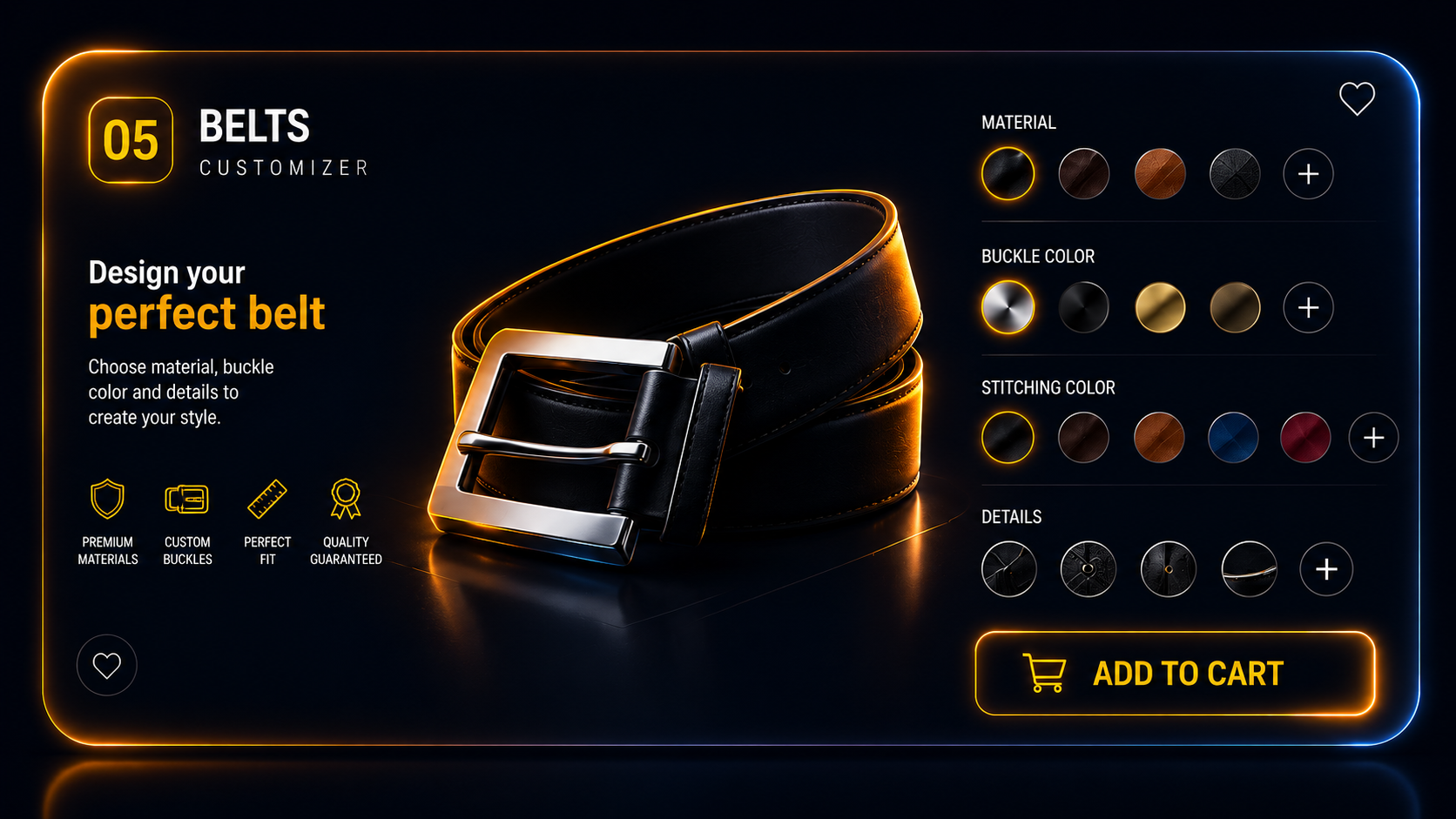
Example: a handcrafted men’s leather belt brand added a configurator to their online store: the customer selects the leather type, color, buckle, and orders monogram embossing. The monogrammed product became the most popular option — its share of orders grew from 15% to 54% in the first three months after the configurator launched.
Higher conversion rates. An engaged user who has built their own product is far less likely to abandon their cart. According to Tron Pool Energy client data, conversion to purchase increases by 20–40% after a configurator is introduced.
Fewer returns. Customers know exactly what they’re getting. Returns due to unmet expectations decrease by an average of 30–50%.
Higher average order value. Premium options, high-end materials, and add-on elements are built naturally into the interface — customers upgrade their orders on their own.
Made-to-order production. No need to stock every variation. Hundreds of combinations exist virtually — only what is actually purchased gets made.
Automation. Integration with ERP and CRM enables an end-to-end cycle: selection → order → production → logistics, with no manual data entry.
Demand analytics. User configuration data reveals which colors, materials, and styles are genuinely popular — a direct signal for the next collection.
Tron Pool Energy manages the project end-to-end: from business analysis and prototyping through to launch and ongoing technical support. The process is transparent: fixed milestones, clear timelines, and staged payments.
Pricing depends on the format (2D or 3D), the number of configurable parameters, integration depth, and UX complexity. We match the solution to your budget — from a basic 2D designer to a full-featured 3D configurator with AR try-on.
Contact Tron Pool Energy — and we’ll show you exactly how the configurator will work in your niche.
A gallery displays pre-shot images — a fixed set of angles and variants captured by a photographer. A 3D configurator generates the image in real time based on the user’s choices: they change the color, material, and cut themselves, and instantly see exactly how their product will look. It’s not just a visualization — it’s an interactive sales tool that engages the buyer and reduces the likelihood of them walking away without purchasing.
A configurator scales to any size of business. A small cap brand or corporate uniform manufacturer can start with a 2D solution — it’s faster to develop and requires a smaller investment. Larger players opt for 3D with ERP and CRM integration. Tron Pool Energy selects the format and feature set based on the real goals and budget of each specific project.
The configurator is embedded as a module on the product page — no full site rebuild required. We develop API integrations with your platform (Shopify, WooCommerce, custom engine), payment systems, ERP, and warehouse. The customer configures the product, and the configuration data automatically flows into the order and on to production. No manual data transfer.
Timelines depend on project complexity. A basic 2D designer with a limited set of options can be launched in 4–6 weeks. A full-featured 3D configurator with multiple product categories, integrations, and a custom interface design takes 2 to 4 months. Exact timelines are locked in the technical specification after an initial project analysis.
Yes. The configurator is developed in a format compatible with mobile apps on iOS and Android, and can also be adapted for offline use — on a tablet or touchscreen panel in a showroom or retail store. This is part of an omnichannel strategy: the customer interacts with the brand in any format and on any device, receiving a consistently high-quality experience.
Lean Canvas: How to Validate a Business Idea Before Wasting Months on It
Lean Canvas: One Page Instead of a 30-Page Business Plan. How to Find Out in One Evening Whether Your Idea Has the Potential to Become a Real Business.
2026-05-25
169
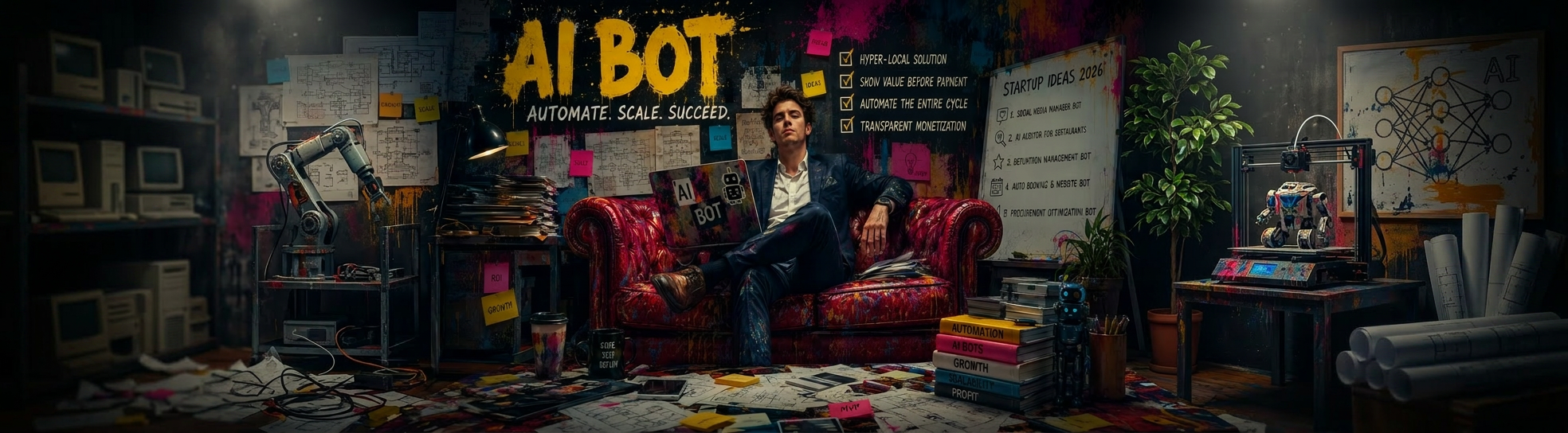
How to Build a Successful AI Startup Based on AI Agents in 2026
An AI agent finds clients, creates demos, and closes deals without human involvement. How to build a startup like this in 2026: principles and real-world ideas.
2026-05-21
107

Recruit HRM: A Flexible CRM for HR Teams — All Messengers, Candidates, and Hiring Stages in One Workspace
Your recruiter quit and took the candidate database with them? With Recruit HRM, that won’t happen. We break down an HR CRM built to work for the company, not the employee.
2026-05-20
194

Reduce USDT TRC-20 transaction fees for frequent transfers from a single wallet with no time limits

Quick activation for one-time and occasional USDT TRC-20 transfers

Fund a shared balance and distribute TRON Energy and Bandwidth across multiple wallets

Automatic TRON Energy delegation for exchanges, swap services, and payment platforms

Quick access to Tron Pool Energy services directly in Telegram

Fast USDT TRC-20 to TRX swap, no exchange or registration required

Get all the benefits of Telegram at up to 15% less than through the App Store and Google Play

Gifts, reactions, and digital content with USDT TRC-20 — no registration required

Get a custom TRON address with your name, brand, or nickname