




 English (EN)
 Русский (RU)
 Українська (UK)
 español (ES)
 Türkçe (TR)


DefiLlama and TVL: How to Read DeFi Liquidity
A breakdown of DefiLlama: TVL, liquidity dynamics, stablecoin distribution, and chain analytics. How to read data and understand DeFi trends.
2025-11-18
177
Authorization is required only to use the service «Team energy»
Enter the e-mail you provided during registration and we will send you instructions on how to reset your password.
An error occurred while processing your request. Please try again later. If the problem persists, please contact our support team.
In-depth DeFi review: principles, key differences from banks, protocol architecture, privacy, risks, and the user’s role in the new financial system.
Decentralized finance has ceased to be an abstract term and is gradually shaping a new model of working with capital. In it, the user retains control over funds, and instead of intermediaries with fees and regulations there are smart contracts that execute the rules precisely and without the possibility of interference.
In this article you will learn:
By the end of the material it will become clear that DeFi does not turn the economy into chaos but creates a system of incentives where capital works according to clear and equal rules.
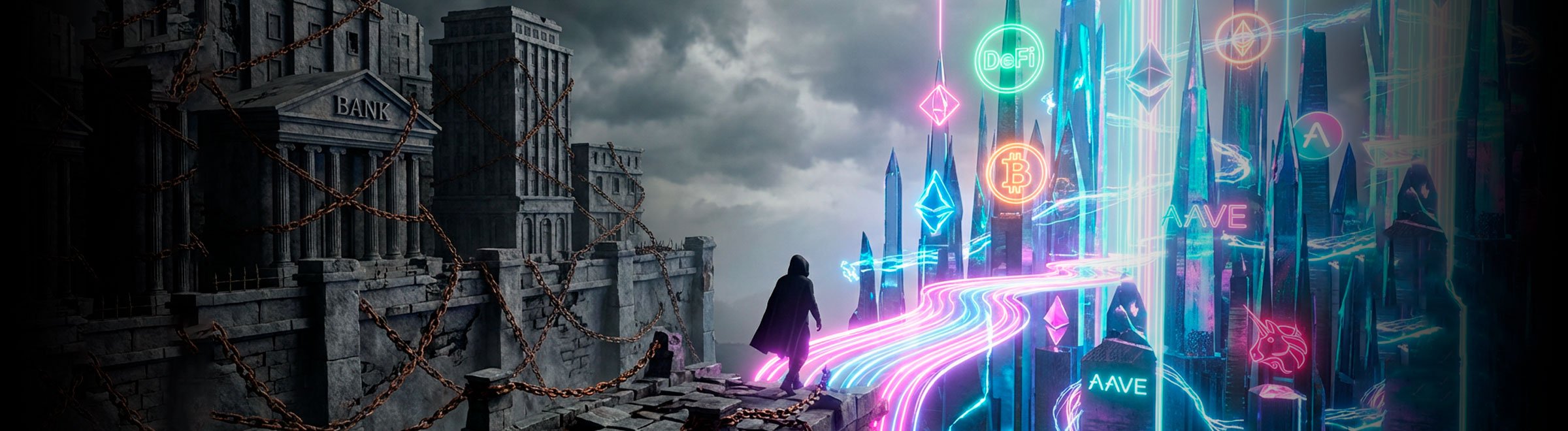
Before understanding why a new financial model was needed at all, it is important to look at how the familiar system is structured and why it is increasingly slowing down the development of the modern user. It is precisely the comparison that gives clarity as to how the old logic of money management differs from what DeFi offers.
The traditional financial system is based on a chain of intermediaries: banks, brokers, payment operators, and SWIFT. The money in your account belongs to you only nominally, because legally it is a bank’s obligation to issue it upon request.
Any access to your funds depends on regulations and permissions, and any operation—from a transfer to obtaining a loan—goes through organizations that decide whether to allow you to perform this action or not.
What DeFi is can be described as a parallel economy on the blockchain, where there are no offices or managers, and the rules of capital movement are defined by code that is available for verification. The user interacts with the system directly and does not spend time on forms, approvals, and waiting for business hours.
If we explain DeFi in simple terms, it is a set of automatic rules that allow you to trade, lend, borrow, and earn yield while retaining full control over your assets. That is why the question of what decentralized finance is goes far beyond the idea of services without KYC.
Before diving into protocol mechanics, it is useful to see why DeFi is perceived not as yet another technology but as a turning point in the logic of dealing with money. The most striking differences become noticeable precisely in comparison with how banks operate.
In a bank there is always a risk of facing an account freeze, additional document requests, or transfer limits. In DeFi everything comes down to your private key.
No one can interfere with your transactions, which is why many describe this approach as managing money without intermediaries in the full sense of the phrase.
Banks require a passport, selfies, various confirmations, and checks. In DeFi the principle of DeFi without KYC applies.
It is enough to connect a wallet, and the system will accept you without questions. A smart contract truly does not care who you are and where you are from, which makes access to financial instruments as free as possible.
In the classic system there are privileged clients, scoring, and service tiers. In DeFi the same code runs regardless of the balance in your wallet.
There is no status-based segmentation, and that is why one of the key advantages of DeFi lies in equal conditions for all participants.
A bank’s operations remain opaque to the client, and you can only hope everything is happening correctly. In DeFi the logic of a protocol lies on the surface: anyone can review the code and understand how the process is structured.
This explains why the difference between DeFi and banks is described as a transition from trust to verification.
Banks operate on a schedule, and transfers regularly run into weekends, holidays, or internal regulations. DeFi protocols operate without pauses as long as the internet and the blockchain exist.
It is this continuity that best shows why DeFi is a revolution, as it removes time constraints as a phenomenon.
Understanding DeFi becomes much easier when you break the system down into its basic elements. Despite external complexity, the entire architecture is arranged logically and consistently, so you can figure it out even without deep technical expertise.
Thanks to this, DeFi remains accessible even for newcomers, since the system is open, does not require permissions, and allows the user to choose convenient combinations of services.
There is no full anonymity here. What operates here is pseudonymity, where the user is represented by a wallet address. It is open for viewing, and transactions are visible to everyone, but the owner’s identity remains hidden, which is why “DeFi anonymity” describes the system incorrectly, and “DeFi privacy” works precisely at the level of the individual.
This approach removes the need to disclose citizenship, age, or documents. The user gets equal access to tools, and asset management does not depend on a country’s policies or decisions of the banking system.
Protocols see only on-chain actions, not a person’s social status.
Privacy does not turn DeFi into chaos. All operations are recorded on-chain and remain transparent. Anyone can see the movement of funds but cannot link them to a specific person.
This creates a balance in which the individual is protected and actions are verifiable, which eliminates discrimination and strengthens the resilience of the system.
In the classic financial system responsibility for safeguarding funds lies with banks and regulators. A mistake can be reversed, access can be restored, and risks are most often taken on by the infrastructure, so the user does not think about the technical side of processes.
In decentralized finance the situation is the opposite. The user is personally responsible for their actions, and the system executes any signed transaction.
An error in an address, a fake smart contract, or a lost seed phrase leads to irreversible loss of assets. There is no rollback mechanism here and no support service that will solve the problem for you.
This model makes protocols resilient and independent of the human factor but requires attentiveness and understanding of basic mechanics. This is how DeFi security is revealed, where the key risk is not tied to the technology itself but to user behavior.
Freedom here is maximal and is inseparably linked to full personal responsibility.
Decentralized finance has long gone beyond simple swaps, turning into an independent financial toolkit. The user gains access to services that were previously available only through banks or brokers, but now operate directly through protocols and smart contracts.
Thanks to this, the ecosystem becomes flexible and accessible, and the range of instruments grows every year.
Taken together, all these instruments provide a complete answer to the question of what can be done in DeFi, because the system covers almost the entire spectrum of financial operations that were previously available only through banks and centralized services.
The decentralized finance ecosystem rests on a simple principle. Each participant performs a useful function because it brings them direct benefit. There are no random roles inside protocols, and development proceeds naturally as users themselves support the system’s operation.
Liquidity providers give protocols the ability to execute swaps and receive a share of the fees. Validators ensure network security and are rewarded through staking. Teams build new products and earn revenue from fees and tokens. Every contribution is tied to an economic incentive, so the system remains stable.
This is exactly where the answer to the question of why DeFi is needed is revealed. The economy works because all participants are interested in maintaining it. As a result, DeFi turns into a self-regulating model, where development depends on user actions rather than the decisions of a centralized authority.
There is no single main network here; however, several ecosystems are developing so actively that they are considered the key directions. Each solves its own task, so the choice depends on which tools and conditions the user needs.
This perspective helps to understand in which networks DeFi is revealed best.
Ethereum remains the central platform thanks to mature code and a large number of battle-tested solutions. BNB Chain provides mass-market access and attracts those who want to operate with minimal fees.
Solana bets on high speed and is suitable for scenarios with intensive trading. TRON stands out by its stablecoin volume and number of transactions and has therefore become one of the most heavily used networks.
Practical usage is especially noticeable in the DeFi ecosystem on TRON. Working with SunSwap, lending, and farming requires network resources called Energy, so users aim to reduce operational costs.
One convenient option is Tron Pool Energy, which helps to lower fees and makes working with TRON protocols more comfortable. This approach reduces the strain on the budget and allows you to participate in DeFi without unnecessary expenses.
Decentralized finance is suitable for those who want to manage capital independently and not depend on the decisions of banks or the state. Users who value privacy and flexibility gain access to instruments without restrictions by country or status and can interact with protocols directly.
This model is comfortable for those who are ready to monitor security and understand basic mechanics. A person who understands how wallets work and how transactions are signed quickly masters the ecosystem and gets the most out of it.
DeFi can be inconvenient for those who are used to bank support and guarantees. There is no mechanism here for reversing mistakes and no services that will return funds in case of inattention.
If full insurance and minimal involvement are important, the traditional financial system remains a more suitable option.
Decentralized finance is becoming a full-fledged financial model thanks to its logic and transparency. This environment gives the user direct control over assets and access to instruments that operate without intermediaries and restrictions.
This approach changes the familiar rules of dealing with money and remains clear to those who are ready to study the basic principles.
Freedom in DeFi is always tied to responsibility. The user makes decisions themselves and bears responsibility for the consequences.
When a person understands the risks and how the infrastructure is built, they gain a level of transparency and control that is unavailable in the traditional financial system.
Decentralized finance is developing in parallel with classical institutions and is moving faster thanks to open technologies. The core idea is built on a transition from trust to verification.
The system operates fairly exactly to the extent that you control your keys, which is why the principle “your keys are your money” remains the most accurate description of the essence of DeFi.
It is a system of financial services on the blockchain where operations are executed by smart contracts. The main difference between DeFi and banks is that the user retains full control over assets and interacts directly, without intermediaries.
The model removes banks, managers, and permissions, and the rules are defined by code. The system makes access to finance equal for everyone and reveals key advantages such as openness, speed, and 24/7 availability.
DeFi does not provide full anonymity but does offer pseudonymity. Thanks to this privacy, your identity remains hidden even if your on-chain actions remain public.
Smart contracts operate according to open rules, and their logic can be reviewed. However, DeFi security depends on the quality of audits and the user’s experience: inattentive interaction with smart contracts can lead to loss of assets.
The main DeFi risks are related not so much to volatility as to user mistakes. This is especially important to remember for those who are coming into DeFi, where an incorrect signature or a lost seed phrase leads to irretrievable losses.
The ecosystem offers loans, yield strategies, crypto lending, DeFi staking, farming, and many other instruments.
Different networks offer different opportunities. To understand in which networks DeFi works best specifically for you, look at fees, speed, and the ecosystem. For fast operations many choose TRON — an active DeFi ecosystem makes working with stablecoins especially convenient.
DefiLlama and TVL: How to Read DeFi Liquidity
A breakdown of DefiLlama: TVL, liquidity dynamics, stablecoin distribution, and chain analytics. How to read data and understand DeFi trends.
2025-11-18
177

Decentralized Exchanges (DEX): Principles, Risks, and Opportunities
On DEX platforms, users manage their own funds and trade directly from their wallets. The article explains how DEX works, its main types, and key risks.
2025-10-24
144

Web3 wallet security: how anti-phishing extensions protect you
We explain how Wallet Guard, ScamSniffer and built-in filters protect wallets from phishing, malicious websites and dangerous signatures.
2025-11-20
148