2D or 3D Configurator? Find Out Which Solution Is the Best Fit for Your Jewelry and Accessories Brand.
Content
Technology that transforms customers into designers and increases sales by 40%
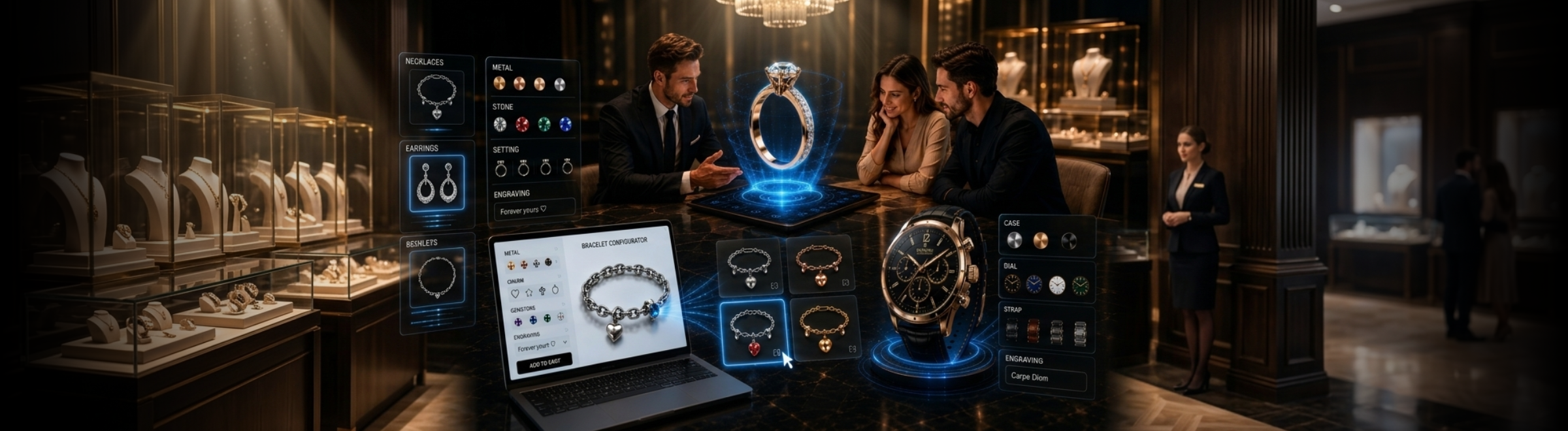
Imagine this: a customer enters your website not just viewing ready-made jewelry, but creating their own piece. They choose metal, stones, engraving — working with a jeweler, yet all this happens within minutes online. This isn't fantasy. This is reality created by interactive configurators for jewelry and accessories.
In an era of mass personalization, the market demands tools giving customers purchasing power. The global personalized goods market shows fantastic growth — analysts predict exceeding $565 billion by 2033. Jewelry configurators aren't just a nice feature; they're strategic weapons for boosting conversion, average order value, and customer loyalty.
In this article, we'll understand why configurators become essential tools for any jewelry brand or accessories company, and how to implement this technology in your business today.
From static catalog to interactive experience: why configurators change the game
Traditional jewelry sales approaches are long outdated. A customer sees a beautiful ring, but it doesn't match their taste — slightly different design, wrong stone color, incorrect setting height. Result? They seek competitors offering exactly what they want. Or worse — they don't buy anything.
Interactive configurators completely reverse this logic. Instead of customers seeking perfect jewelry, jewelry is created specifically for them. This simple paradigm shift creates powerful effects:
Increased average order value. When customers invest time creating jewelry, they perceive greater value. Data shows average order increases of 25-45%.
Reduced returns. Customers know exactly what they'll receive since they saw the finished result. Returns drop 50-70%.
Stronger emotional bond. Jewelry customers create themselves becomes more than merchandise — it reflects their personality.
2D vs 3D: choosing the right configurator for your business
Two main configurator types exist, each with advantages and applications
2D configurator: when speed and simplicity matter
A 2D configurator is a streamlined solution for quick jewelry creation. Customers select from preset options (color, shape, size, material), and the system instantly updates the image. It's like LEGO for jewelry: simple, fast, intuitive.
When to use a 2D configurator:
Simple jewelry with limited options (beaded bracelets, pendants, key chains)
Mobile commerce (fast loading, minimal resources)
Large-volume corporate orders
Startups with limited development budgets
3D configurator: complete visualization for premium segments
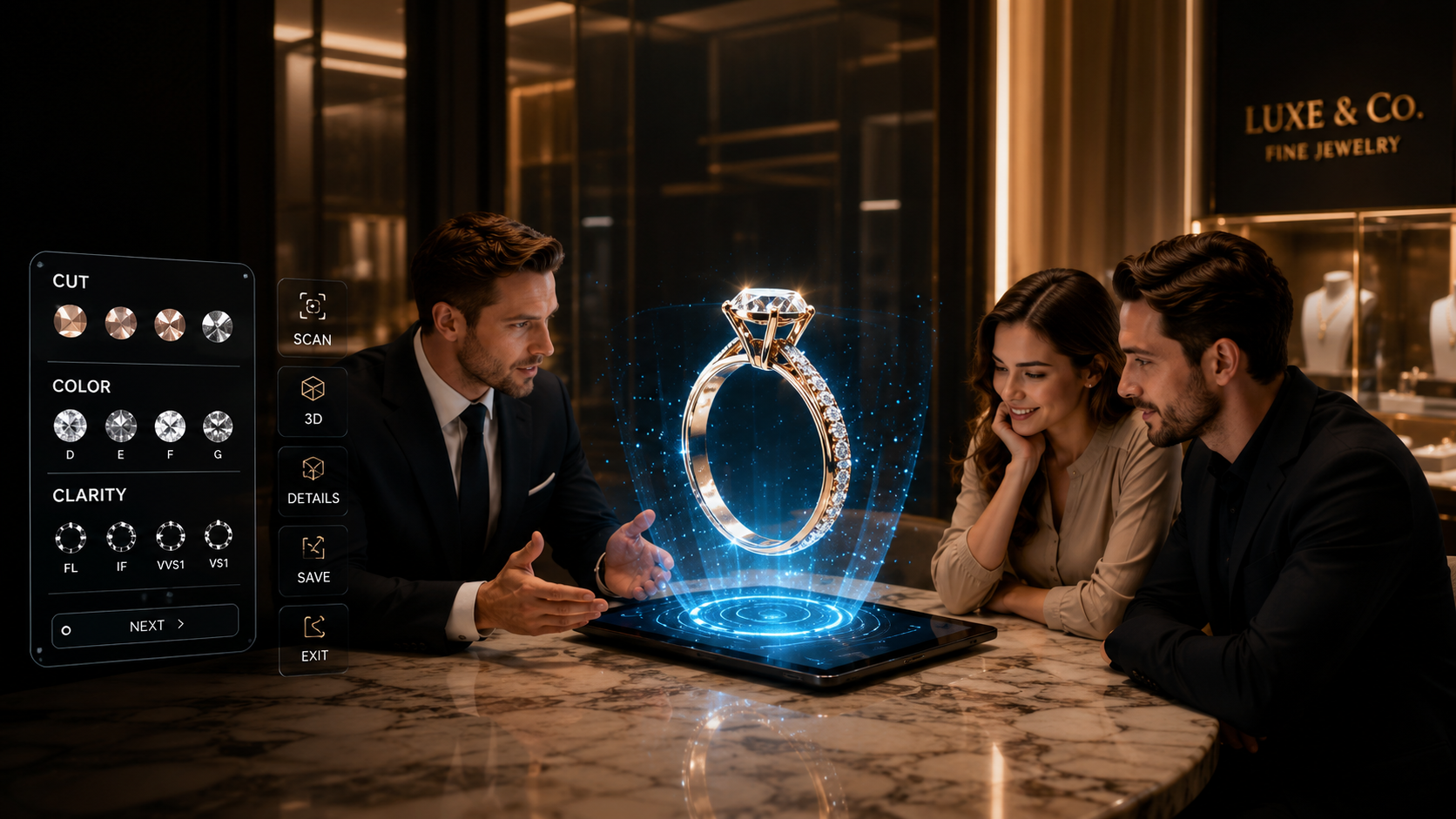
A 3D configurator is a premium solution providing customers complete control. Jewelry displays in three-dimensional space — customers can rotate, zoom, and view from all angles. They see shadows, light reflection, real material texture. It's like trying on jewelry in reality, from home.
Customers willing to spend time creating unique pieces
Practical case studies: how configurators work across industries
Theory is nice, but practice is better. Let's look at how real brands use configurators and what results they achieve.
Jewelry stores: transforming consultants into digital assistants
Picture a customer entering a jewelry store with clear ideas about their desired ring. But all available options fall short. The consultant spends 2 hours discussing details, showing samples, sketching ideas. Result? Customer leaves seeking another store.
A store deploying a 3D configurator offers something entirely different. In 15 minutes on a tablet using an interactive builder, customers see several ring options, rotate them, examine stone brilliance from different angles. The consultant then provides exact specifications to the workshop. The process becomes transparent and efficient.
Results: consultation-to-order conversion increased 60%, checkout completion 70% faster, satisfaction ratings rose from 7.2 to 9.1 out of 10.
Bonus: data helps craftspeople completely eliminate remakes and manufacturing errors.
Online jewelry stores: conversion at a new level
Traditional online stores display a single-color bracelet with text saying 'also available in red and gold.' Customer clicks — sees another image. Can this inspire purchase? Perhaps. Probably not.
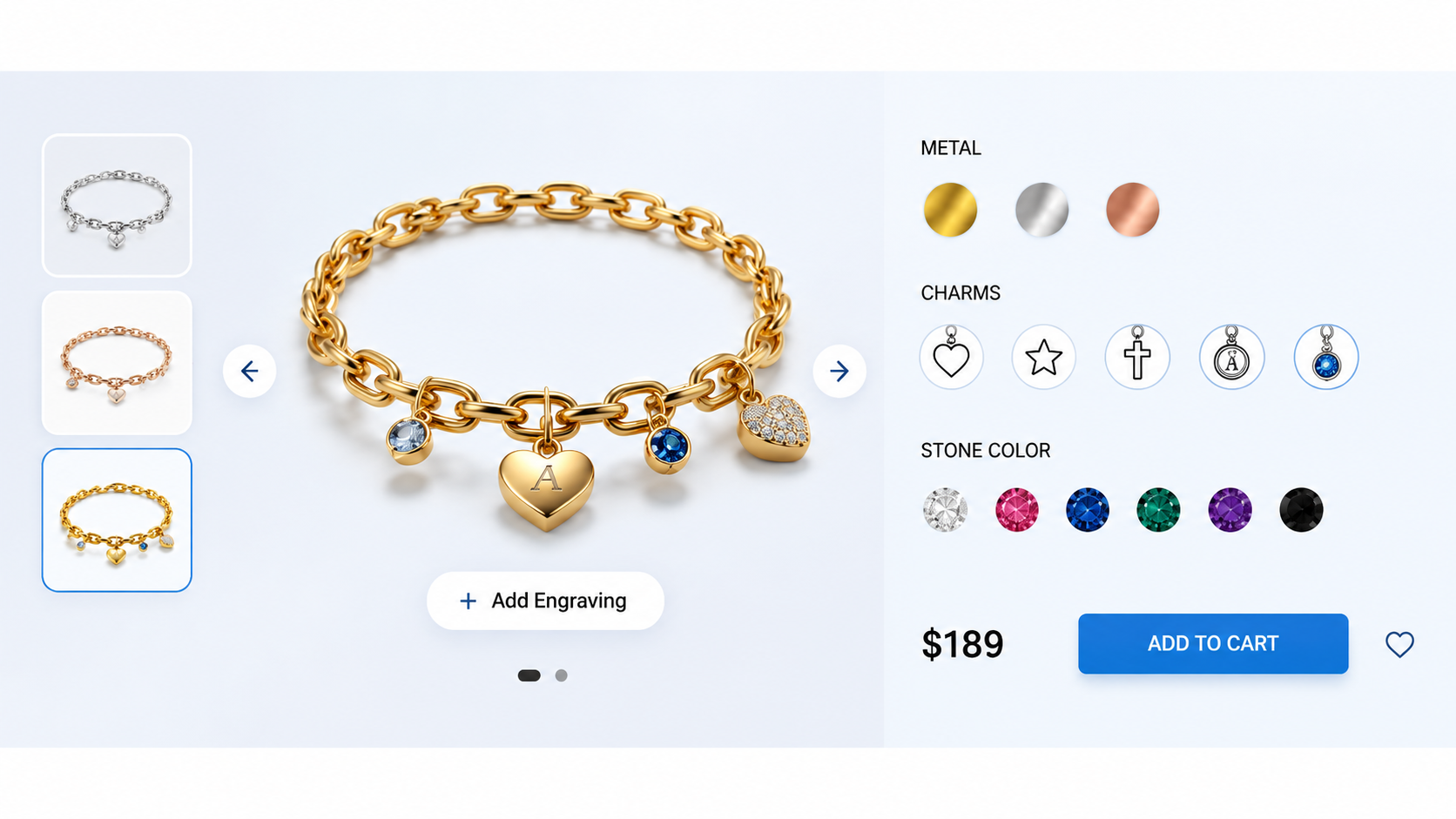
A 2D configurator on a store website lets customers instantly view bracelets in all color options. They add custom engraving, choose different chains, see combinations. The experience becomes interactive, engaging.
Results: time spent on page increased 3.5x, conversion rose 38%, average order value increased 32%.
Additional benefit: popular combination data optimizes purchasing and inventory management.
Watch brands: customization as a premium-segment tool
Watches aren't just accessories — they express status and style. Premium watch buyers want unique timepieces. One chooses a date dial, another wants sports chronograph styling, a third dreams of leather strap with engraving.
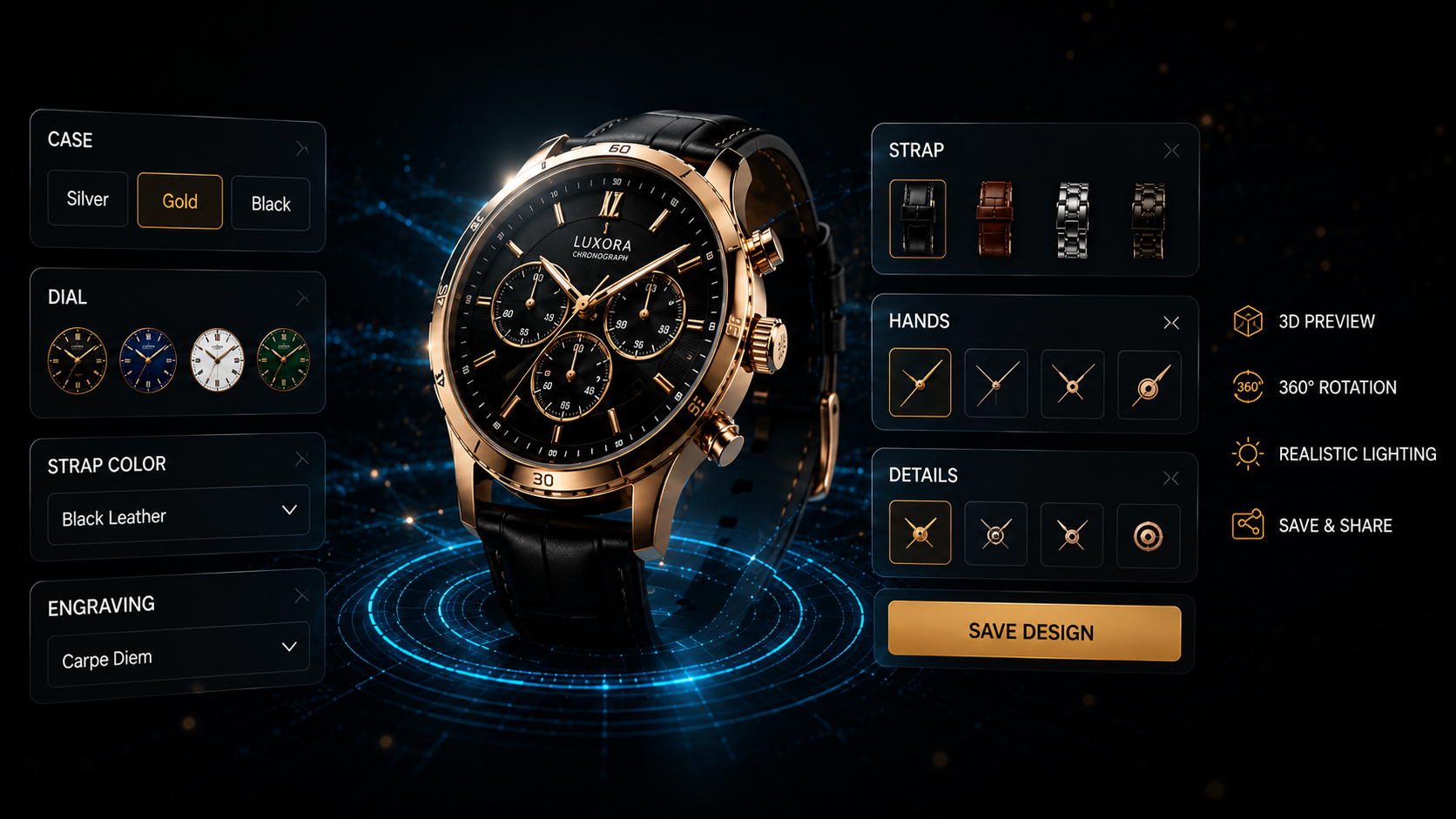
Traditionally, watch brands release fixed models. Customers take it or leave it. A 3D watch configurator changes everything. Customers see real-time interactive representations: selecting case material (steel, gold, platinum, titanium), dial design (classic, sports, skeleton), strap color and type (leather, metal, rubber), complications (chronograph, stopwatch, calendar). Each choice instantly updates the 3D model.
Result? Buyers see exactly what they'll receive. They can rotate watches in the configurator, watch light reflect off the dial, see engraving on the case. This transparency — plus customization emotion — creates entirely different satisfaction levels.
Results: average order value rose 47% (customers add expensive materials and complications), product review time jumped from 3 to 18 minutes, return rate fell 65%.
Premium effect: custom configurator watches feel like exclusive orders, not standard products — even though they're manufactured normally. This enabled one brand to raise retail prices 15-20% without losing conversions.
Corporate orders: scaling personalization
A corporate client orders 500 branded bracelets. Traditionally: manager calls, discussions, mockup exchanges, design approvals, countless emails back and forth. A week just to start production.
A company using a corporate order configurator offers completely different process. Clients log into their account, select from preset shapes, sizes, colors, upload logos, adjust placement. In 30 minutes they see complete mockups of all 500 pieces with pricing. One click — order goes to production.
Results: request-to-production time dropped from 7 days to 1, order errors nearly eliminated, clients satisfied with speed and transparency.
Scaling: one manager handles 5x more orders because they're not spending time on correspondence and approvals.
Why custom configurators are investment in competitive advantage
The market contains many ready-made SaaS configurator solutions. They're accessible, easy to implement, relatively inexpensive. But one major problem: they work identically for everyone.
Using a SaaS configurator means your configurator looks identical to competitors'. Same features. Similar creation process. Nothing differentiates you. It leads to endless price battles.
1. Uniqueness that attracts and retains customers
A custom configurator expresses your brand personality. It can be designed perfectly reflecting your style, values, customer approach. Unique interface, original interaction process, personalized recommendations — all make configurators your signature feature.
Result: customers remember you not because you're cheaper, but because you offer superior experience. This lets you position premium pricing and maintain higher margins.
2. Complete business process integration
A SaaS configurator is a separate tool connected to your website. A custom configurator embeds directly in your business. It integrates with order management, CRM, production, inventory systems.
Result: when customers create jewelry in the configurator, specifications automatically enter production systems. Managers don't manually re-enter data. Errors essentially disappear. Production starts the moment payment arrives.
3. Scalability for your growth
SaaS solutions have built-in limitations. Product quantity restrictions. Interface customization bounds. External system integrations. When business grows, these constraints become obstacles.
Result: custom configurators grow with you. Want new jewelry types? Easy. Need integration with unexpected software? Developers handle it. Require new currency or language support? No problem. Your configurator remains flexible, adaptive.
4. Data and analytics belong exclusively to you
SaaS stores customer behavior data, popular combinations, configurator time spent on vendor servers. They see your data. They use it for their analytics, benchmarking, even AI model training.
Result: custom configurators are your property. All data stays on your server. You maintain full control and confidentiality. Moreover, this data becomes competitive advantage. You know which combinations are most popular, which colors customers prefer, when they abandon. Competitors never see this information.
5. Innovation at your pace
SaaS companies update for masses. Updates happen infrequently because each feature must work for thousands. Need experimental features? You wait or find another vendor.
Result: custom configurators let you experiment. Want new features? A/B tests? AR virtual try-on integration? Everything happens quickly, without waiting for vendor updates. You're first to market with new experiences.
Comparison: SaaS vs custom solutions
Let's examine numbers. Custom costs more upfront, but actual ROI tells the real story.
SaaS configurator: $500-3,000/month ($6,000-36,000/year). Simple and fast. But you depend on vendor, functionality limited, data isn't yours.
Custom configurator: $15,000-50,000 development. Then minimal hosting ($100-500/month). Larger upfront investment, but within 2-3 years custom becomes significantly cheaper. Plus unique product gives competitive advantage, allows price increases.
Let's calculate for a $500,000 annual revenue store:
SaaS over 5 years: $180,000 subscription + lost additional revenue (if configurator were better) = real losses.
Custom over 5 years: $30,000 development + $30,000 hosting = $60,000. But unique configurator increases conversion 15% vs typical 8%, price increases 5% (customers value better experience). Additional revenue over 5 years: $1,500,000+. ROI: exceeds expectations.
Key metrics: measuring configurator impact
Configurator deployed — excellent. But does it work? Watch these metrics:
Conversion rate. How many configurator users purchase? Typically increases 30-60%.
Average order value. How much larger are orders? Expect increases 20-40%.
Return rate. How much did returns drop through better visualization? Typically 40-70%.
Session duration. How long do customers spend with configurators? Indicates engagement level.
Customer satisfaction. How much improved ratings and reviews? Happy customers drive best marketing.
2026 and beyond: personalization trends
Personalized goods market grows rapidly. Here's what we see ahead:
AR try-on. Augmented reality lets customers see rings on their fingers or bracelets on wrists BEFORE purchase. Reduces returns, increases purchase confidence.
AI recommendations. AI suggests combinations based on customer style, purchase history, trends. Personalization reaches new heights.
3D printing on demand. Configurator + 3D printing = create and deliver jewelry within days, not weeks.
Social sharing. Customer creates jewelry, shares link with friends. Friends view, create their own versions. Viral marketing in action.
Custom configurators let you integrate these innovations in real-time. SaaS providers update solutions over years. You'll accomplish this in weeks.
Getting started: step-by-step implementation plan
Ready to implement a configurator? Here's the practical plan:
Step 1: Determine priority. Which product first? Usually your most popular or highest-priced item.
Step 3: Pilot. Launch configurator for one product, gather data. One-two months shows impact.
Step 4: Scale. If pilot succeeds, expand to other products and categories.
Step 5: Optimize. Analyze data, improve interface, add options based on customer interest.
Conclusion: personalization is necessity, not luxury
If you sell jewelry or accessories without a configurator, you're leaving significant money on the table. Every day a customer can't create their perfect piece is a lost sale, lost order value, lost emotional connection opportunity.
A configurator is investment in your business's future. Investment paying back within approximately 3-6 months and continuing generating profit for years. In 2026, with rising competition, this investment becomes critical.
Choose custom solutions if you want true competitive advantage, full control over all processes, flexibility for innovation, and independence from external vendors. Yes, initial investment is larger. But long-term benefits are incomparable.
Start now. Pick a product, choose a development partner, launch a pilot. Results will pleasantly surprise you.
Share
Did you like the article?
FAQ
What is a jewelry configurator?
An interactive tool where customers create jewelry themselves: choosing materials, stones, colors, engraving. The system shows results in real-time (2D or 3D). Customers see exactly what they'll receive and are willing to pay more for it.
2D or 3D — which should you choose?
2D: for simple jewelry, mobile devices, bulk corporate orders. 3D: for complex jewelry, watches, premium brands where detail matters.
How much will sales grow?
On average: conversion +30-60%, average order value +20-47%, returns -40-70%, page time ×3-6. Results depend on product and target audience.
What products work best?
Jewelry, watches, bags, accessories, eyewear, corporate merchandise. Key requirement: product must have variable parameters (material, color, size, extras).
Custom configurator vs SaaS?
SaaS costs less upfront ($500-3,000/month), but reaches $180K over 5 years. Custom costs $15-50K once + hosting, totals $60K over 5 years. Custom gives you uniqueness, full integration, data control, and innovation freedom.
TRX calculator
Find out how much you spend on commissions!
Enter your crypto wallet address and we'll calculate how much TRX you've spent on fees over the last 30 days.
A jacket, dress, cap, or sneakers—customers build them themselves and see the result instantly. We break down how online configurators are changing the economics of the fashion business.
Lean Canvas: One Page Instead of a 30-Page Business Plan. How to Find Out in One Evening Whether Your Idea Has the Potential to Become a Real Business.
An AI agent finds clients, creates demos, and closes deals without human involvement. How to build a startup like this in 2026: principles and real-world ideas.





 English (EN)
 Русский (RU)
 Українська (UK)
 español (ES)
 Türkçe (TR)