How can you tell if your niche is big enough before writing the first line of code? A simple guide to TAM, SAM, and SOM with real examples and practical calculation methods.
Content
Every ambitious entrepreneur dreams of a product that will conquer the world and bring in billions. But before diving into development and marketing, it is extremely important to answer one fundamental question: how big is the market you are targeting? Without a clear understanding of market size (Market Sizing), your startup will be moving blindly, risking spending resources on a niche without sufficient potential. This is precisely what the concepts of TAM, SAM, and SOM exist for.
What are TAM, SAM, SOM? Explaining it “in plain terms”
These three abbreviations are key metrics for assessing market potential. They help investors and the founders themselves understand how much money can be earned in the chosen niche and how realistic the plans for scaling are.
TAM (Total Addressable Market) – Total Addressable Market
This is the maximum possible revenue that can be obtained if your product captures 100% of the entire market.
SAM (Serviceable Addressable Market) – Serviceable Addressable Market
This is the part of TAM that you can realistically reach given your business model, geography, and technologies.
SOM (Serviceable Obtainable Market) – Serviceable Obtainable Market
This is the part of SAM that you can realistically capture in the next 1–3 years, taking competition and your resources into account.
Summary table: TAM vs SAM vs SOM
Metric
Full name
What it shows
Example (“USDT Energy” case)
TAM
Total Addressable Market — total addressable market
The whole market at 100% capture
The global market for fees across all stablecoins on all networks
The realistic share over 1–3 years given competition
~1% of USDT TRON transactions available for fee optimization
🔥 Real case: how we chose the “USDT Energy” market (TRON)
When our team was deciding to launch a service for selling energy for the TRON network, we did not read the tea leaves. We used those very TAM/SAM/SOM formulas, relying on the hard numbers of blockchain analytics.
1. TAM: The global stablecoin market
We looked at the big picture. In 2024, the volume of stablecoin transactions exceeded $10.6 trillion. This is a gigantic ocean of money that is constantly moving. This is our TAM – the theoretical limit, if we were solving the fee problem for all stablecoins on all networks.
2. SAM: USDT on the TRON network (TRC-20)
Why did we choose TRON specifically? The numbers speak for themselves:
Issuance: As of the beginning of 2026, more than $80 billion in USDT is circulating on the TRON network. This is more than 50% of the entire global volume of USDT.
Transaction volume: In 2025, the volume of USDT transfers on the TRON network amounted to an incredible $7.9 trillion.
Activity: The network processes an average of $20 billion in USDT daily.
Our SAM is the fee market specifically on the TRON network, since our technical stack is perfectly tailored for working with the energy of this network.
TRON network metric
Value
USDT issuance (beginning of 2026)
> $80 billion (>50% of global USDT)
USDT transfer volume for 2025
$7.9 trillion
Average daily USDT volume
~$20 billion
3. SOM: Our obtainable share (the “bottom-up” calculation)
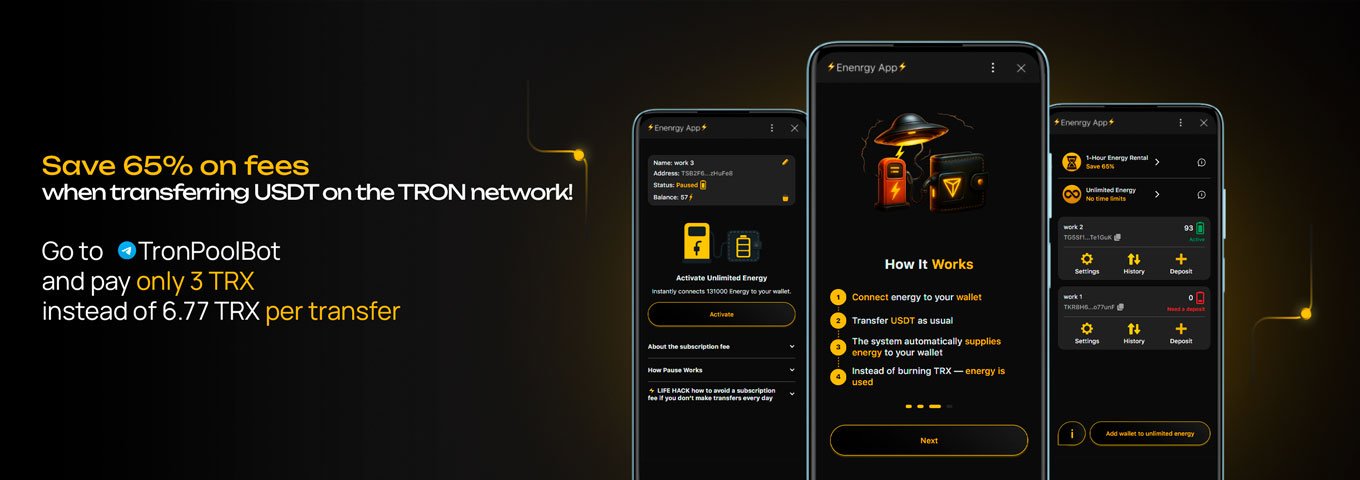
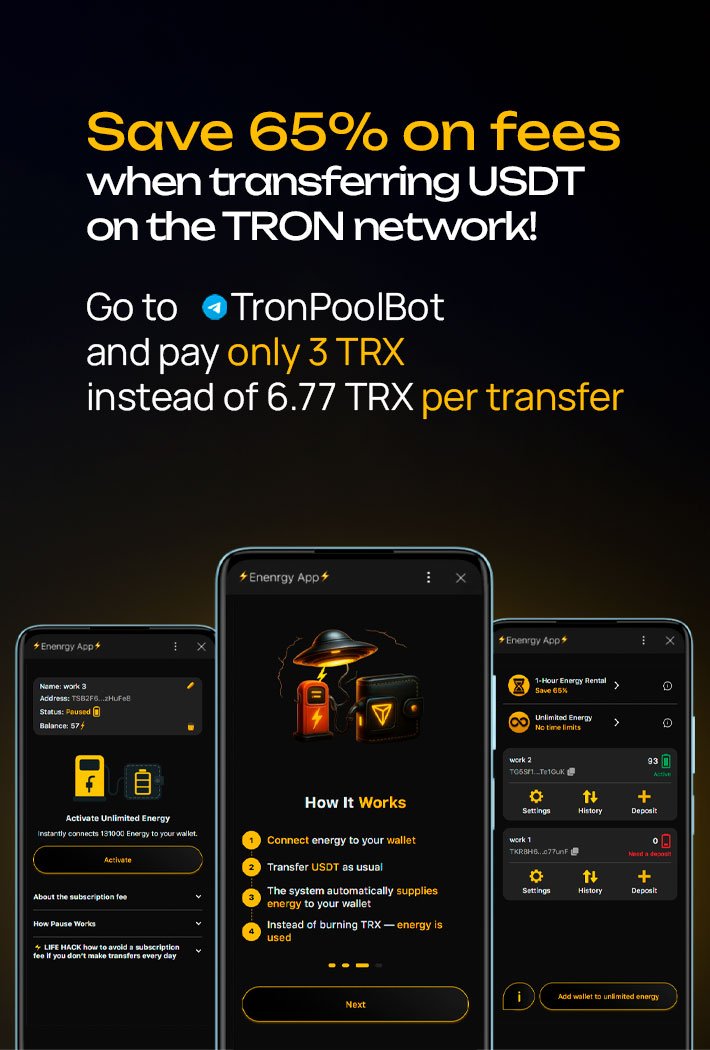
Here is where the most interesting math begins. We know that for every USDT transfer, the TRON network charges a fee in the form of “Energy”. If a user has no energy, they pay TRX (approximately 6.77 or 13.37 TRX per transfer).
At a TRX price of $0.33, one transaction costs the user $2.2 – $4.5.
Our service allows this cost to be reduced by half.
Calculation: If about 2 million USDT transactions are made per day on the TRON network, and at least 10% of users look for ways to optimize fees – that is 200,000 transactions per day.
Even capturing 1% of this volume (2,000 transactions per day) with our margin, we get a stable and highly profitable business.
Calculation step (Bottom-Up)
Logic
Value
Total USDT TRON transactions per day
Base market volume
~2,000,000
Looking for fee optimization
10% of the volume
200,000
Our obtainable share (SOM)
1% of the interested
2,000 transactions/day
Bottom line: The numbers confirmed that even a “tiny” 1% share in such a gigantic market as USDT TRON turns the project into a “gold mine”.
Market assessment methodologies: “top-down” and “bottom-up”
There are two main approaches to the calculation. Combining both gives the most accurate picture.
The “top-down” method (Top-Down)
We start with an estimate of the entire global market (TAM) and gradually narrow it down.
Example: The global clothing market → Online sales in Europe → Brands using 3D.
The “bottom-up” method (Bottom-Up)
We start with an estimate of one customer and scale up. This is the method of practitioners.
Formula: (Average check) × (Number of potential customers within reach).
Example: Our USDT energy calculation above is a classic Bottom-Up.
Comparison of methods: Top-Down versus Bottom-Up
Parameter
“Top-Down”
“Bottom-Up”
Starting point
The entire global market (TAM)
One customer and the average check
Direction
From the general to the specific
From the specific to the general
Data source
Analyst reports, ready-made market research
Your own funnel, prices, real customers
Strength
Fast, the scale of the niche is visible
Realistic, defensible before an investor
Weakness
Overstates the numbers, detached from practice
Requires your own data, easy to understate the market
When to use
For a quick TAM estimate
For calculating SOM and the financial model
Why do investors look specifically at SOM?
Investors value realism. A huge TAM without a plan to capture SOM is just fantasy. It is important for investors to see:
Obtainability: How exactly will you get your first 1000 customers?
Competitive advantage: Why will they buy from you and not from the giants?
Focus: Understanding your SOM shows that you know your customer by face.
Conclusion
Market assessment is not just numbers for a presentation. It is your radar. If you see that your SOM is too small to feed the team – change the business model now, and not when the money runs out. Be like our team: rely on data, look for “fat” niches, and do not be afraid to take your slice of the pie.
Share
Did you like the article?
FAQ
How does TAM differ from SAM and SOM in plain terms?
TAM is the entire market under a hypothetical 100% capture (the theoretical ceiling). SAM is the part of it that you can realistically serve given your business model, geography, and technologies. SOM is the share you will realistically take over 1–3 years given competition and resources. The funnel logic: TAM ⊃ SAM ⊃ SOM.
How do you calculate market size using the “bottom-up” method?
Take the average check (how much one customer pays) and multiply it by the number of potential customers available to you. Then narrow it down to a realistic share given competition — this will be your SOM. The Bottom-Up method relies on your own numbers (prices, the funnel), which is why investors trust it more than “top-down” estimates.
What SOM volume is considered sufficient for a startup?
There is no universal number: SOM should at least cover the team and operating expenses, and ideally provide profit and room for growth. If the calculated SOM is too small to feed the team, this is a signal to reconsider the business model, the niche, or the pricing even before launch.
Where do you get the data to estimate TAM, SAM, and SOM?
For TAM, you use industry reports, market research, and open analytics (for blockchain projects — the on-chain data of networks and stablecoins). For SAM and SOM — your own data: prices, the average check, conversion, the size of the target audience by geography. The best practice is to combine Top-Down and Bottom-Up and cross-check the results.
Why do investors look at SOM rather than TAM?
A large TAM shows only the scale of the opportunity, but not the startup’s ability to realize it. SOM demonstrates realism: a clear path to the first customers, a competitive advantage, and focus on a specific segment. It is precisely the obtainable share that shows that the founder knows their customer and can calculate unit economics.
TRX calculator
Find out how much you spend on commissions!
Enter your crypto wallet address and we'll calculate how much TRX you've spent on fees over the last 30 days.
Are you building something customers actively seek out, or just something that would be nice to have? We break down how to evaluate a startup idea before writing a single line of code.
AI selects 3 qualified candidates instead of 80, an agent manages the deal autonomously, and TRON processes payments with near-zero fees. Discover how the DealMind AI-powered marketplace works.
An AI agent finds clients, creates demos, and closes deals without human involvement. How to build a startup like this in 2026: principles and real-world ideas.






 English (EN)
 Русский (RU)
 Українська (UK)
 español (ES)
 Türkçe (TR)