 English (EN)
 Русский (RU)
 Українська (UK)
 español (ES)
 Türkçe (TR)

How to Use Trust Wallet for USDT TRC-20: Step-by-Step Guide
A complete guide to using Trust Wallet with USDT TRC-20: how to send and receive transfers, avoid fee-related mistakes, and save on every transaction.
2025-07-30
173





Support
Authorization is required only to use the service «Team energy»
Ваш аккаунт заблокирован. За детальной информацией обращайтесь в службу поддержки.
Enter the e-mail you provided during registration and we will send you instructions on how to reset your password.
An error occurred while processing your request. Please try again later. If the problem persists, please contact our support team.
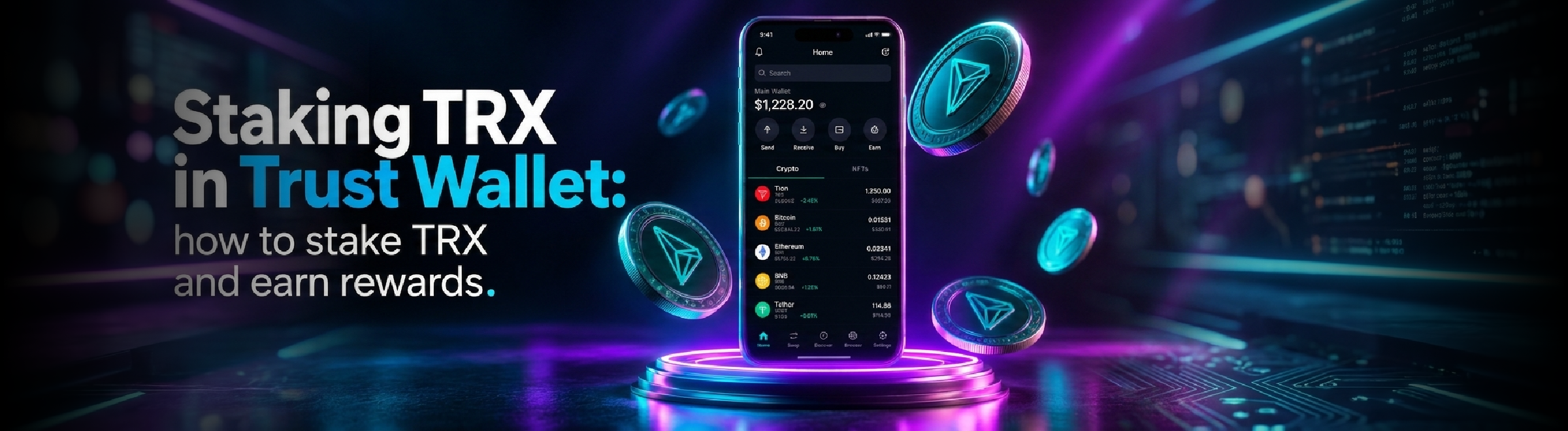
Complete Guide to TRX Staking in Trust Wallet. We Explain How Much TRX You Need to Get Energy, How to Earn Network Rewards, How to Unstake TRX and Get Your Coins Back, and Which Is More Cost-Effective for USDT TRC-20 Transfers: TRX Staking or Renting Energy.
Staking TRX in Trust Wallet allows you to earn yield in TRX and network resources — Energy or Bandwidth. At the time of the update, the official Trust Wallet shows an APR of about 4.4%, but the rate may change.
Staking TRX means locking up coins in the TRON network. In Trust Wallet, this can be managed right from the app: staked TRX remains under your control, but is temporarily unavailable for regular sending.
Staking can provide two practical benefits: rewards and network resources — Energy or Bandwidth. For operations with USDT TRC-20, Energy is usually more important because it is used when working with a smart contract.
TRON uses the Stake 2.0 mechanism. If you need the technical part — TRON Power, resource delegation, and stake structure — separately look up how Stake 2.0 works in TRON.
It is specifically TRX that is staked to get Energy or Bandwidth. USDT TRC-20 is a separate token and does not create these resources on its own.
The main reason users choose to stake is the opportunity to earn additional income on their existing TRX.
At the time of updating this article, the official Trust Walletshows an estimated yield of about 4.4% APR for TRON.
APR shows the approximate annual income. For example, if the rate remains at 4.4% all year:
| In Staking | Approx. per month | Approx. per year |
|---|---|---|
| 100 TRX | 0.37 TRX | 4.4 TRX |
| 1,000 TRX | 3.67 TRX | 44 TRX |
| 10,000 TRX | 36.67 TRX | 440 TRX |
This is an approximate calculation without taking into account changes in the APR and the TRX exchange rate.
The yield is not fixed forever. It depends on the network reward parameters, the chosen validator, and the number of TRX participating in the voting. If there are more votes, and the other parameters do not change, the reward share per vote may decrease.
You can view the dynamics of the total volume of locked TRX on the TRX staking chart. The chart itself does not show the future APR directly, but it helps to assess whether staking activity in the network is growing or declining.
Income in the TRON network is linked to voting for Super Representatives. Upon staking, the user receives TRON Power — voting rights in the TRON network. Voting allows you to receive corresponding network rewards.
Trust Wallet simplifies this process: the user chooses a validator, and the app shows the expected APR.
To stake, you must have TRX on your balance. If you do not have any coins yet, first learn how to buy TRX in Trust Wallet.
After confirmation, the staked TRX will appear in the staking section. The exact set of actions may differ slightly depending on the app version, so before confirming, refer to the parameters shown by Trust Wallet.
By staking TRX, you can get Energy or Bandwidth. These are different TRON network resources, and the choice depends on what operations you plan to use the wallet for.
Energy is needed for operations with smart contracts, including many actions with USDT TRC-20. If there is enough Energy, TRX consumption for this part of network expenses is reduced or may be absent.
Bandwidth is used to transmit transaction data. Energy is usually chosen for regular USDT transfers, while Bandwidth can be useful for simple operations with TRX.
The same staked amount does not give the full volume of both resources simultaneously: TRX is staked for the chosen resource.
There is no fixed value. The correlation here is more direct: the more TRX staked in the network specifically for Energy, the less Energy falls on 1 TRX. Therefore, the indicator changes over time.
For calculation, it is more convenient to use a TRX staking resource calculator: it shows how much Energy or Bandwidth a selected amount of TRX will give based on current network parameters.
At the time of the update, the calculator shows about 9.58 Energy per 1 staked TRX. With this ratio, about 6,800 TRX would be required to get approximately 65,000 Energy.
This is a guideline, not a constant value. Before staking, it is better to recalculate the volume of resources using up-to-date data.
Staking can solve two tasks at once: bring yield in TRX and provide Energy or Bandwidth. But if the main goal is to get Energy for USDT transfers, staking is not always suitable.
| Parameter | TRX Staking | Energy Rental |
|---|---|---|
| Yield in TRX | Yes | No |
| Need a large supply of TRX | May be required | No |
| TRX remains available | No, while staked | Yes |
| Energy | Depends on stake size and network | Get the required volume |
| After Unstake | There is a waiting period | No |
| Suitable for | Long-term holding of TRX | Getting Energy for transfers |
If you are already holding TRX long-term, staking can be profitable: the coins bring potential yield and provide network resources at the same time.
But buying several thousand TRX just for Energy usually makes no sense. If the resource is needed for USDT TRC-20 transfers, it can be obtained without buying and locking a large number of coins.
Through Tron Pool Energy, you can rent Energy for USDT TRC-20 and receive the necessary resource to your Trust Wallet address before the transfer.
The practical division is simple: if you are holding TRX for yield — staking makes sense. If you only need Energy for transfers — it is usually easier to rent the resource.
This is not a direct cost comparison: when staking, the TRX remains yours and can generate yield, whereas when renting, you only pay for receiving the resource.
Staking and unstaking are operations on the TRON network. They use network resources, so before confirming, it is worth checking the final costs shown by Trust Wallet.
In addition to the fee, staking has another important point: staked TRX cannot be freely sent or sold while it is staked.
Before staking, consider:
If the main goal is to reduce costs for sending USDT, separately compare ways to reduce the USDT TRC-20 fee.
To return TRX to the available balance, you need to initiate Unstake.
After initiating Unstake, the coins are not returned immediately. In the current TRON configuration, there is a 14-day waiting period. After it ends, the TRX can be returned to the available balance.
Upon cancellation, the corresponding portion of Energy or Bandwidth ceases to be available. If you use these resources for regular transactions, consider this before initiating Unstake.
Staking TRX in Trust Wallet is primarily suitable for those who already hold TRX and want to earn additional yield. Before the operation, check the current APR, the chosen validator, and the conditions for returning TRX after Unstake.
TRX is staked to obtain Energy or Bandwidth on the TRON network. USDT TRC-20 does not create these resources by itself.
At the TRON Stake 2.0 level, the minimum operation amount is 1 TRX. To obtain a noticeable amount of resources, more is usually required; refer to the current network and app conditions.
There is no constant value. The amount of Energy per 1 TRX changes depending on the total staking of the network, so it is better to calculate it based on current data.
Staked TRX is not consumed as a fee, but there remain risks related to the coin's price changes and the security of the wallet itself. The APR and the amount of resources received can also change.
While TRX is staked, it cannot be sent or sold. You must first initiate Unstake, wait for the waiting period to end, and return the coins to your available balance.
How to Use Trust Wallet for USDT TRC-20: Step-by-Step Guide
A complete guide to using Trust Wallet with USDT TRC-20: how to send and receive transfers, avoid fee-related mistakes, and save on every transaction.
2025-07-30
173

Stake 2.0 on TRON: How TRX Staking Works
Complete guide to Stake 2.0 on TRON: how to get Energy and Bandwidth, delegate resources, and reduce fees without burning TRX.
2026-03-06
175
How to Buy TRX Through Trust Wallet or Swap USDT for TRX
Four Ways to Buy TRX in Trust Wallet, from Built-In Purchases to Swapping USDT. Step-by-Step Instructions and a Comparison Table Covering the Key Details of Each Method.
2025-08-04
156

Reduce USDT TRC-20 transaction fees for frequent transfers from a single wallet with no time limits

Quick activation for one-time and occasional USDT TRC-20 transfers

Fund a shared balance and distribute TRON Energy and Bandwidth across multiple wallets

Automatic TRON Energy delegation for exchanges, swap services, and payment platforms

Quick access to Tron Pool Energy services directly in Telegram

Fast USDT TRC-20 to TRX swap, no exchange or registration required

Get all the benefits of Telegram at up to 15% less than through the App Store and Google Play

Gifts, reactions, and digital content with USDT TRC-20 — no registration required

Get a custom TRON address with your name, brand, or nickname